Palo Duro Canyon–No Winners But Great Loss–A Pandemia Chronicle

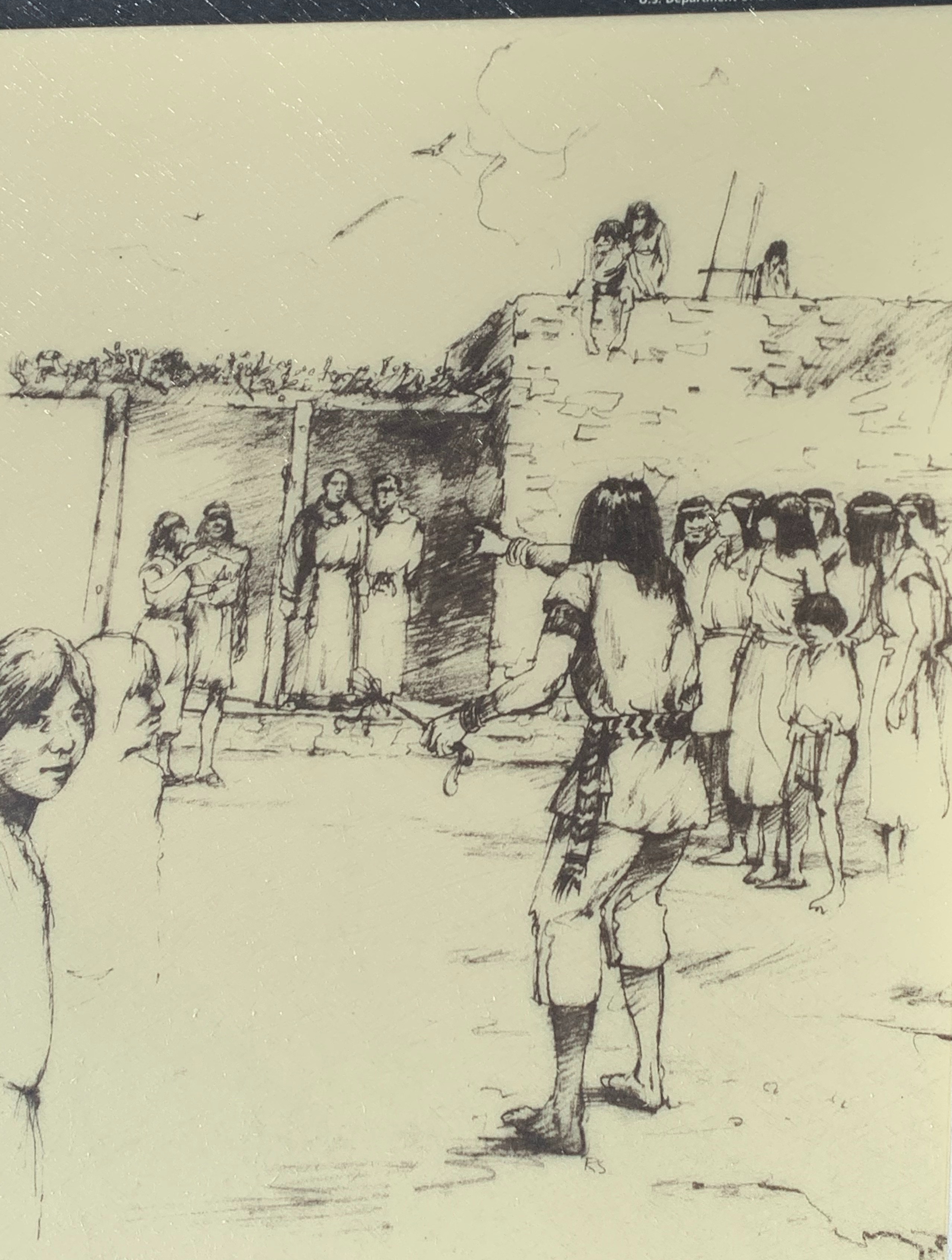
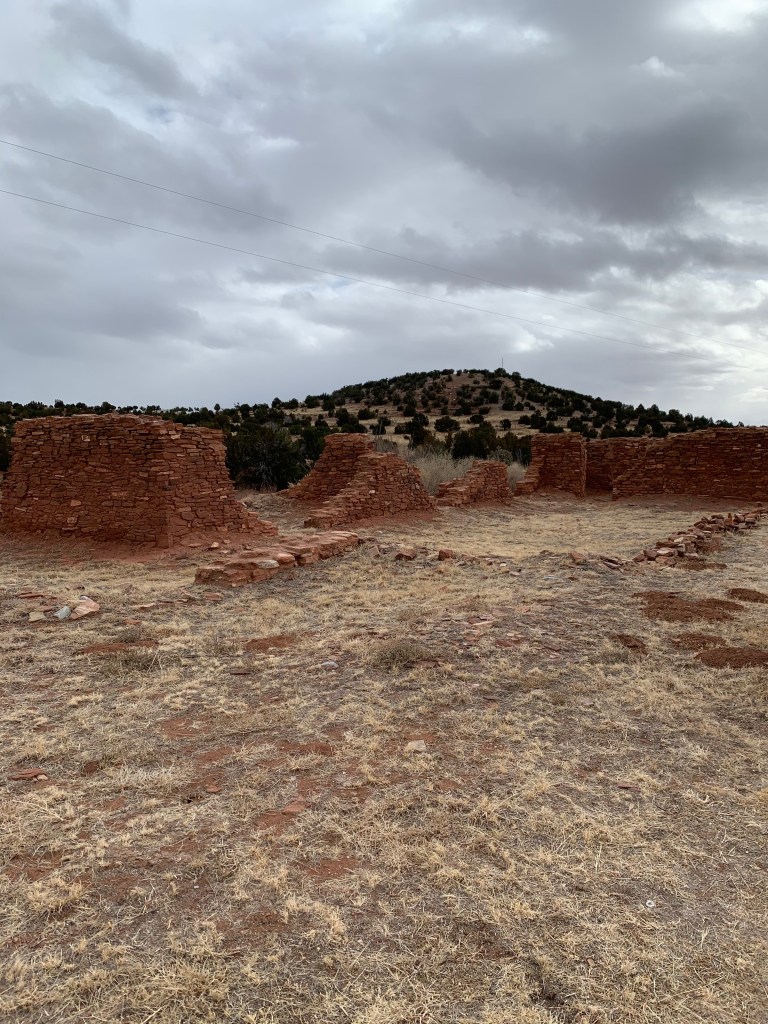
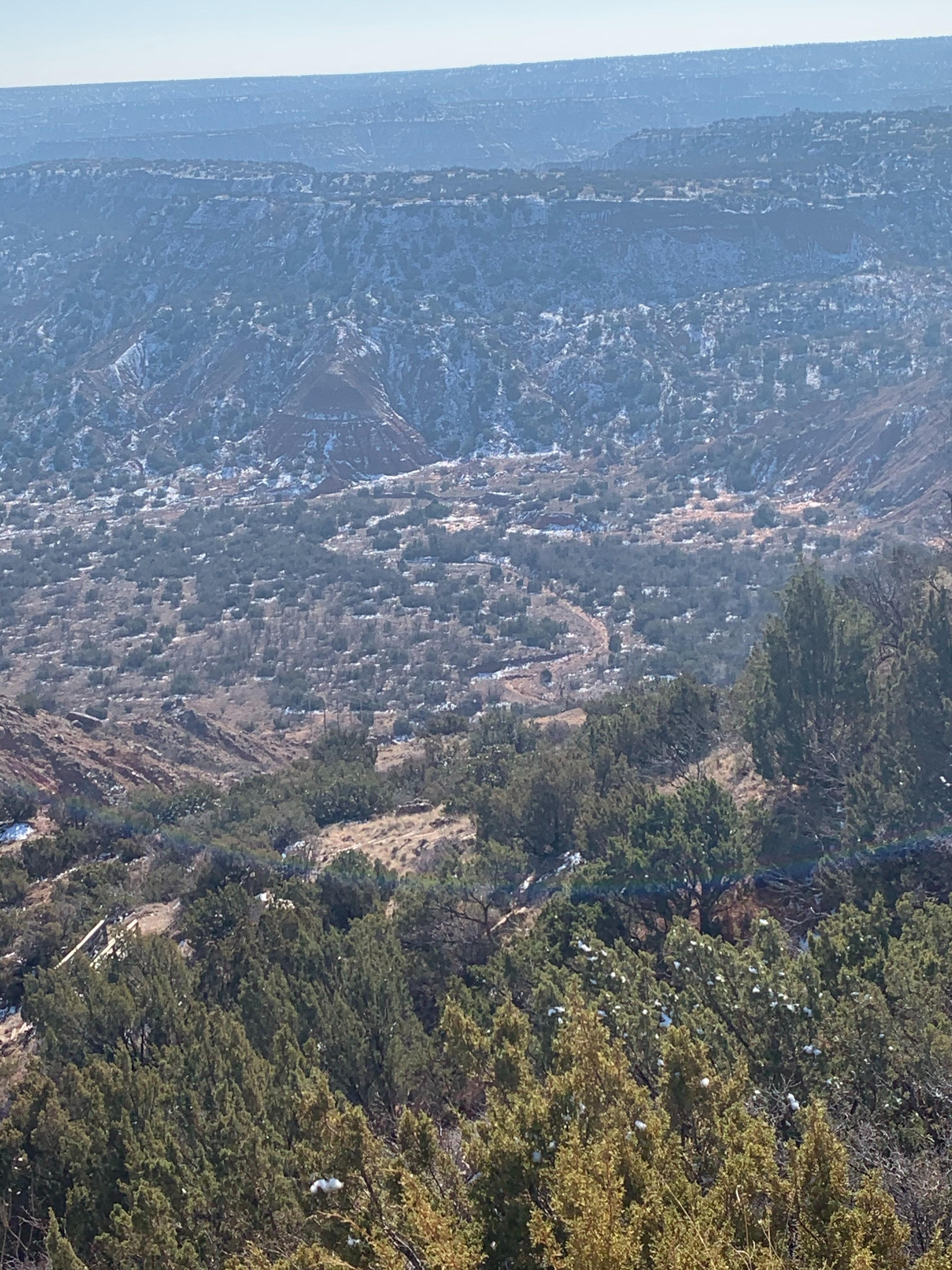
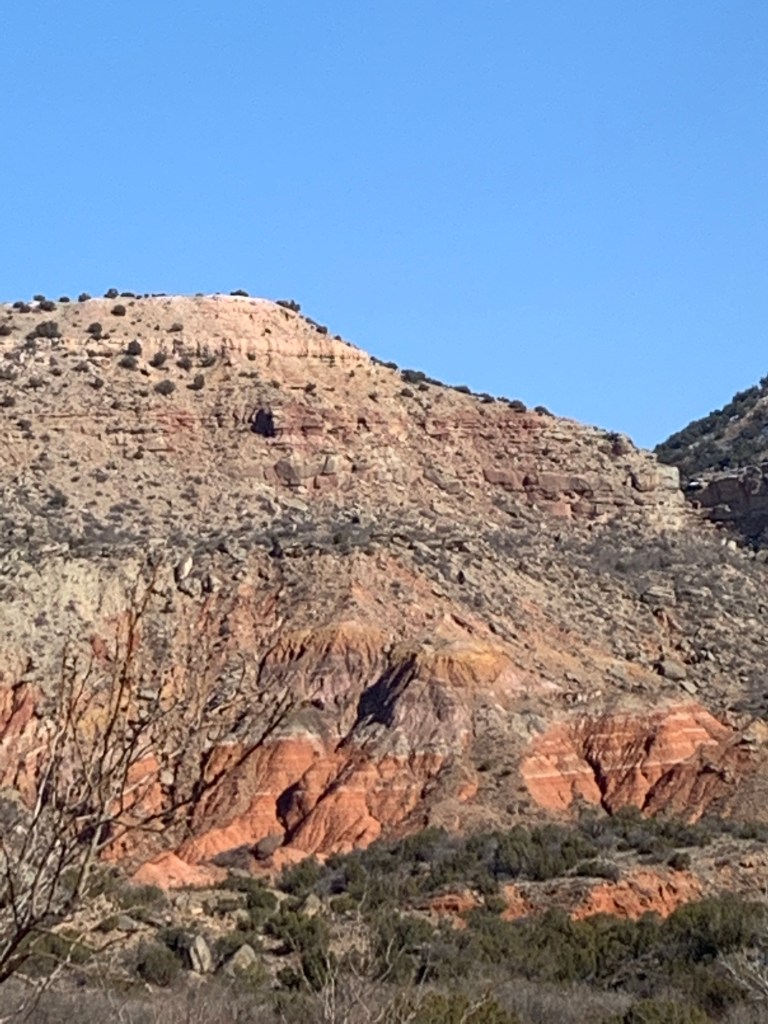
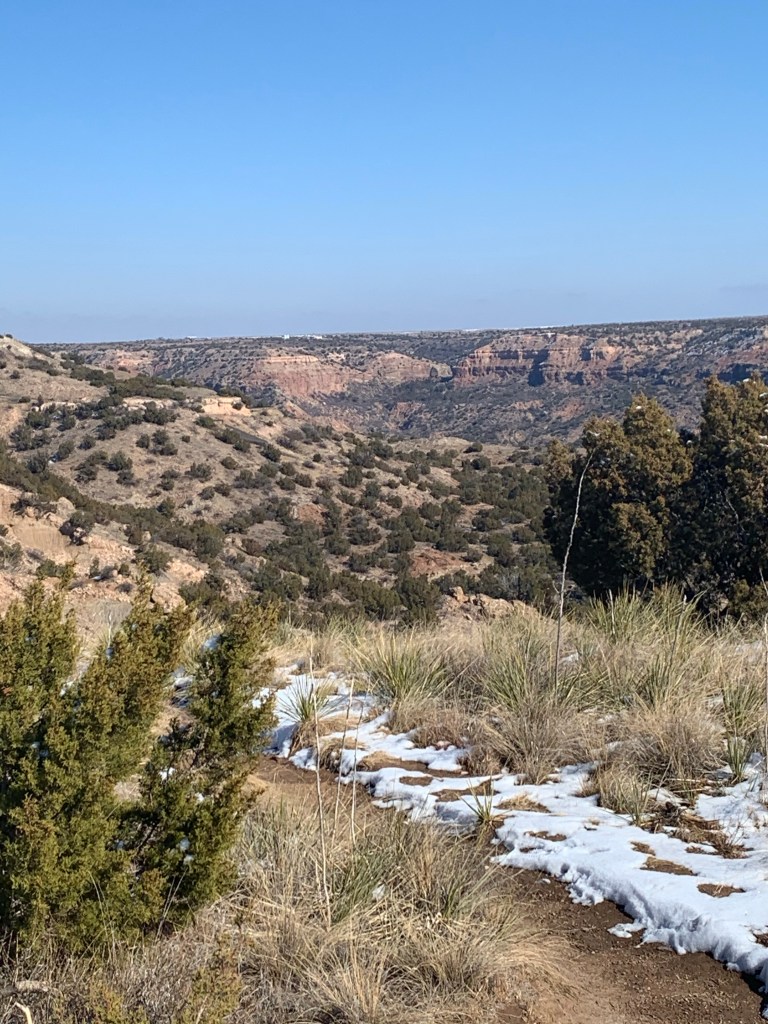
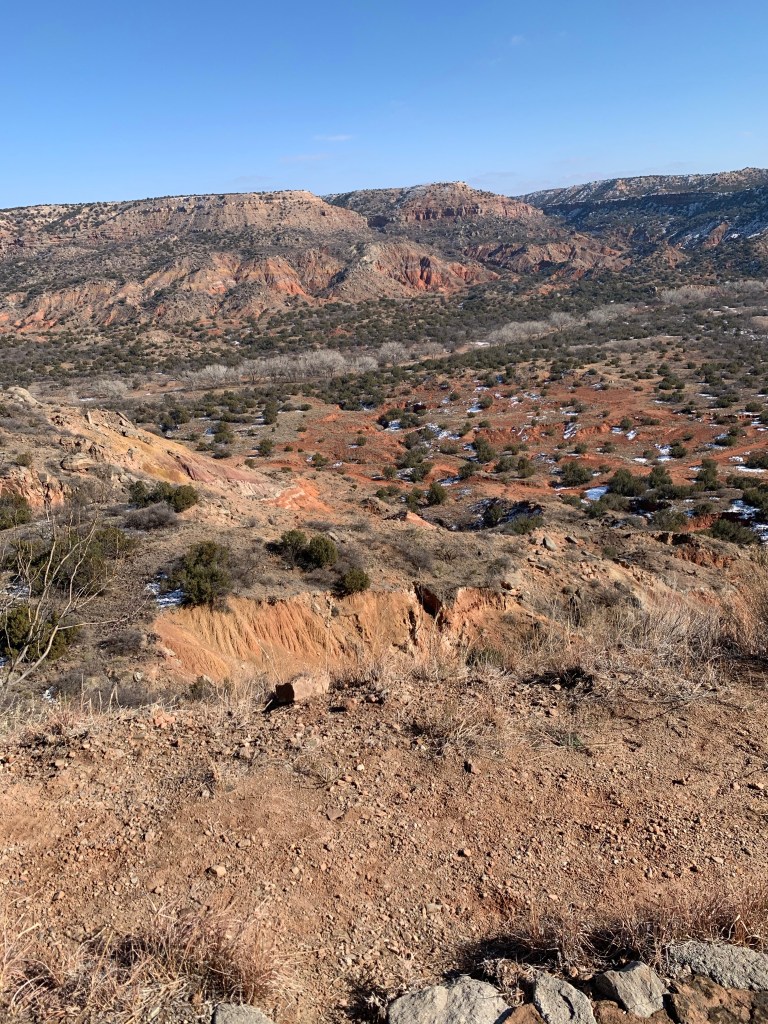
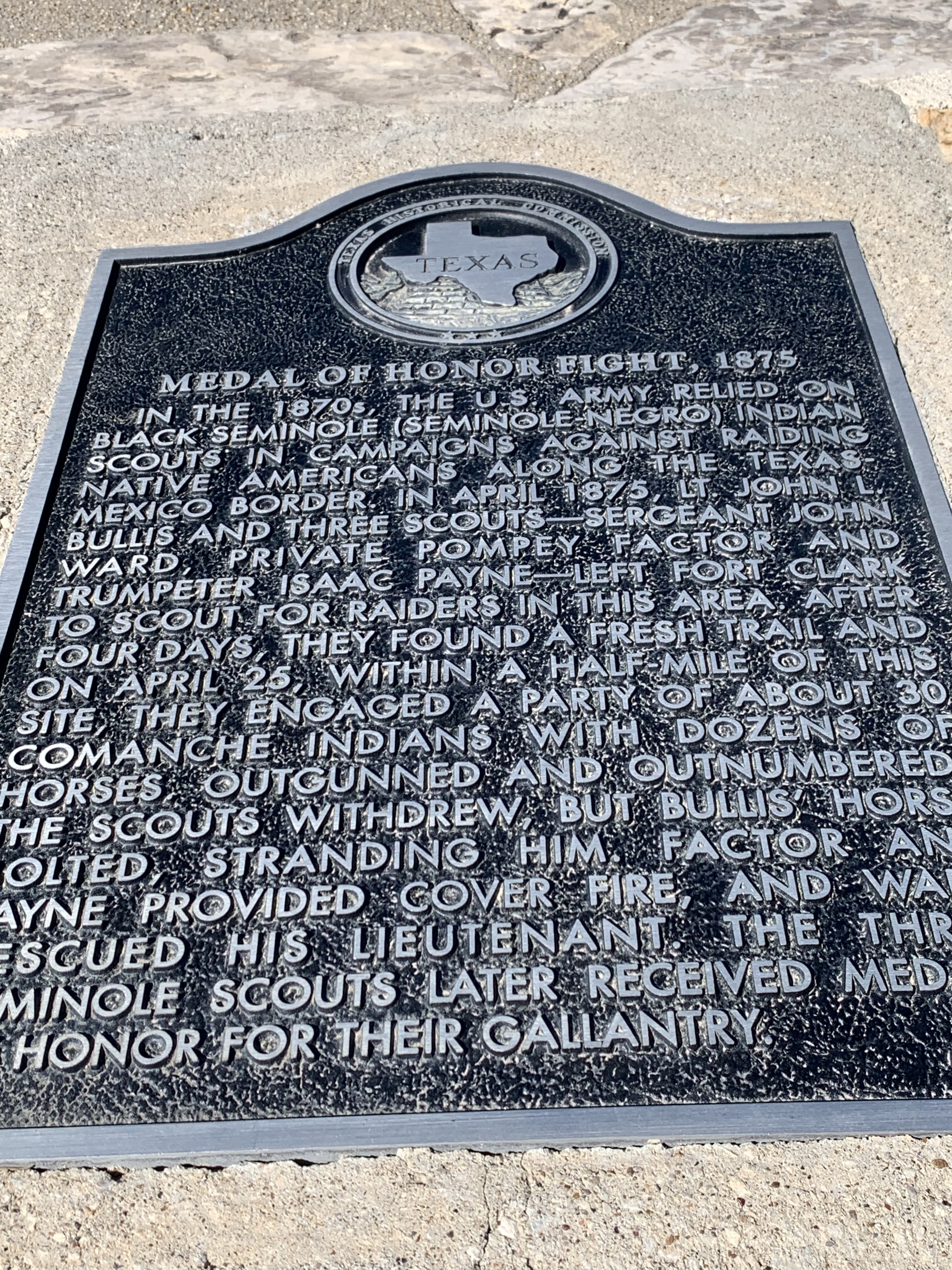
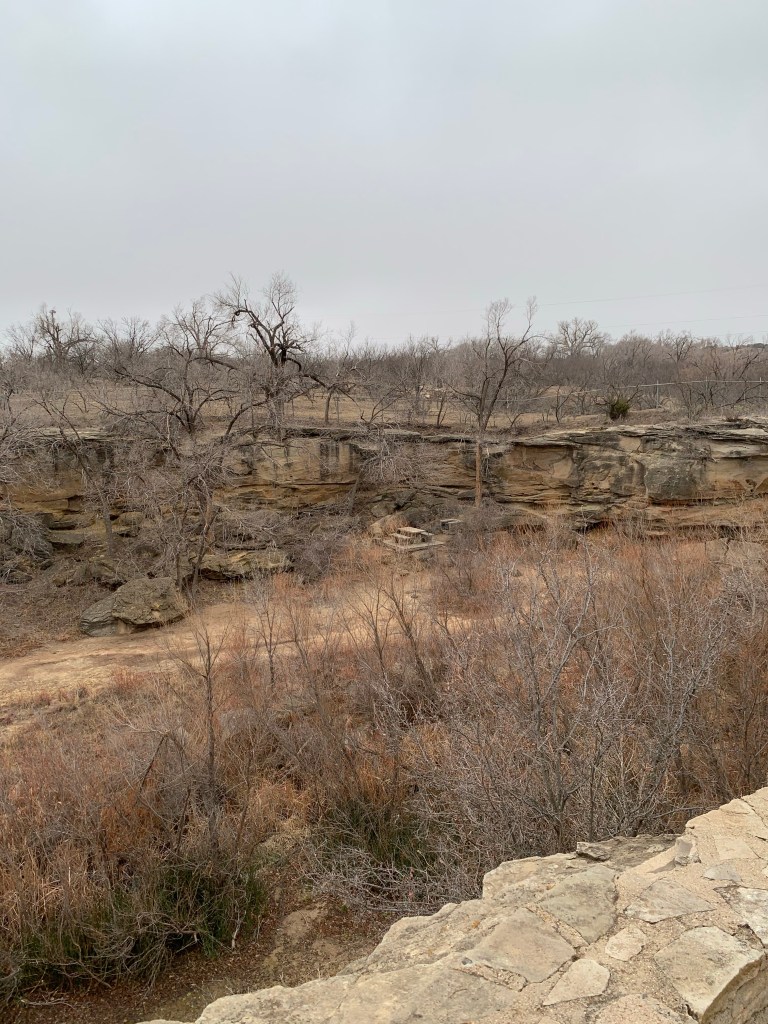
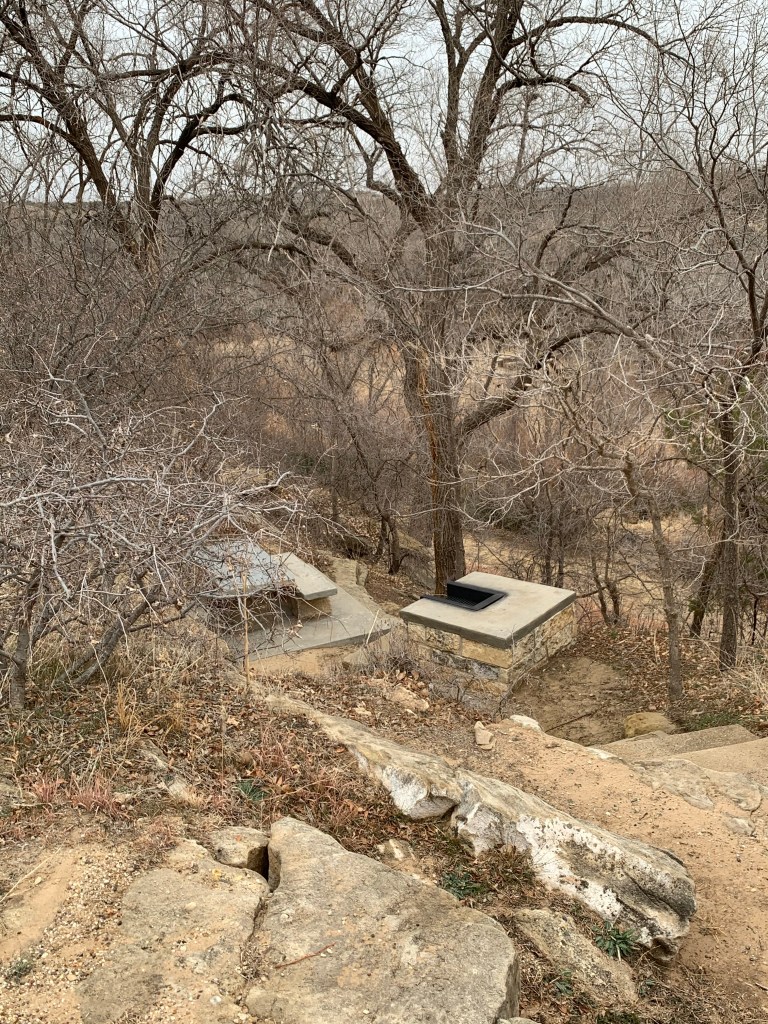
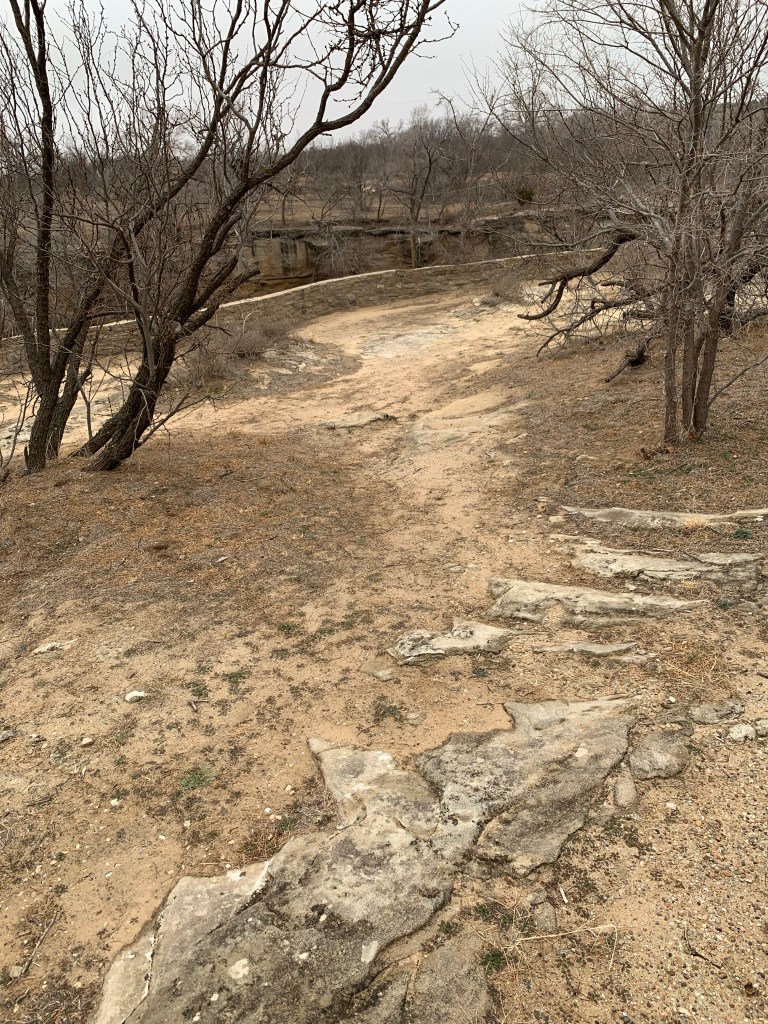
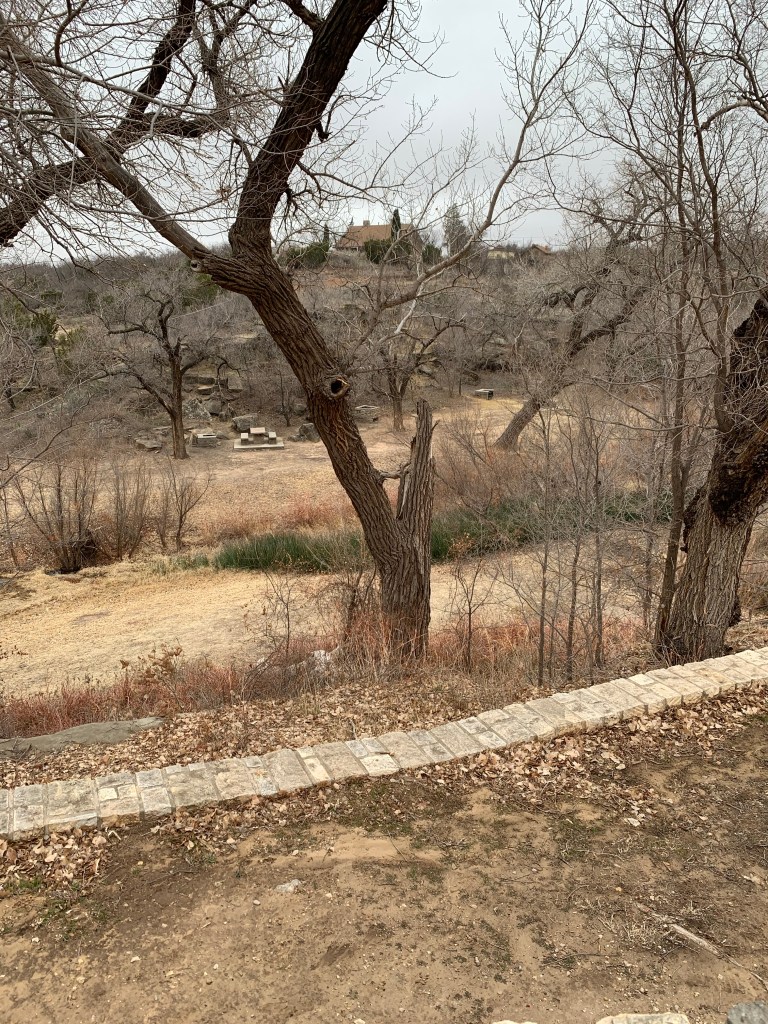
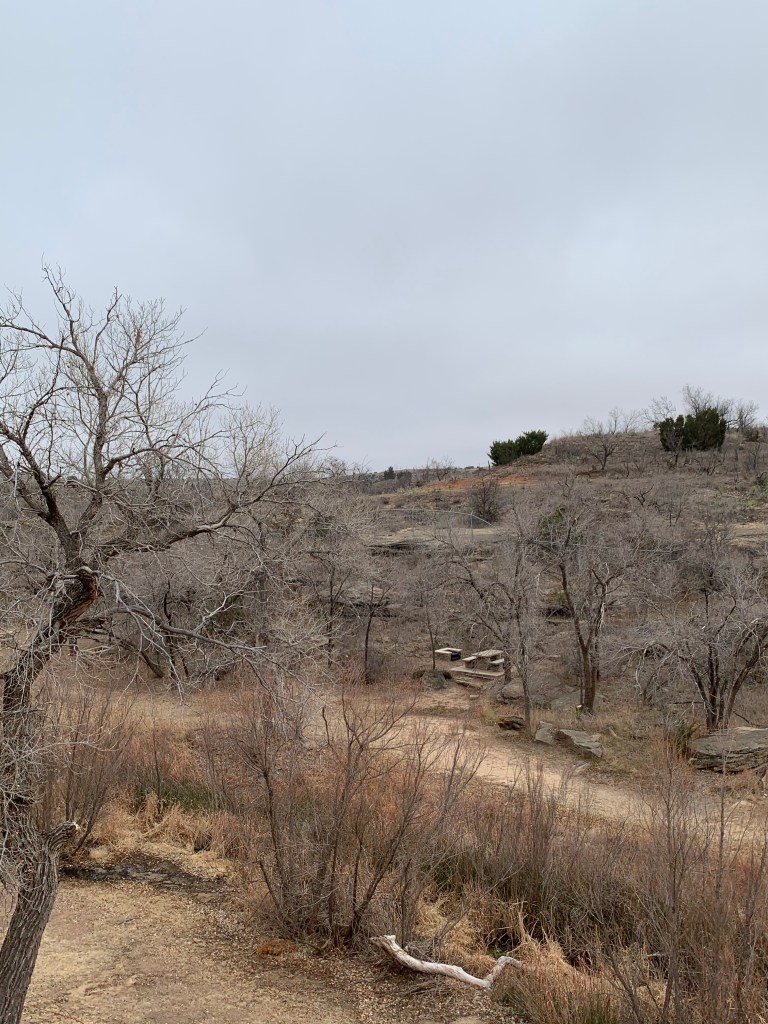
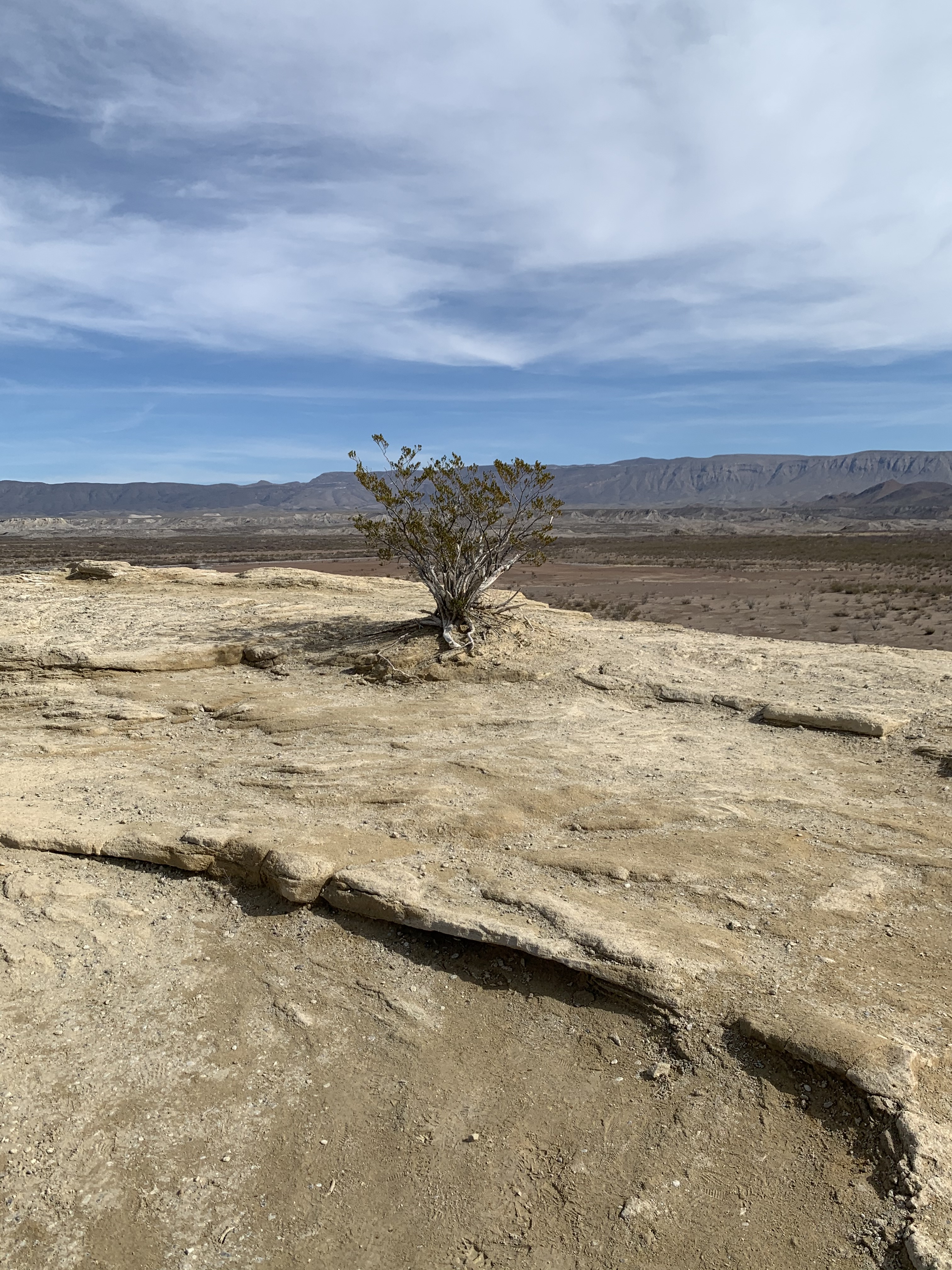
Approximate Battle Site in the Upper Palo Duro Canyon

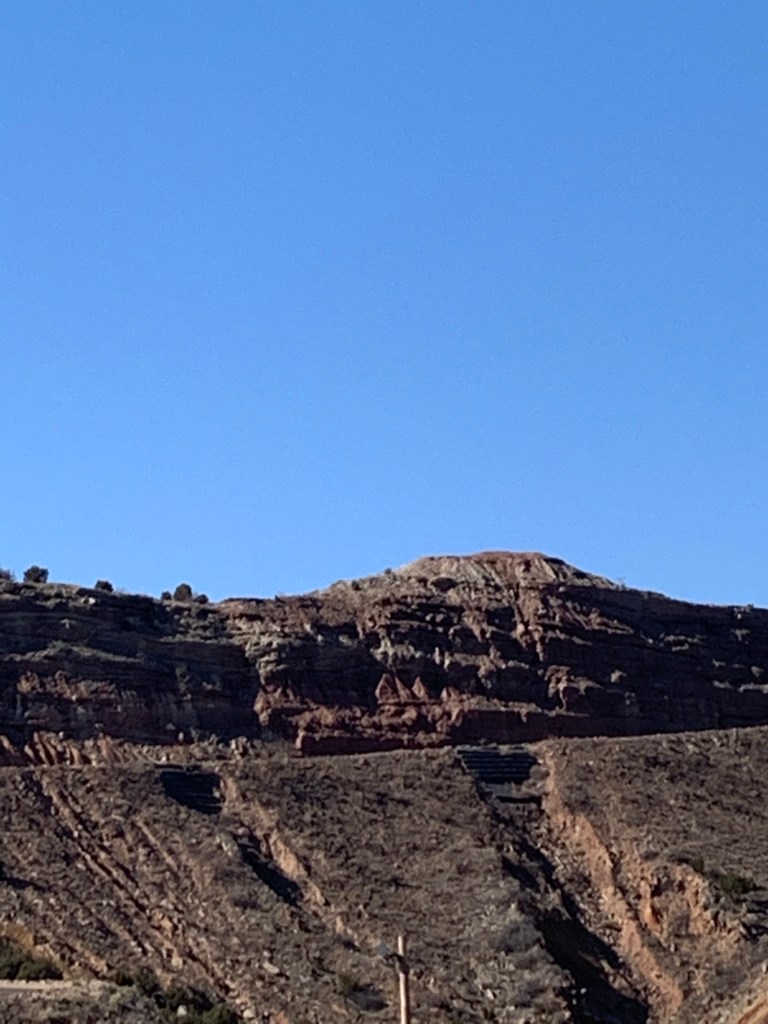
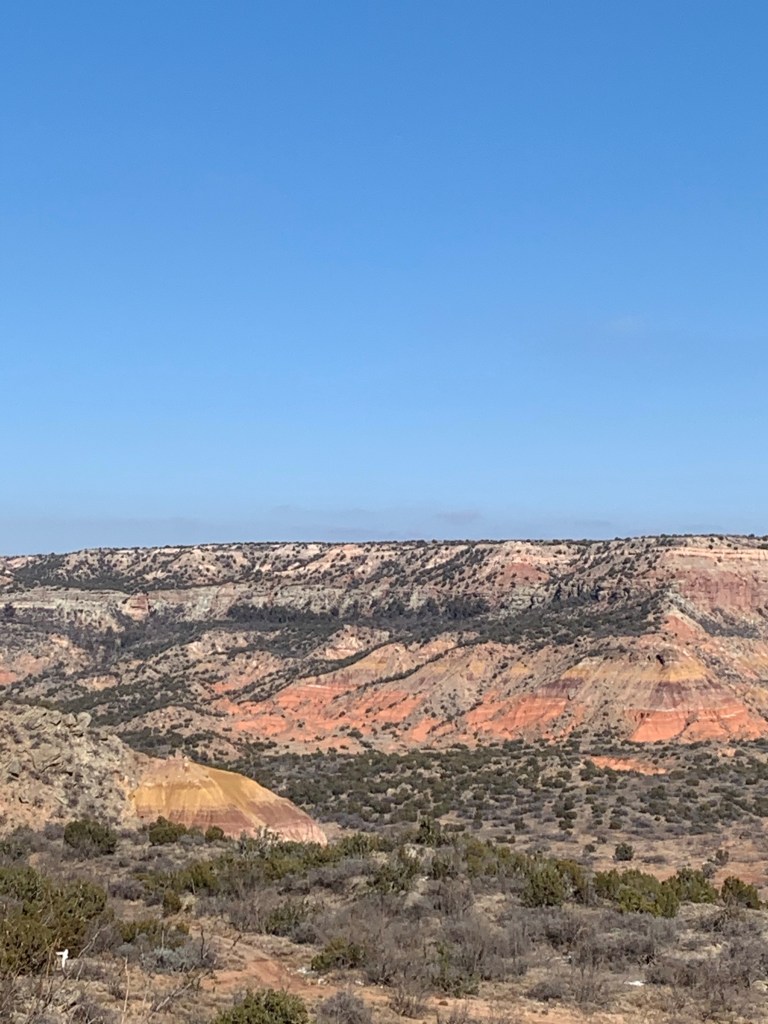
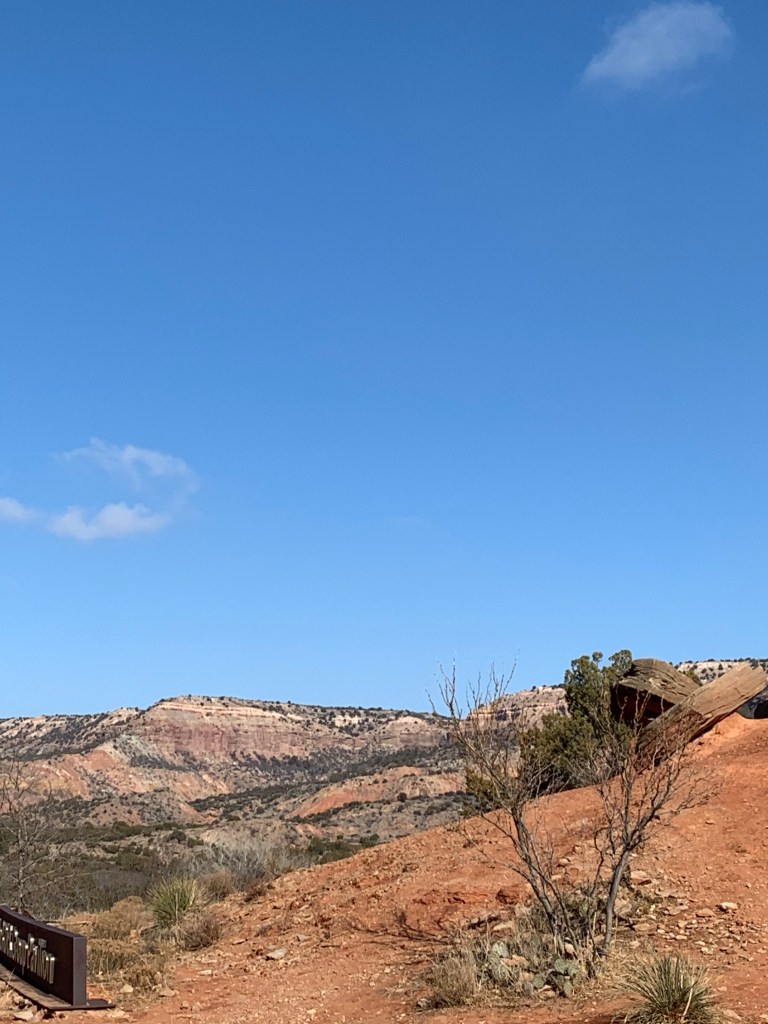
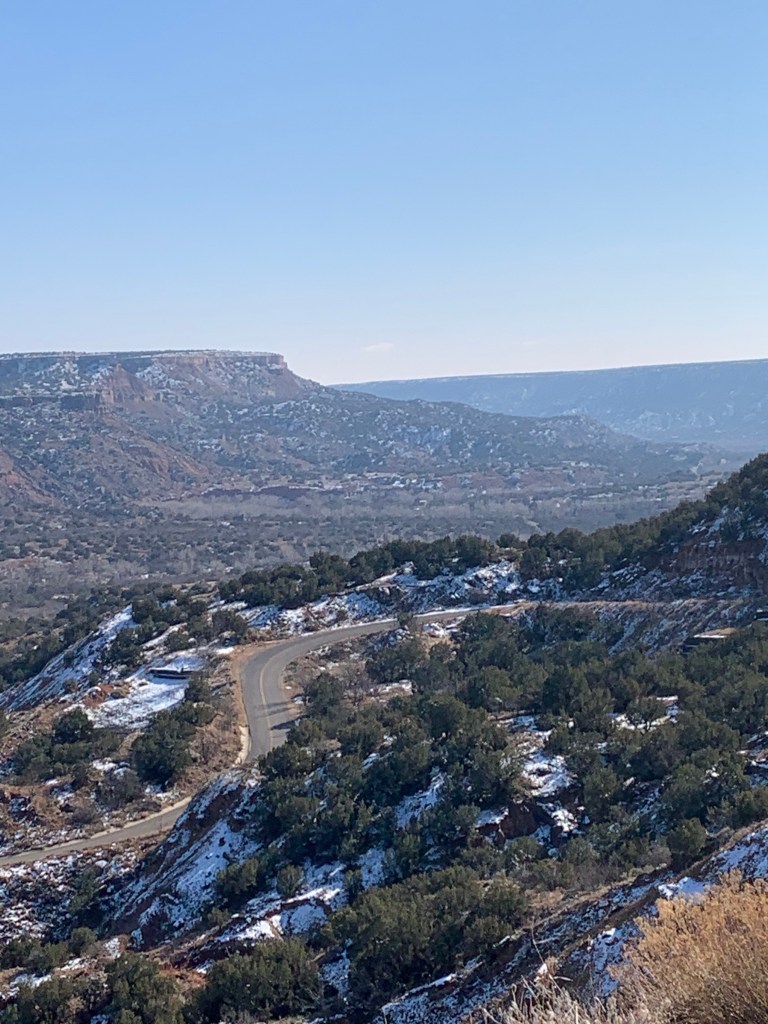
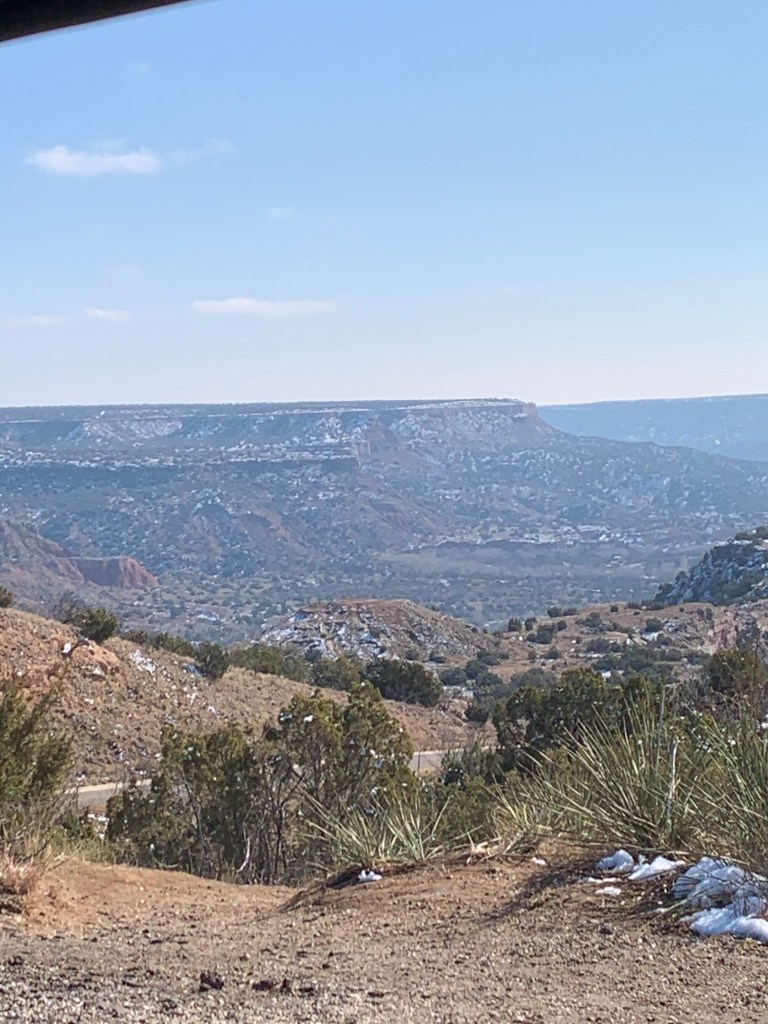
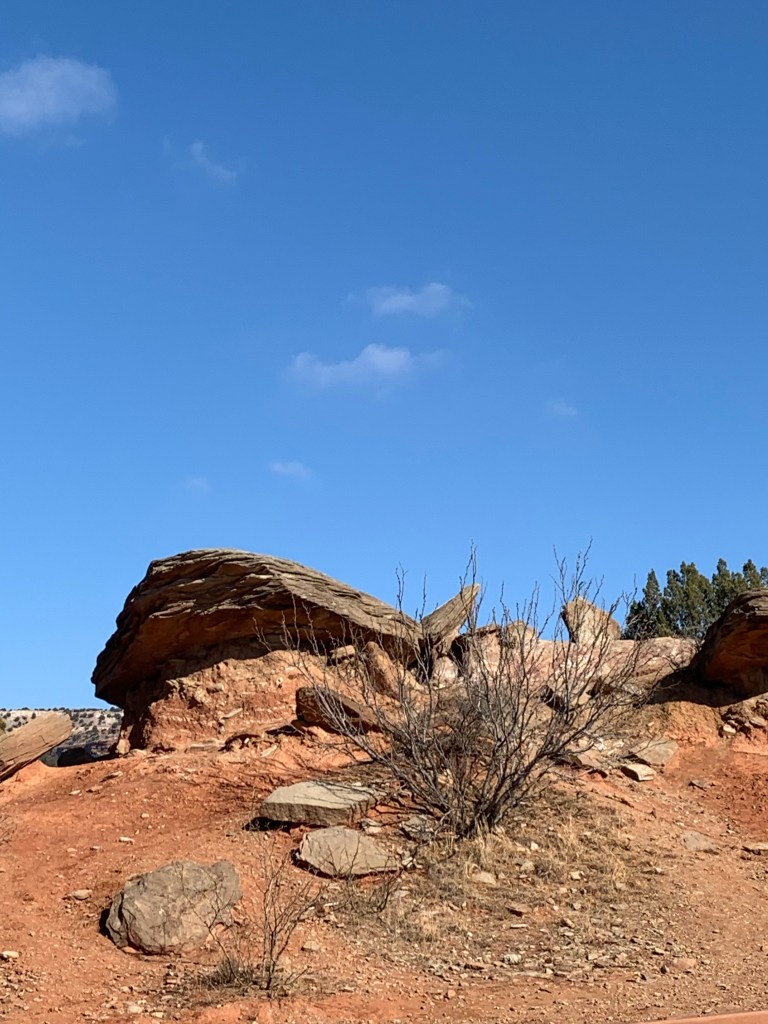
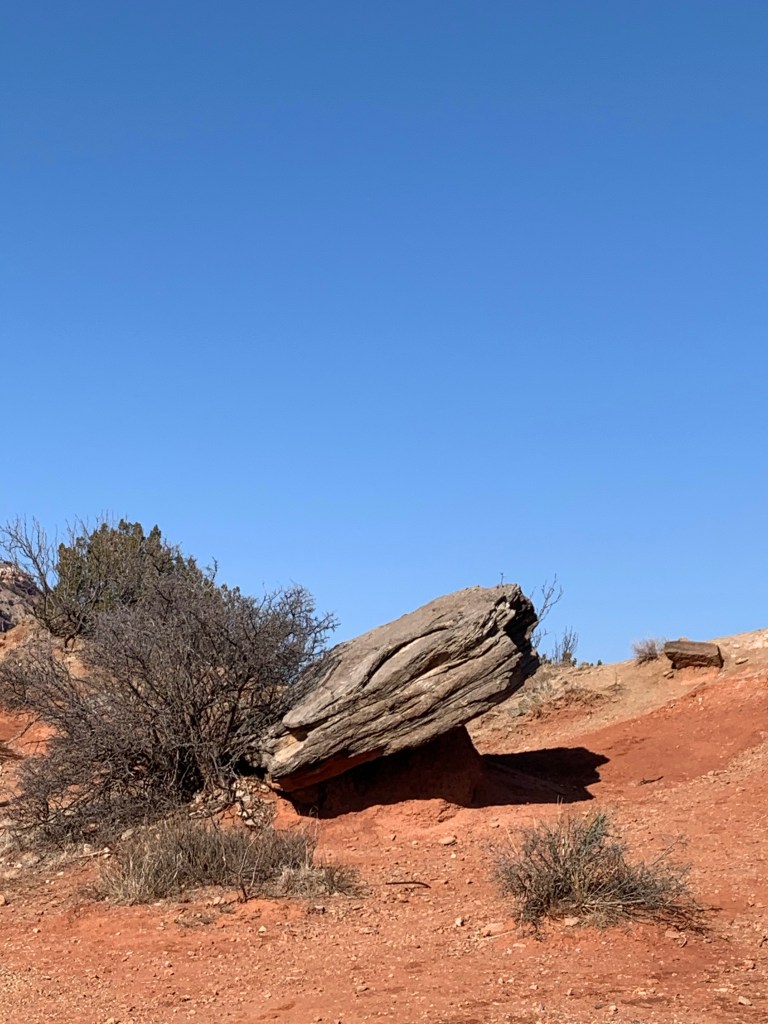
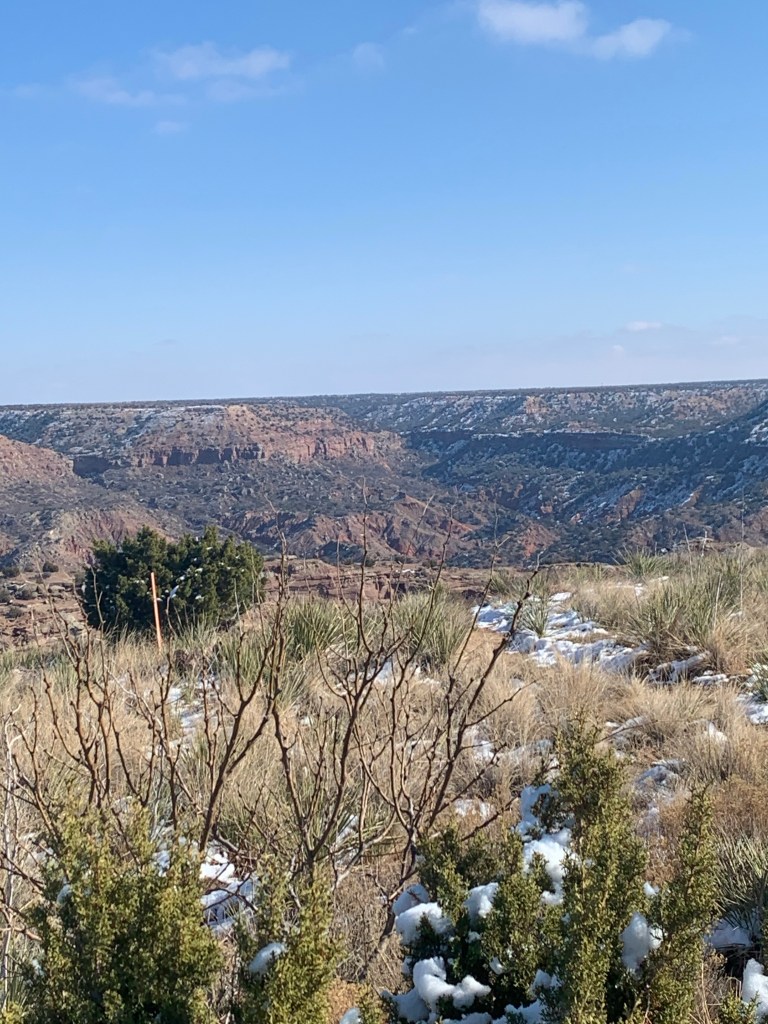
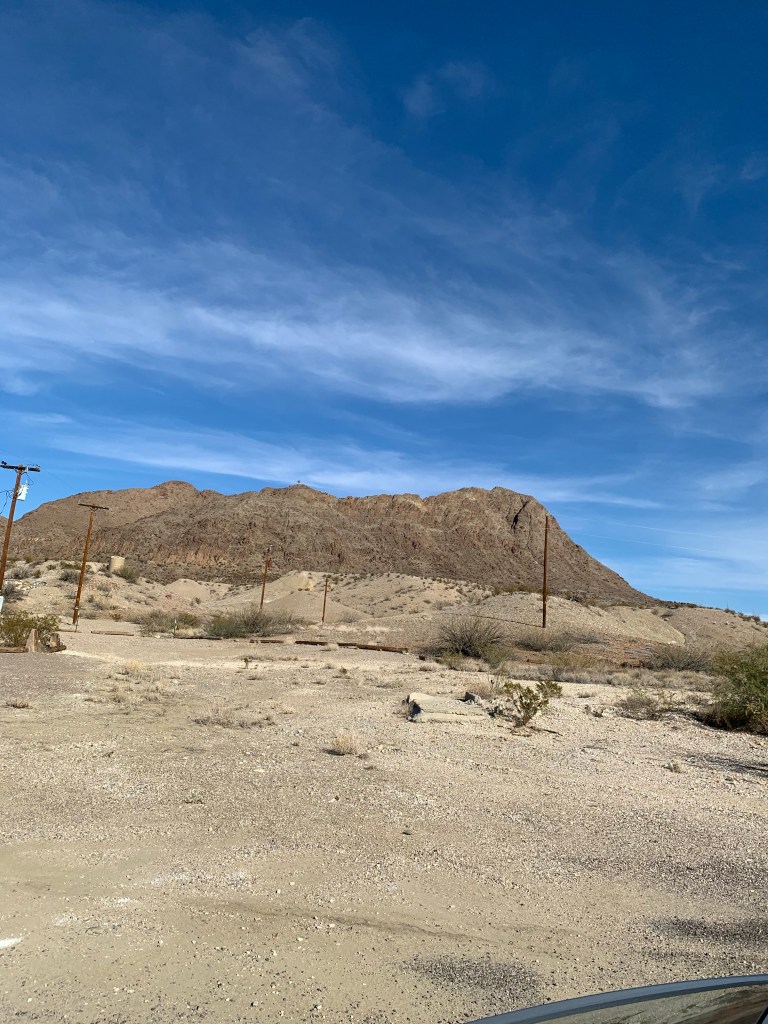
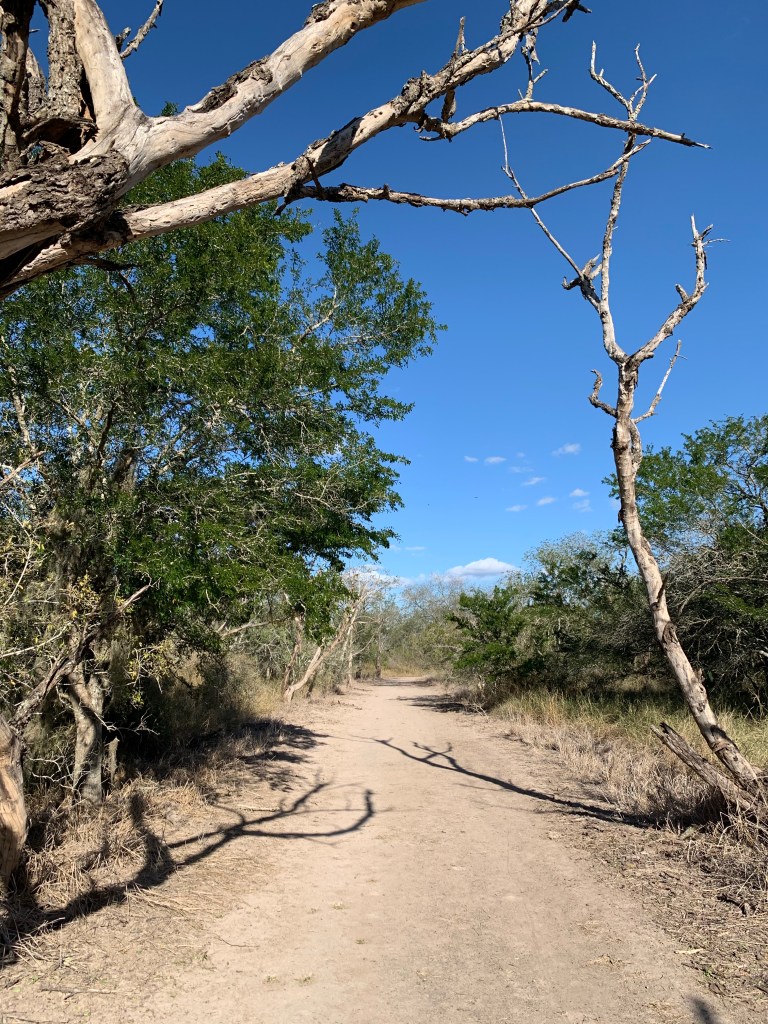
I entered Palo Duro Canyon not realizing how vast it is. It’s considered the “Grand Canyon of Texas” and is, in fact, second only in size to the actual Grand Canyon. It’s origins are humble, a sandy Palo Duro Creek, a stream atop the Llano Estacado converging with another creek, the Tierra Blanca (“White Land” meant to describe the limestone upon which it flows–Really). Together they form the Prairie Dog Town Fork Red River that has formed the canyon through the Caprock Escarpment of the Llano. It was a “yawning chasm” largely unknown to Europeans until 1874 meticulously etching a place of refuge for anyone adept enough to find it, at the edge of what seemed like a vast unyielding plain. The Canyon has been continuously inhabited for over 10,000 years and known to the Spanish as a result of the Coronado expedition who came across it in 1541 when the Apache inhabited it. It was mapped by the U.S. Army in 1852 but was under Comanche and Kiowa control until the “Red River War”.

From the time of the Comanche rise in the late 1600’s, Palo Duro was a place well known only to the Comanche and their Comanchero suppliers and not suspected as their refuge. To be sure, it wasn’t the Army that found this redoubt of the Comanche, but by a combination of Black Seminole Scouts who encountered the Comanche on the Pecos River and Tonkawa scouts, Indians known for tracking and who had aided the U.S. and the Texas Republic over many years because of their enmity with all those who had displaced them from their lands in Oklahoma through their resulting migration into south central Texas. The Comanche were not the ones to displace them, that was the Apache. By the time of the U.S. campaign, the Tonkawa had been well emplaced as U.S. scouts. This despite having been herded into reservations, ironically back in their ancestral lands of Oklahoma.

A Great Loss, Not Really a War

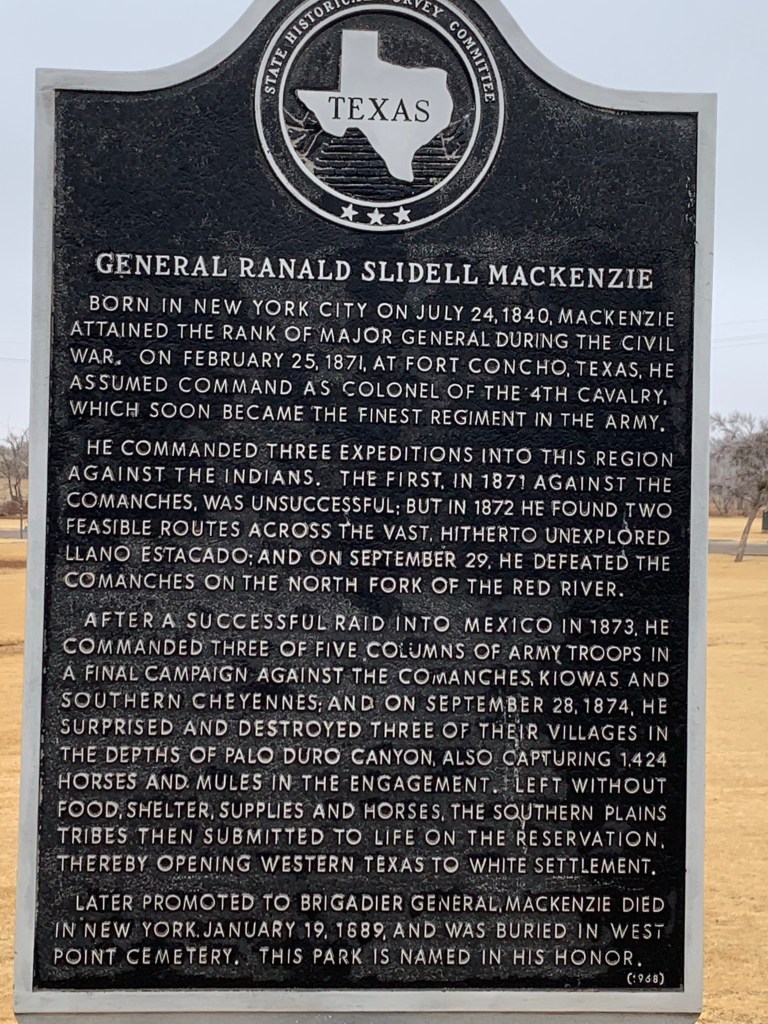
It was called the Red River War in which the Comanche were defeated by overwhelming U.S. military force. A narrative written convincingly to the ears of Texans. As distant from reality as the the real fear it hides. Texans, well, those who’ve tried to dominate it, wear bravado on their sleeves and write them on the historical markers all along the highways. It assuages not their guilt but their trauma of a period where their helplessness was given respite by the luck of treachery, decimation by disease, and the orchestrated destruction of the buffalo. It was a war in name only and a battle that was largely unfought. And, even in surprise, all the Anglo could do is further poison the Comanche well of sustenance, destroying their stores, killing their horses–that way the Comanche couldn’t steal them back, because the Army knew the Comanche could–and leaving the Comanche to roam horseless and starving on the plains. With no buffalo herds and the dead of winter coming, the result was all but written long before, Ranald MacKenzie entered the Palo Duro.

When MacKenzie’s army came upon the camps at Palo Duro, they found a village led by Quanah Parker and a host of Comanche, Kiowa, and Souther Cheyenne. The Quahaddi never thought the Army would find them here, it had long been a place hidden in plain sight protected by the great canyon walls and labyrinthine meandering of this Red River fork. The Army took the village by surprise, but despite that, the Comanche/Kiowa/Cheyenne conducted a rearguard defense to protect the retreat of the elderly, women, and children. Indeed, as they Indians scaled the canyon walls, they proved to give deadly fire on the U..S. soldiers preventing them from killing many or taking prisoners. Although successful in preventing slaughter, their defense meant that they would relinquish the village and their large stores of buffalo meat, lodging travel equipment (lodgepoles and teepee hides), and, worst of all, their over 1400 horses astride which they were largely invincible but without them wholly helpless. They escaped but on foot across the plains, it was only a matter of time before they would have to accept defeat.

Historical Treachery Made in Anglo Destiny

Two groups that facilitated the Anglo victory over the Plains people were Black Seminole along with the African-American ex-slave “Buffalo Soldiers” and the host of Indian scouts that helped to find the Indian resistance. This was historically true in the so-called Indian wars. At Palo Duro, it took the great tracking skill of the Tonkawa scouts, long enlisted to support the Army, to find the largely hidden village. This pattern in using cultural-geographic “informants” marked ultimately the military demise of the ever-decreasing forces of Indian resistance, first to Spanish colonial ventures and then successive Anglo incursions from the Texas Republic to the U.S. Army. Along with the largely (but not completely) unintended unwitting infestation and death by European disease, the many peoples who inhabited the “Americas” were eradicated in great numbers and then sytematically defeated militarily through the exploitation of enmity between different peoples born largely of their own histories of struggle to coexist. It is a form of historical treachery, comprehensible but nonetheless ultimately self-defeating. One can only imagine how an Indian people could play such a role in hunting other Indian people but whatever the justification, the result would be the final defeat of Indian people to withstand the onslaught of “Manifest Destiny” through the Southern Great Plains and the “opening” of the West to White settlement. History is all too often prescient only in hindsight and the toll for its advance is paid by the defeated.

And, of course, this historical treachery was greatly effective in a context where disease reduced once great numbers and great civilizations and the actions of the “victors” in destroying the means of subsistence. In the case of the Comanche and the people of the Plains, it was the systematic destruction of the buffalo herds that formed their lifestyle and their sustenance.

My Journey’s Encounter with Palo Duro

I hadn’t understood what Palo Duro really was until I came here. Of course, I’d read much about it. Most of what I’ve written above comes from the accounts of S.C. Gwynne in his ” Empire of the Summer Moon: Quanah Parker and the Rise and Fall of the Comanches, the Most Powerful Indian Tribe in American History” along with Pekka Hämäläinen‘s “Comanche Empire”, popularized for easy access with the help of Wikipedia.

What I didn’t expect is to see its immensity. It is a national park with a multitude of hiking trails and ways to expore including it’s own lodge for visitors and a “glamping” site to accommodate “luxury” camping. It is a site of natural wonder in which the past is greatly hidden or romanticized, a “glamping” experience obscuring the demarcation between one historical civilization process of early peoples in what was a new land and the disruption brought by much later immigrants claiming for their own the land through decimation and destruction inconsiderate to those who had come before.

Seeing all of this had to have an effect. I see the predecessors to my own history and the layers stacked one upon the other, obscured by recreational pursuits, destructive new industries, unremarkable stripmall towns . . . and incomplete histories marked in brief highway markers. Much like the layers across my multiple lifetimes in pursuit of identity, love, meaning, career, and happiness. Driving down the roads, I see myself riding into history and the features of discovery, struggle, desire for one’s place under a sun, and the predictable but not inevitable result crossing, sometimes intruding, into other’s lives.

I come closer to understanding what my life of “layers” has been by uncovering the layers that reside in the histories of all the people that preceded those around me, from those formed like my own dual DNA, Indio and European, and all of those others who comprise the product of our common history, its struggles, its sadness, denouement, joy, and hope.

I’m not sure we have understood that what was forseeable did not really have to be. We can blame what happened on what we didn’t know. It simply isn’t true. There was much to learn from the genesis of Western democracy in understanding our need for human solidarity. As much as there was to learn from the tendency of early peoples to enslave and subjugate in the development of the societies and cultures of the “Americas” before the European devastation. That neither of “us” ever heeded either caution is to me a chosen ignorance albeit written in the longness of history. Seen only with a paltry hindsight and one which we now must so directly attend. Yes, it could have been different. But therein lies the seed of hope. That it could have been different means that it remains possible to do different now.

And, as for me, what comes to mind is that “ain’t none of us clean” and by ourselves, we each may not bring the world to its great resolution, but we each, I, can understand that seeing all the devastation, all the destruction, all the anger these so easily engage is always a choice. We, I, can choose. We may have to fight to bring about a better world. But we can choose to fight with better tools, not by ourselves to save others, but to assure that all of us is brought into a different history. The destruction of a hateful society based in violence, bred in anger is so greatly needed. But the destruction of people never has to be the goal.

Yes, all I say here is naive and I am as much a realist; I am not alone in determining what may eventually be the answer. I do believe that when the “great gettin’ up morning” finally comes, we’ll find that what made the difference is our desire to be each of us worthy, each of us happy, each of us free. That from each of us we gave our best and to each of us we gave our all.

El Llano Estacado–Blanco Canyon, White River: A Pandemia Chronicle

By http://nmviewogc.cr.usgs.gov/viewer.htmTransferred from en.wikipedia to Commons by User:EvaK using CommonsHelper., Public Domain, https://commons.wikimedia.org/w/index.php?curid=5574838

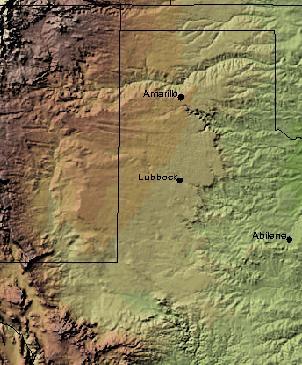
I arrived in what is now Lubbock, Texas, the latest “stake” of history that’s settled over the layers of existence that is the “staked plain”, the Llano Estacado. The term “estacado” usually means “stockaded” or “pallisaded” and refers to the fortress-like rise of the escarpments at the edges of this formation. The “stake” refers to how earlier inhabitants would mark the llano with stakes of various types to guide their way.

For a flat, desolate, seemingly featureless plain of what was a shallow sea millions of years ago, so much has happened in its nearest past. Geographically, the Llano crosses Texas on the west in the “Panhandle through the Permian Basin and somewhat fusing with the Edwards Plateau, another raised flat land that reaches near to Austin and San Antonio. In the east of New Mexico, the Llano ends with the Mescalero Escarpment near Roswell. But this region represents a larger whole merging the histories of western Texas –Oklahoma, and the respective eastern corners New Mexico and Colorado and the western parts of Oklahoma and Kansas; what was the domain of the Comanche. These states claim a portion of what would otherwise be one geologic and geopraphic unity.

Once the sea dried, it became home to a multitude of floral and faunal migrations mxed in with homegrown indigenous plants and creatures; the first layer, the first “stake”. It seems inevitable that all these creatures great and small would be followed by a second stake, human immigrants. Although it is not likely that humans came only via a landbridge “Ellis Island” to the north, a great many did and they proliferated multiple cultures and civilizations. It also seems that the first act of these early peoples was to help along the clearing of the large mammals that once ruled unobstructed. They didn’t do so with disease, but they did fashion spearpoints and a desire to survive, to colonize. After all, the entire area was truly “despoblado”, inhabited only by . . . .food and the materials for shelter.

The third stake on this flat unified plain came with the development of a host of simple to greatly sophisticated cultures; Jumano/Chisos, Anasazi/Pueblo, Zuni, Hopi, Navajo, many others. All of these interacted with others to the east and further west. In their midst entered the Apache, Ute, Kiowa, and an almost inconsequential group of ostracized Shoshone known to themselves as the Nermernuh, to the Ute, kimantsi–“people who alway fight us” or “enemy”–and which the Spanish eventually formed into their tongue as Comanche. The Comanche highlight the fourth stake to this flat land, Mesa, buttressed by eroded canyons that made the land appear like a “palisaded” steppe, “estacado”.

If you watch and listen as you drive through this featureful expanse, you can feel the layers speaking in emotions, from the bones of camels, elephant ancestors, giant sloths, and especially ancient horses and bison to the laughter of Juman/Chiso/Pueblo children and the laments of expelled Shoshone for their lot in trying to eke out a living, unwanted and on foot, atop a sea of grass and succulent buffalo steaks galloping all too fast to catch.

It took a fifth stake, the Spanish, to change history, They brought along the descendants of the earlier horses, those now extinct in the Americas but from whom horses first evolved. There is some belief that horses have remained here and to many Indian people there is a view that rests within their collective memory. What is undeniable is that what the Spanish took for granted as transportation, the Nermernuh/Kimantsi/Comanche learned to prize above all else as their salvation; the ships that would carry them across the seas of grass and the harvest of its bounty. For 250 years, the Comanche sat astride the Llano Estacado holding back the Spanish, French, Mexicans, Texans, and Americans. Until the buffalo were gone and then so were the Comanche. A few other layers have come since then but this journey is about understanding what came before the layers that have obscured a deeper past, a deeper origin.

Ancient Lakes, Ancient (Mega) Fauna

Lubbock Lake is a dried former lake where prehistoric flora and fauna and of human layering in the land can be found through every period of human history for at least 12,000 years. The lake was part of a meander of the Yellow House Draw itself a former part of the Brazos River. It served as a water source until the 1930’s and when the city of Lubbock tried to dredge it to revive access to the underground springs, they were unsuccesful but in the process uncovered the layers of different peoples who “staked” their claim to life on this land. Layers on layers of cultures and the fossilized bones of earlier extinct megafauna like the bison antiquus, the predecessor to the the “American buffalo” (bison bison). Those layers, stakes, begin with the bison and their contemporary megafauna, the mammoth/mastodon, giant sloths, horses, camels, lions, tigers (sabre-toothed) and short-faced bears (yeah, you know you want to say “oh my!” Go ahead).

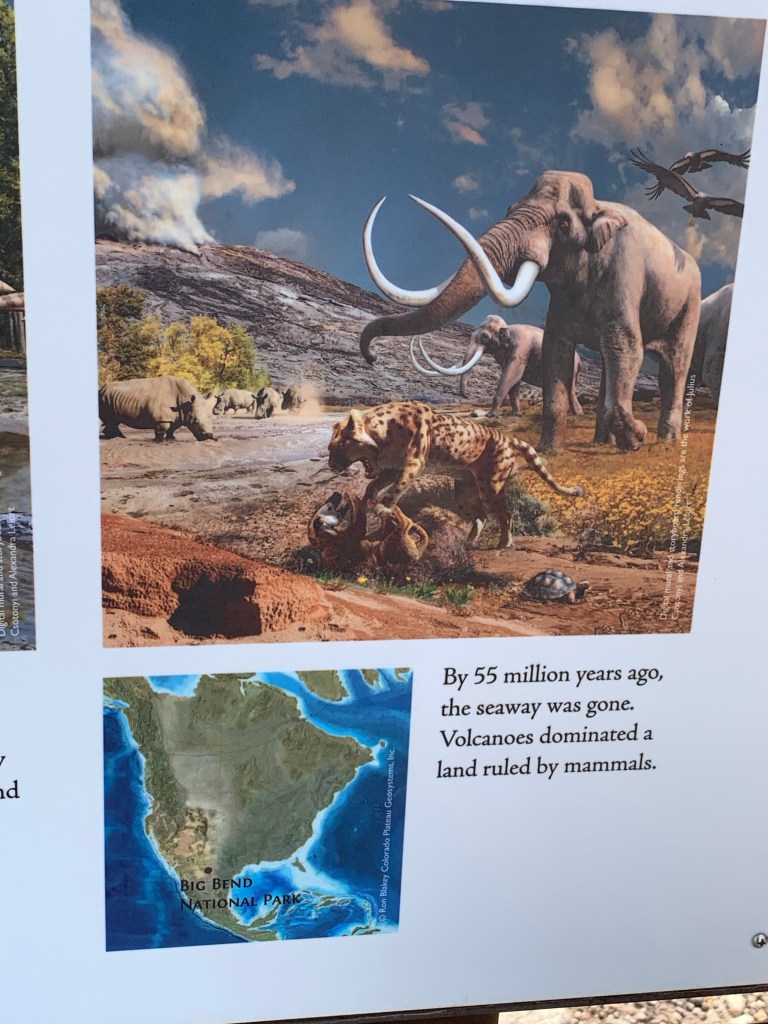
Long before bison bison, the ancestors of the favored resource of the Comanche and other people of the Great Plains in North “America”, there was bison antiquus. B. Antiquus existed 125,000 to 14,500 years before the present (BP) along with other pleistocene megafauna and that finally disappeared from the Americas around 11,000 to 12,000 years ago at the end of the last Ice Age.

There is some controversy about how the megafauna died off, but my favorite paleontologist, Timothy Flannery makes a compelling argument for the final demise of the megafauna as a result not of changing climate, but of the human migration that followed on the heels, or hooves, of these now extinct animals.

Buffalo weren’t just food for the early immigrants of this continent, their social, and eventual poltical, economy rested in the existence of these “Target runs” on hooves. One can see why early people built their lifestyle and subsistence around them.

Contrasting Blanco and White

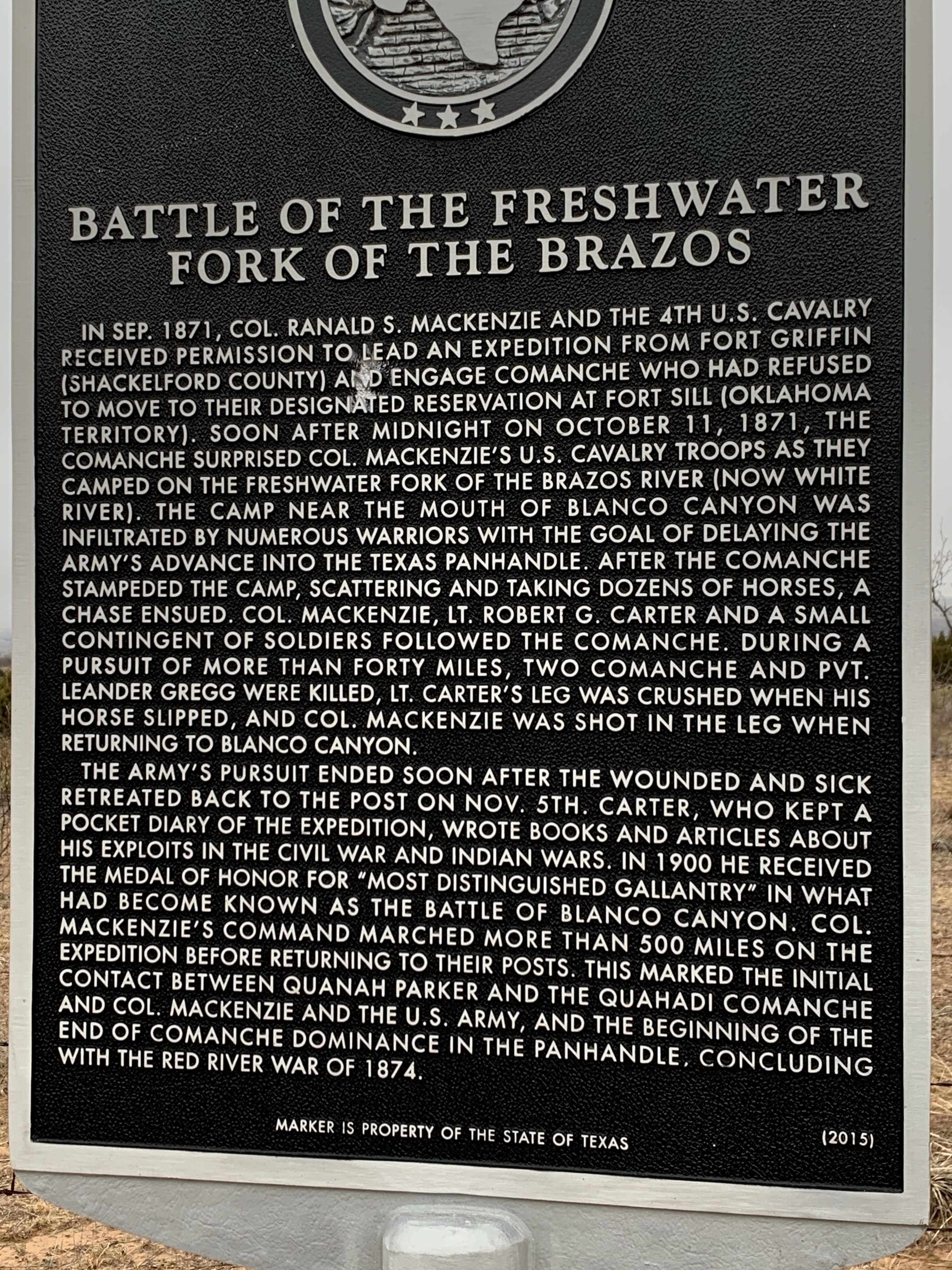
Blanco Canyon is an ever-widening erosion in the Llano Estacado originating out of the steppe from the White River. it is interesting to note the difference in language to denote the same color, “Blanco” and “White”. I’m not sure why this distinction is made, but the metaphor is all too poignant when you consider its history. For, the first battle between the Comanche, led by their last warrior chief, Quannah Parker, and the Anglo, and Black, U.S. Army under Ranald MacKenzie was fought here. Well, to call it a battle is to give the army too much credit, they were largely routed resulting in MacKenzie receiving a debilitating and lifelong painful leg wound. One which would mark him psychologically as well as debilitate him physically from then on. The Comanche surprised the fledgling army unit, stole their horses, and the soldiers barely managed to survive with their lives. Some didn’t. For MacKenzie, it was a learning experience that he used effetively, eventually copying Comanche tactics to his credit and that led to their own surprise attack at Palo Duro Canyon that eventually broke the back of the Comanche resistance. A compelling account of this campaign and the life of Quannah Parker can be found in S. C. Gwynne’s Empire of the Summer Moon.

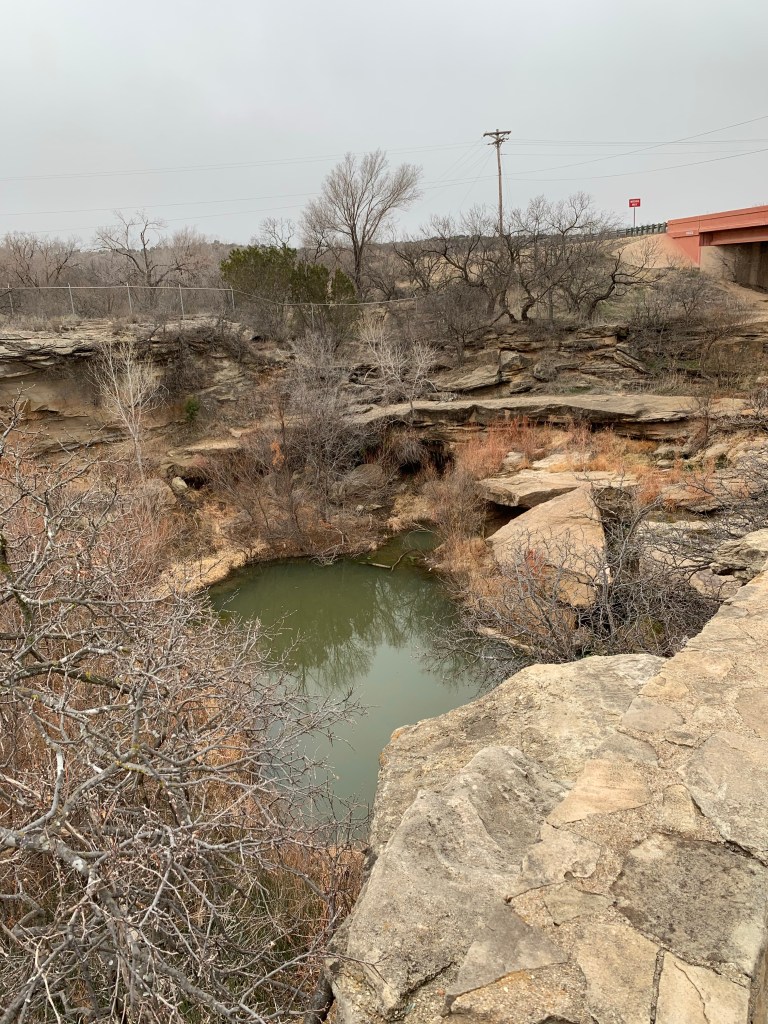
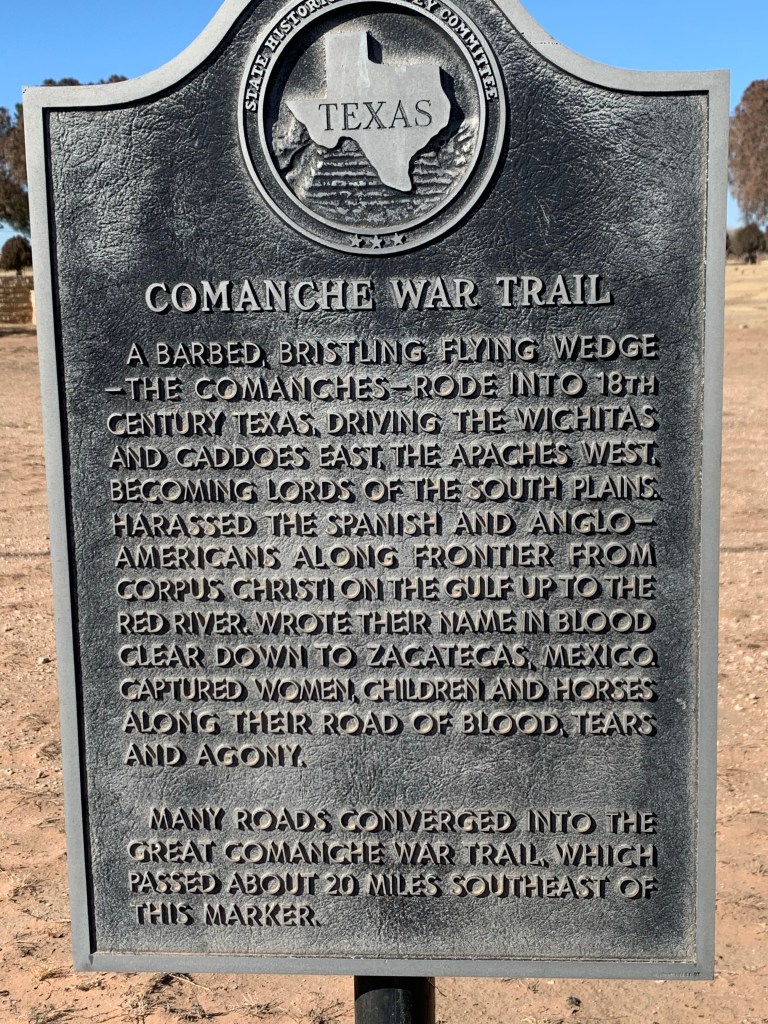
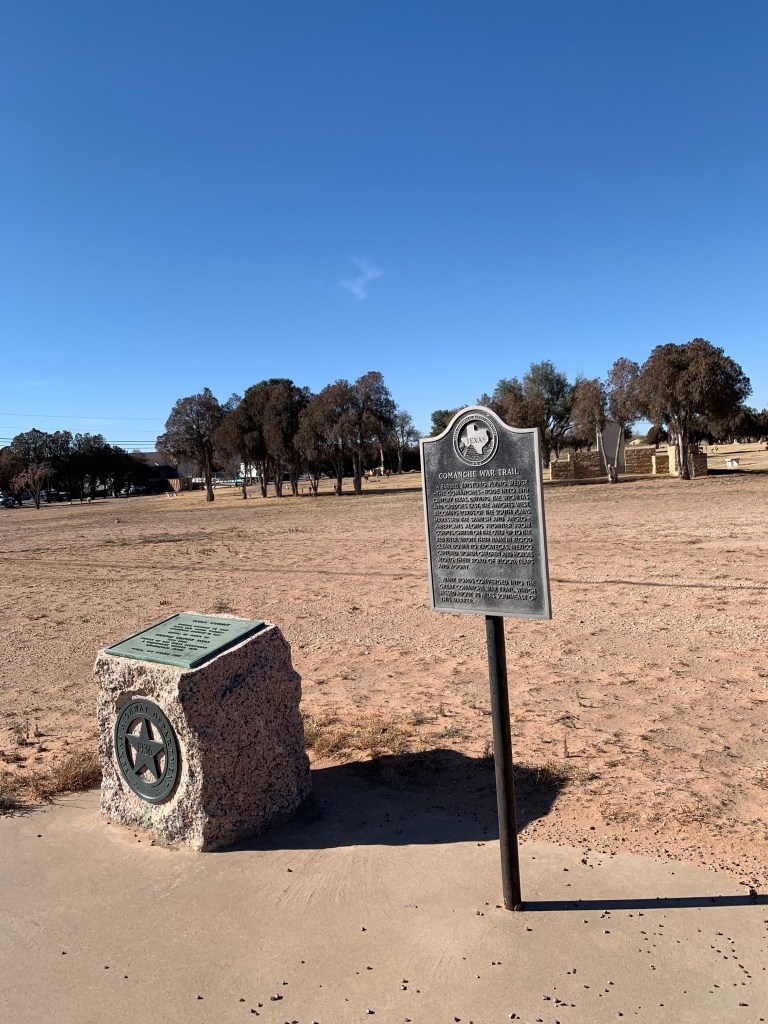
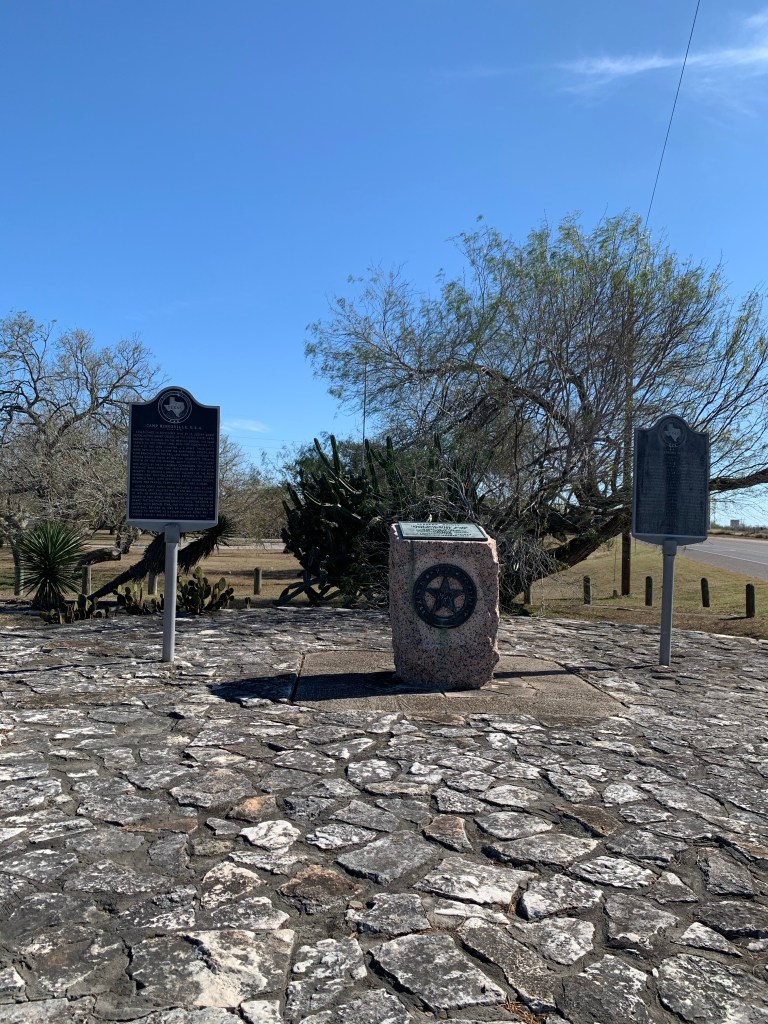
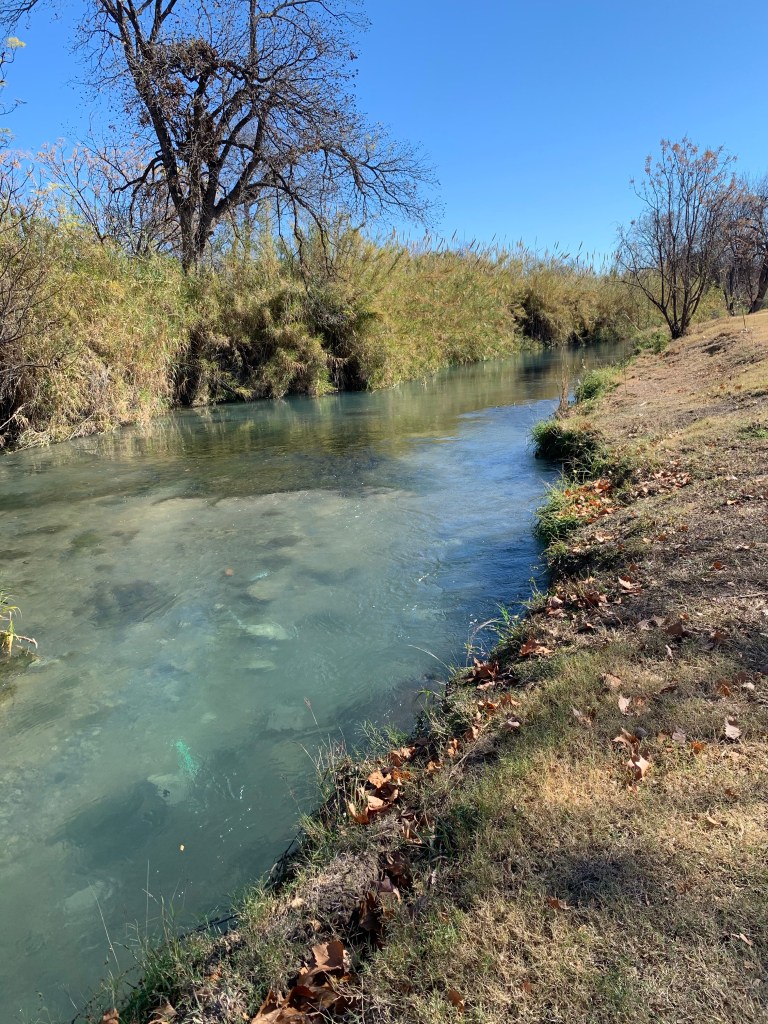
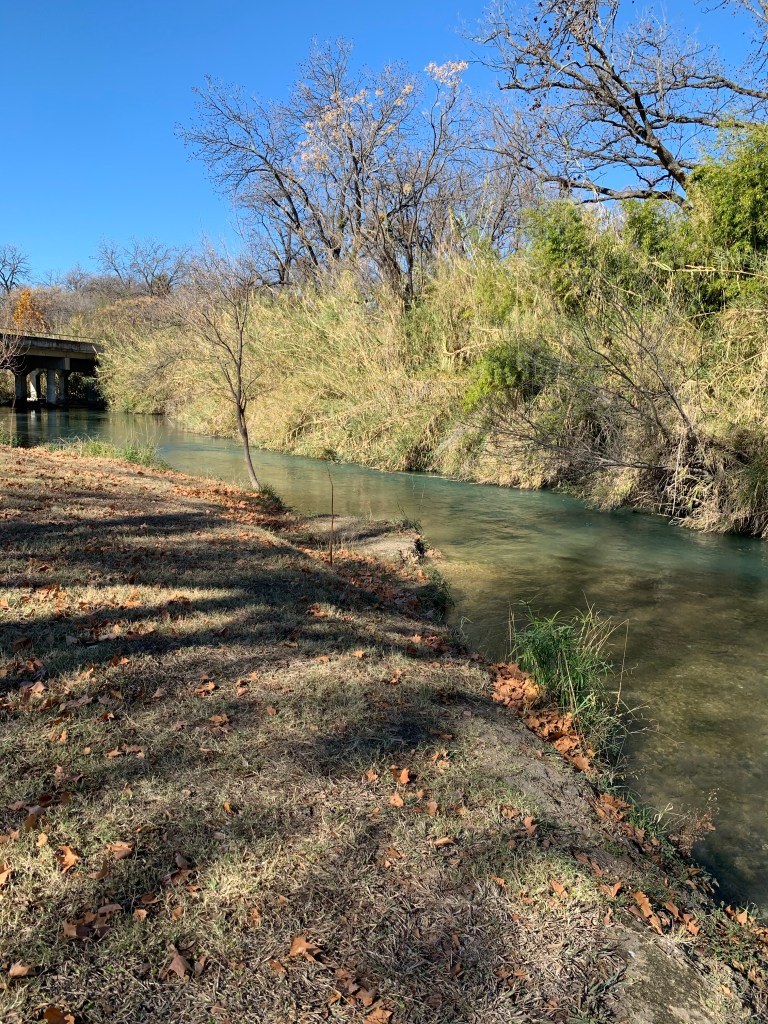
I visited Blanco Canyon at the White River to fnd that it was now a rest stop and visitor center on U.S. Highway 82 about 34 miles southeast of Lubbock. I was struck by the great effort that was spent in stamping (another word for “staking”) the presence of the State of Texas all over this rest area. From well adorned stone walls and large picnic tables with the Texas star in the center all through and even down to the White River to the multiple flat rock viewing platforms, it seemed like the State wanted to make sure every inch of that space, arguably a space of military failure for Texas and budding “America”, was staked out as a place of honor. Indeed, reading the account of the “battle” on the Texas road marker (above), the reported account does its best to obscure that the Army was caught by surprise and that they were routed into a retreat.

The account of history by historians takes pains to leave little doubt that this space was now owned by the eventual victors from Comanche “terror”. It set in context to me the name of the river, like a metaphor for the coming staking of this majestic land as ceded to its new owners, themselves a “river” of White for generations to come. It is something I have recognized, especially among anglo Texans throughout history, to do their best to stamp out any evidence of earlier failures and assure their claim to supremacy. It is a vindictive effort at vindication of their perceived power over history.

Erosion and Recovery of Truth Along the Staked Plains

In both cases of Lubbock Lake and of Blanco Canyon, layers of earlier life and the lives of people in history have been revealed with the passage of time either through the eroding landscape showing who was there and their mark upon the land or by the stamping of a layer to hide what had happened, shoving “under the rug” a failure to establish a more hidden truth; that not every result was a pristine march of victory. That march is layered in a half truth of eventual military victory when the truth is that the Comanche were ultimately defeated not by military prowess alone but with the added success of White poachers that destroyed the buffalo herds–to call them “hunters” is to stretch the meaning given the relatively easy work one can do to ride up to buffalo and shoot them. That along with the weakening of the Comanche by disease like all other early peoples.

Layers of the truth are removed over time. Like a river cuts what seems like a flat interminable plain into canyons revealing all the history layered one on top of the other, I have found revealed my own different layers. From the fears at the bottom of a recurring dream to a search not for a single “heart of the matter” but the kernels of a seeded heart nurtured by the richness of the many different lives I’ve lived; the stamping of passion, intellectual growth, and lost memories that brought me pain as well as wonder. Layers that can only be seen when riding through distant histories of long dead ancestors and the reflections on my own history as the sands upon the winds, and the miles, go by.

I am roughly halfway through what I am sure is just one stage of a curious journey into time. And what motivates my heart. I fight the anxiousness to reach completion. It’s better to savor the very time I am takng. Tomorrow is a day best known before its passing. Today was a good day. To remember.

Odessa (Texas): What Time Fills–A Pandemia Chronicle

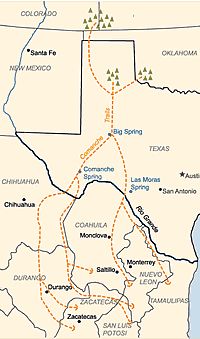
I’m not really sure why I decided to stay over in Odessa. It was meant to shorten my trip between the Big Bend and Lubbock. The majesty of Big Bend and its centrality to the Comanche territory was–is–a hard act to follow. So many thousands of years of forgotten history and so many thousands of people who had inhabited and commanded in the “uninhabited” Santiago and Chisos Mountains. And then the brief but deadly entry of Spanish, Mexican, and Texas colonists. It seems logical now that my travel to the Big Bend would take me to the beginning; up the Comanche Trail

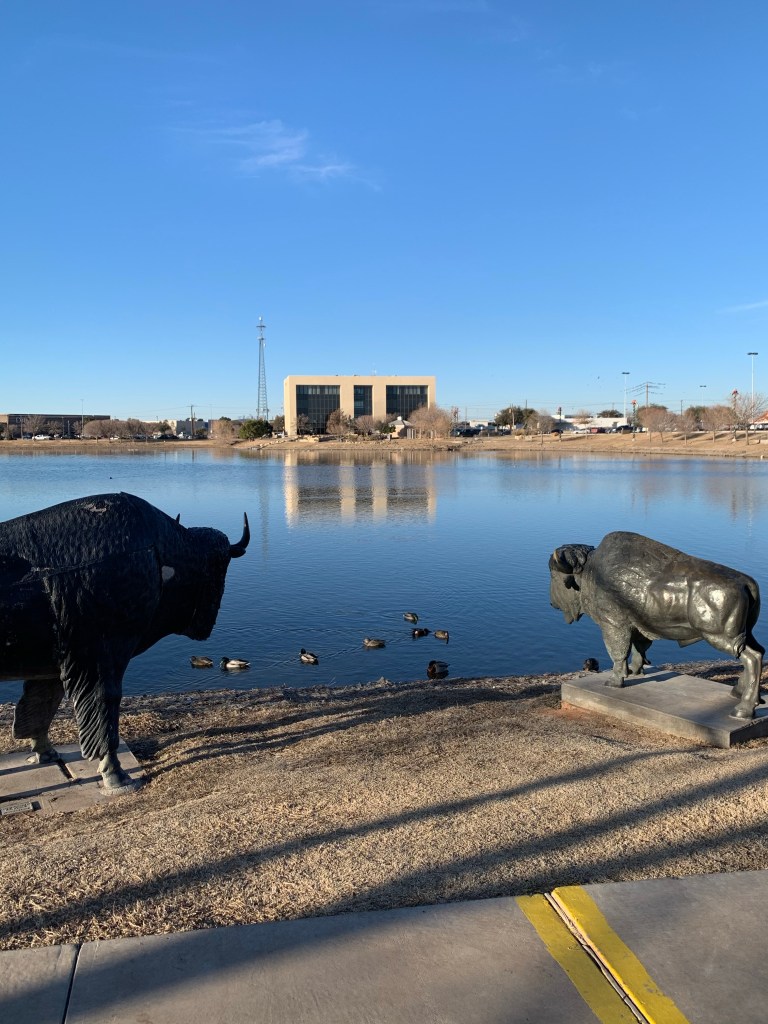
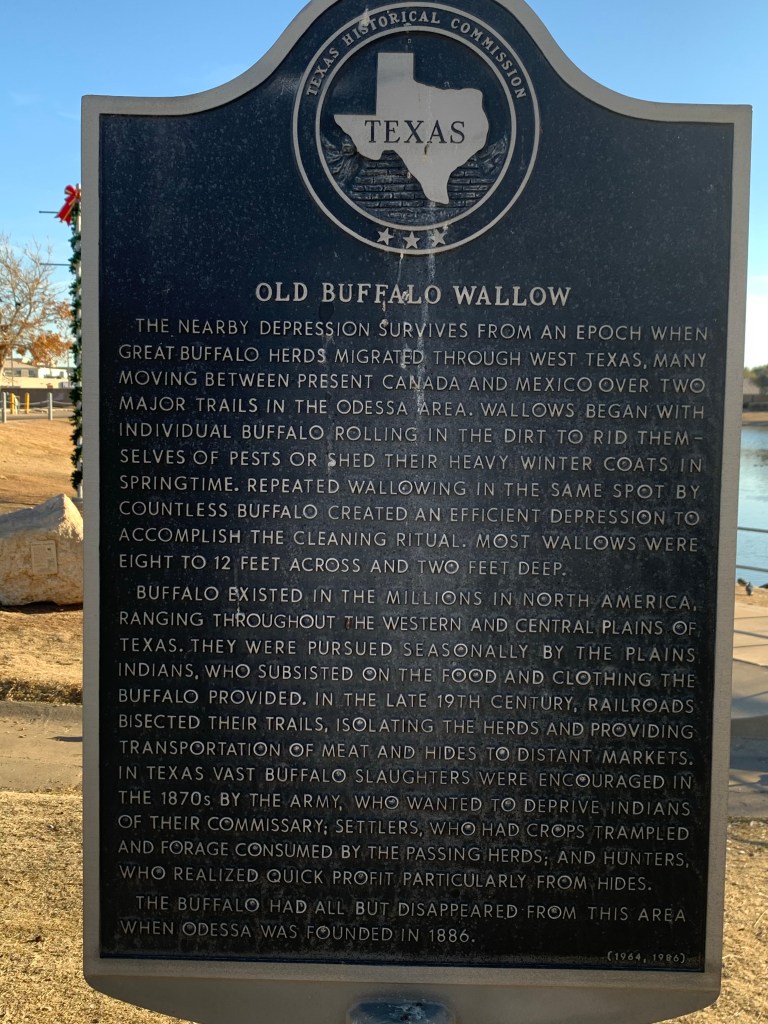
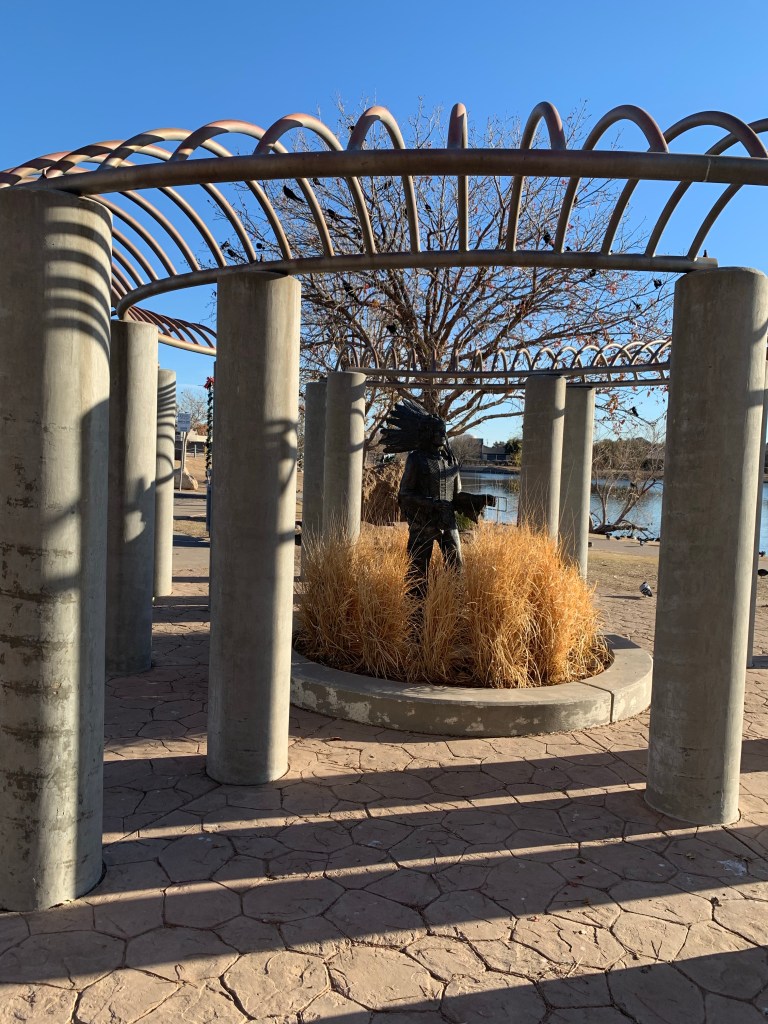
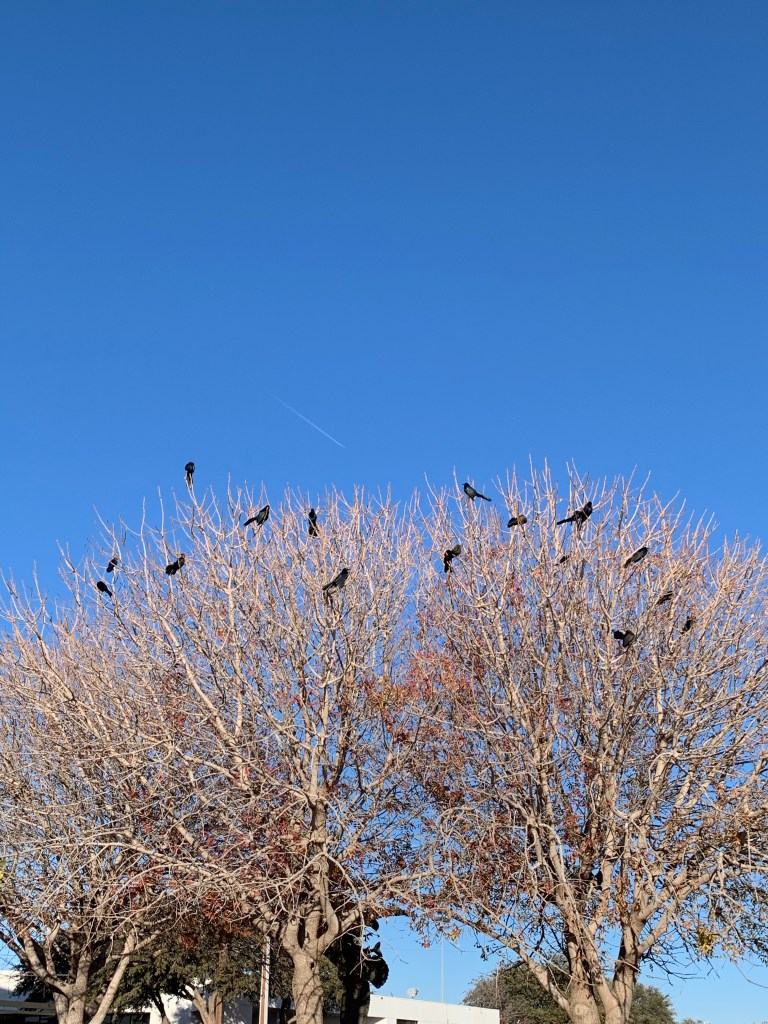
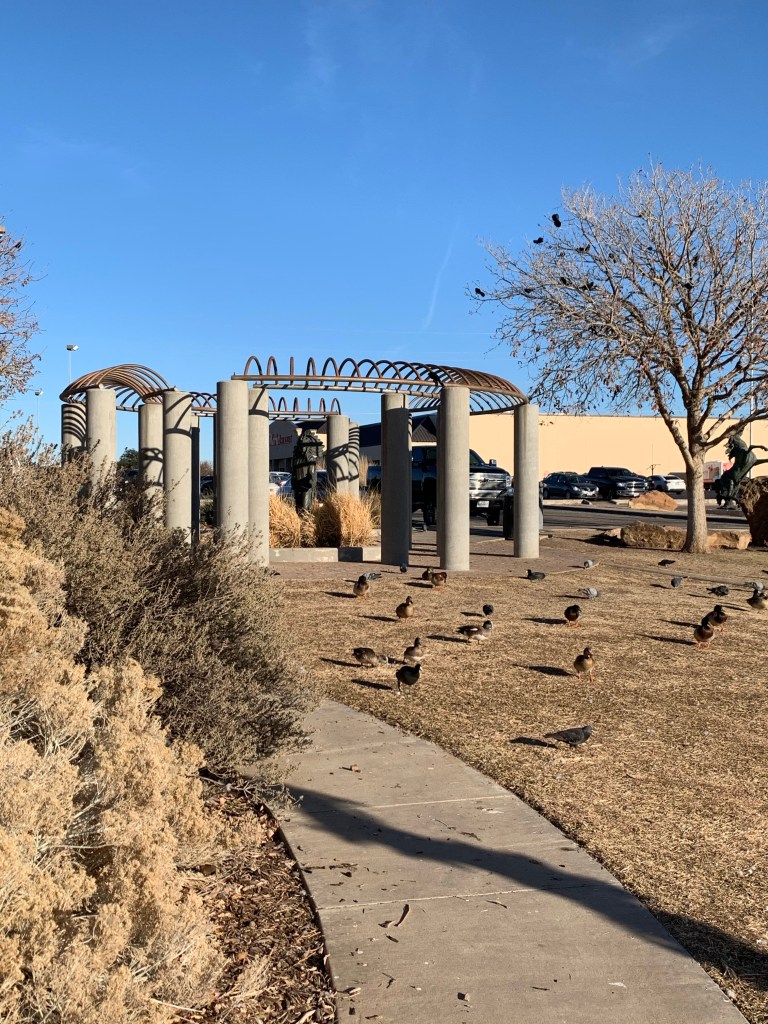
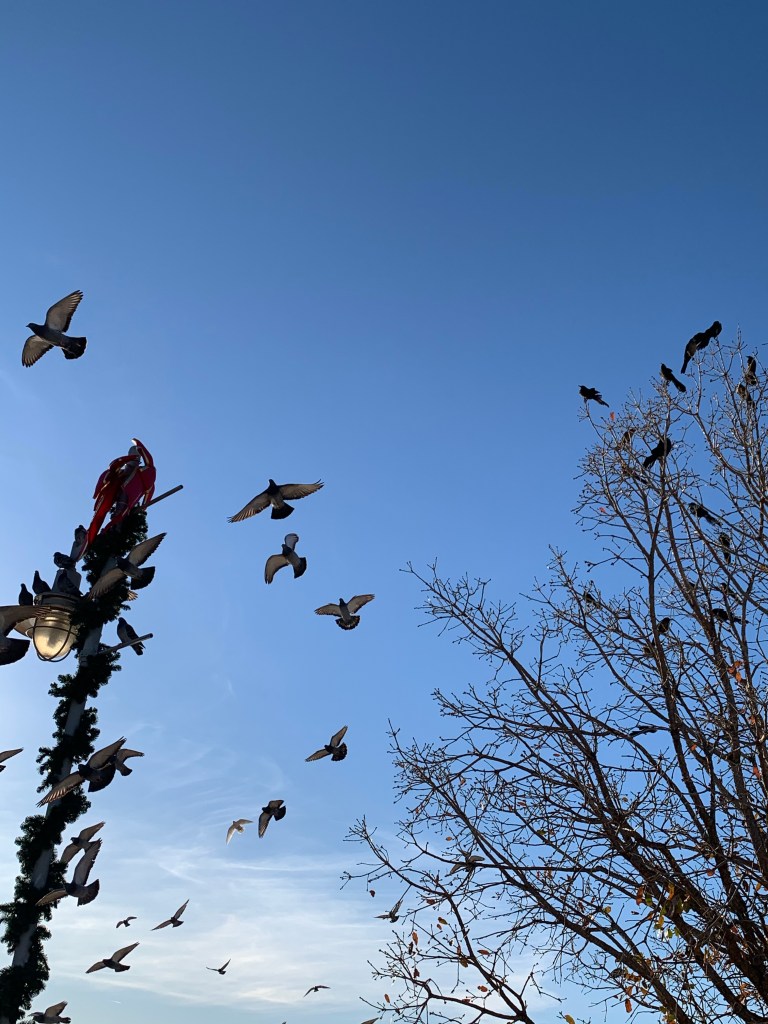
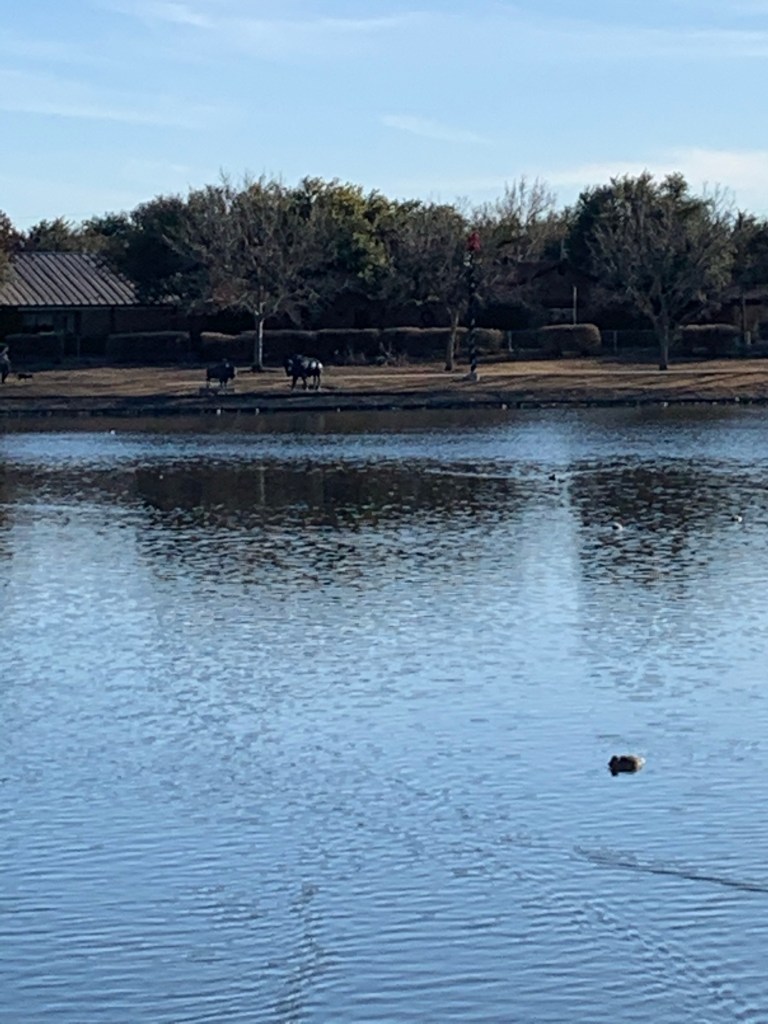
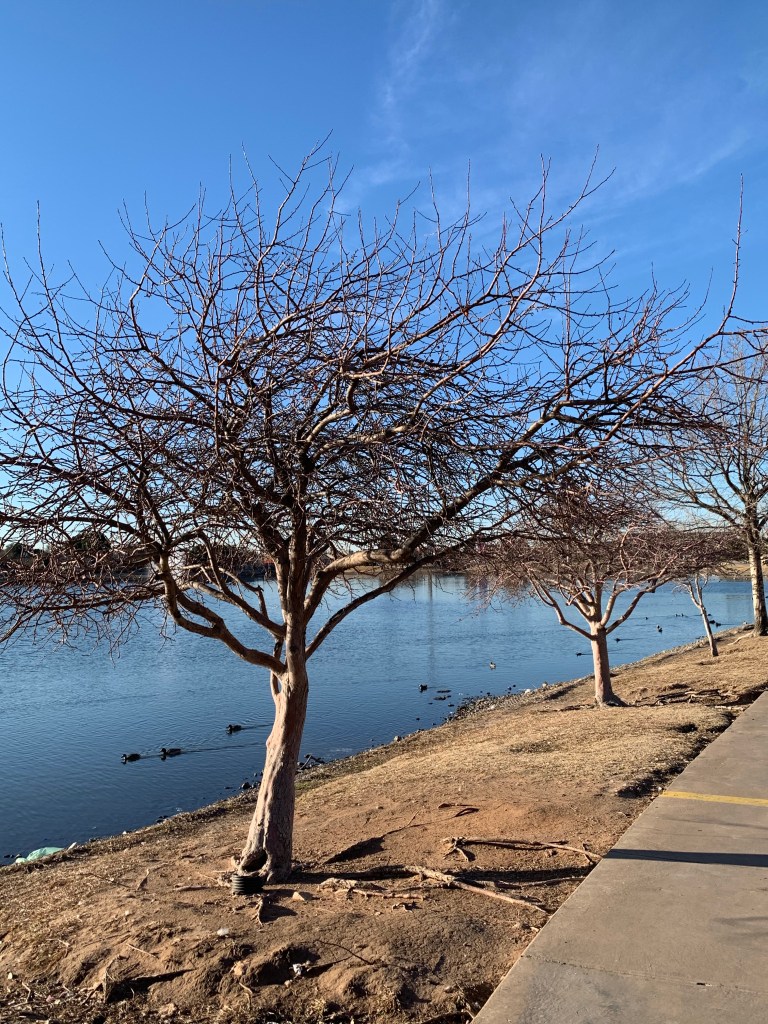
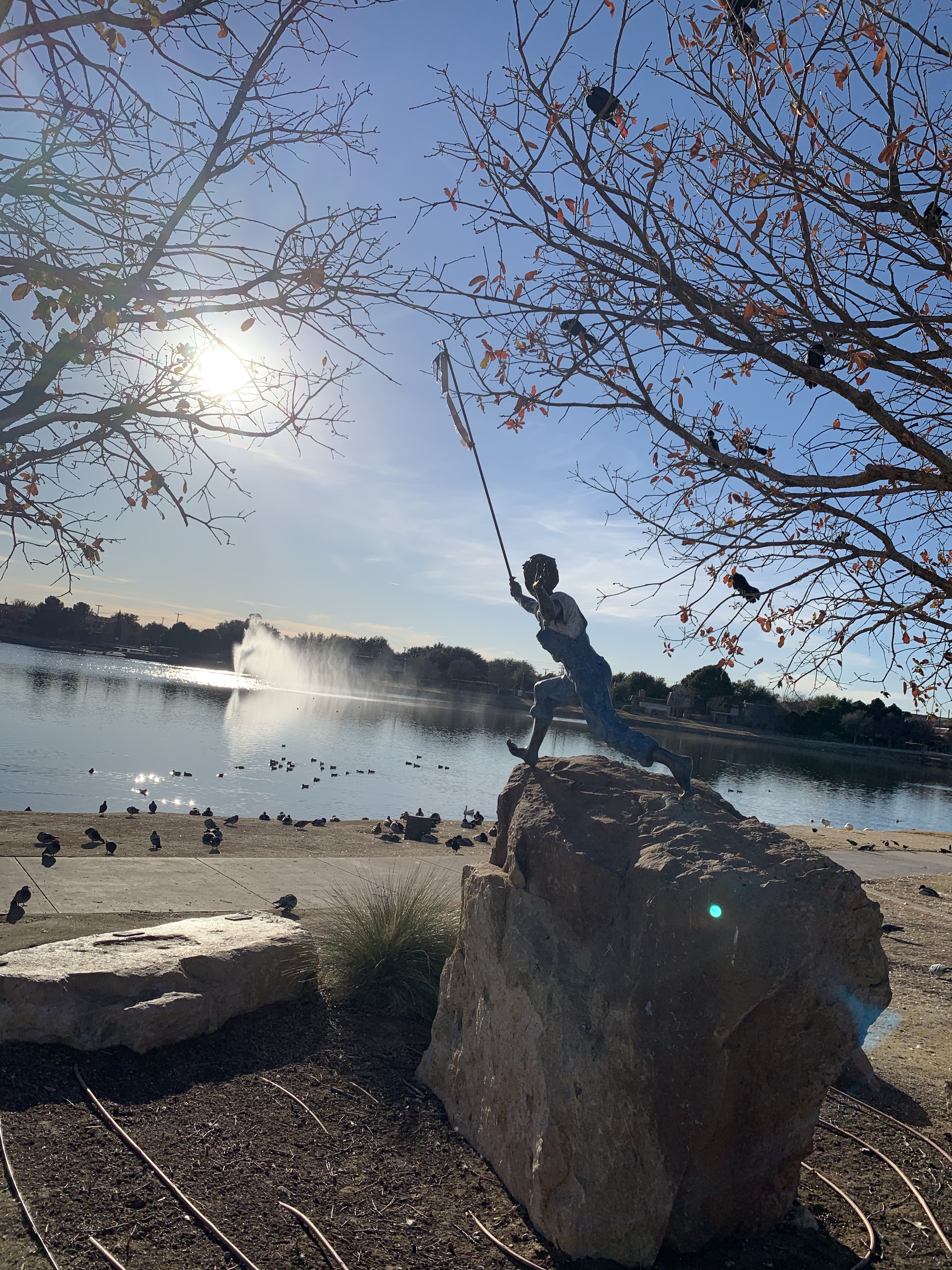
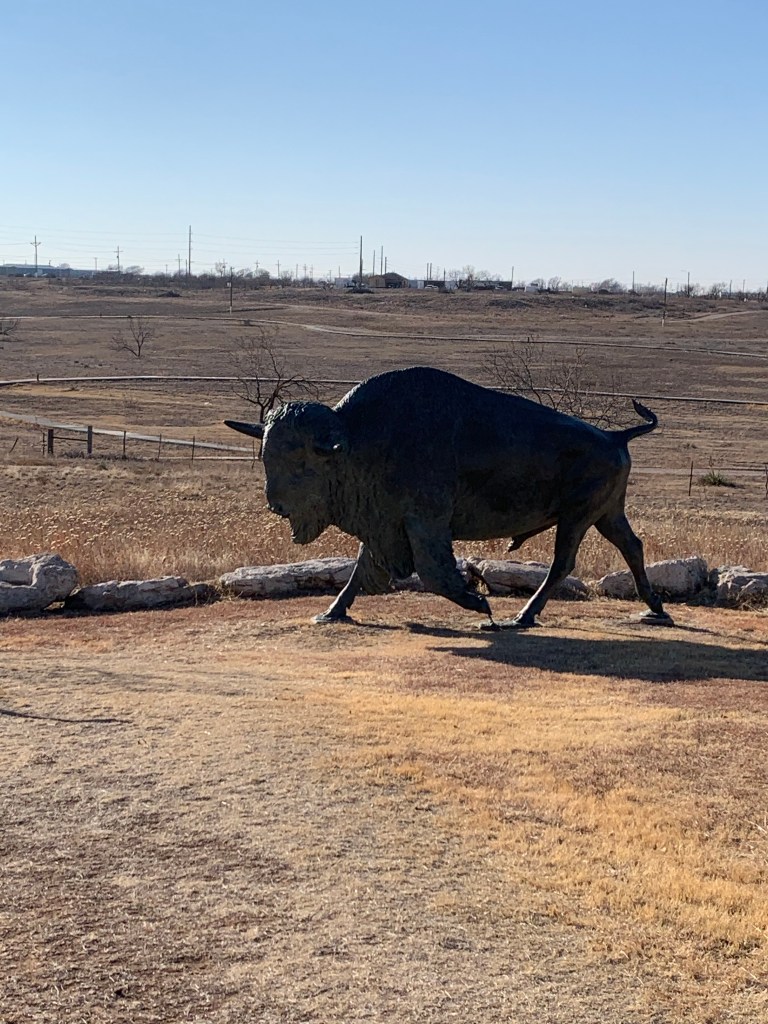
Odessa is situated as a part of the vast sea of grasslands that is the Permian Basin and now the sight of large oil reserves. Odessa’s origins are unremarkable as a cattle watering stop and shipping point named by the Russian workers who came to build it (appearing much like the steppes of their native home of Odessa in souther Russia). The Comanche roamed this territory hunting buffalo and, of course, as the road they took on their way to the south through the Big Bend and north to their home grounds at the base of the adjoining Llano Estacado in places like Blanco Canyon and Yellow House Canyon around what is now Lubbock, Texas. The Comanche hunted here because of the buffalo migration route. Near the Odessa city center is a “Buffalo Wallow”, what used to be a large depression in the ground where buffalo during their migration would lie and roll around in the dirt to rid themselves of parasites and their winter fur. Today, the buffalo wallow is gone and in its place is an artificial lake and a children’s garden. And lots of duck, geese, pigeons and blackbirds. The wallow has been filled by time and the city’s runoff.

A Meteor Crater Filled by Time

As I was coming up on Odessa, I spied a sign for the “Odessa Meteor Crater”. . .You know I had to go.

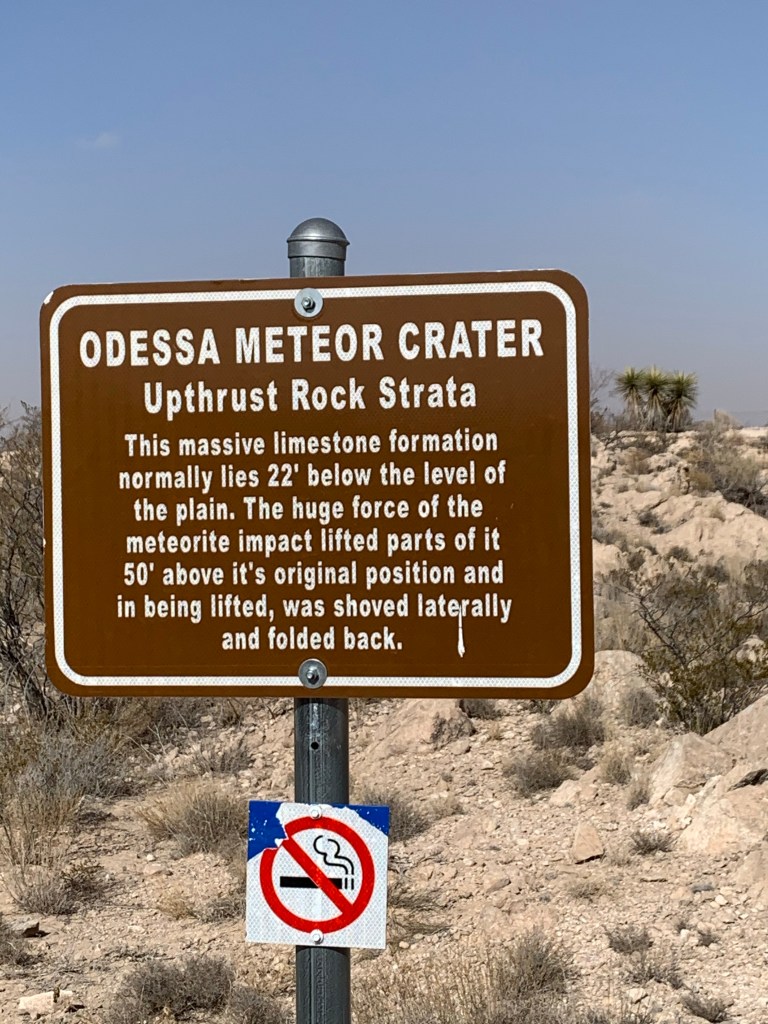
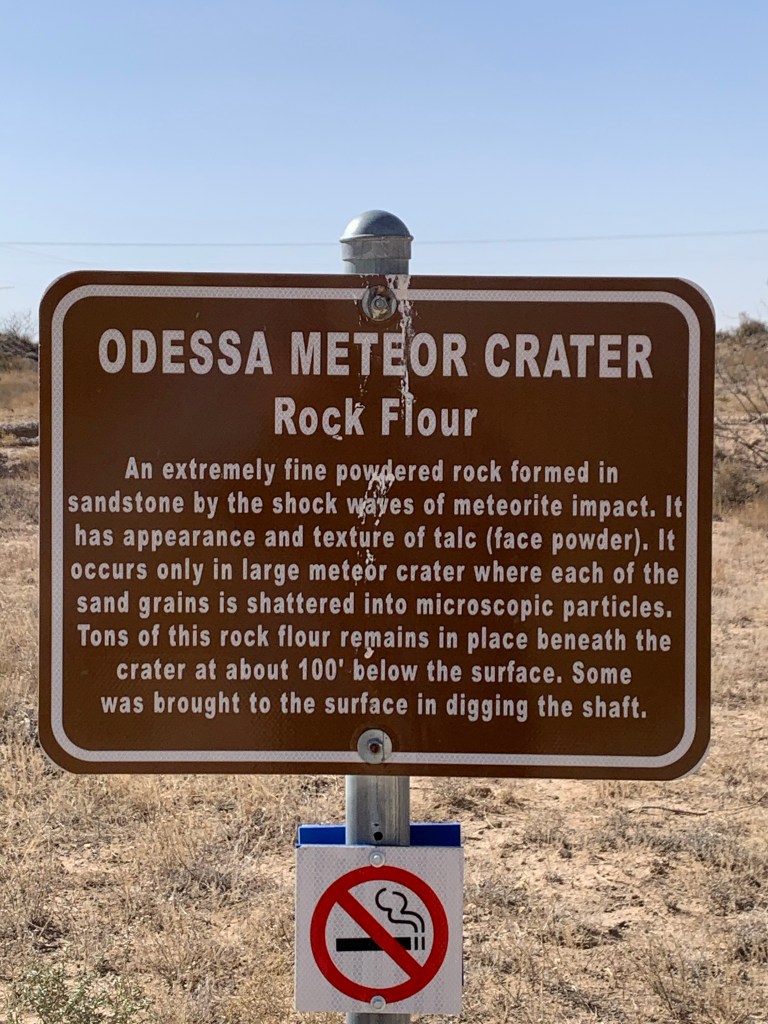
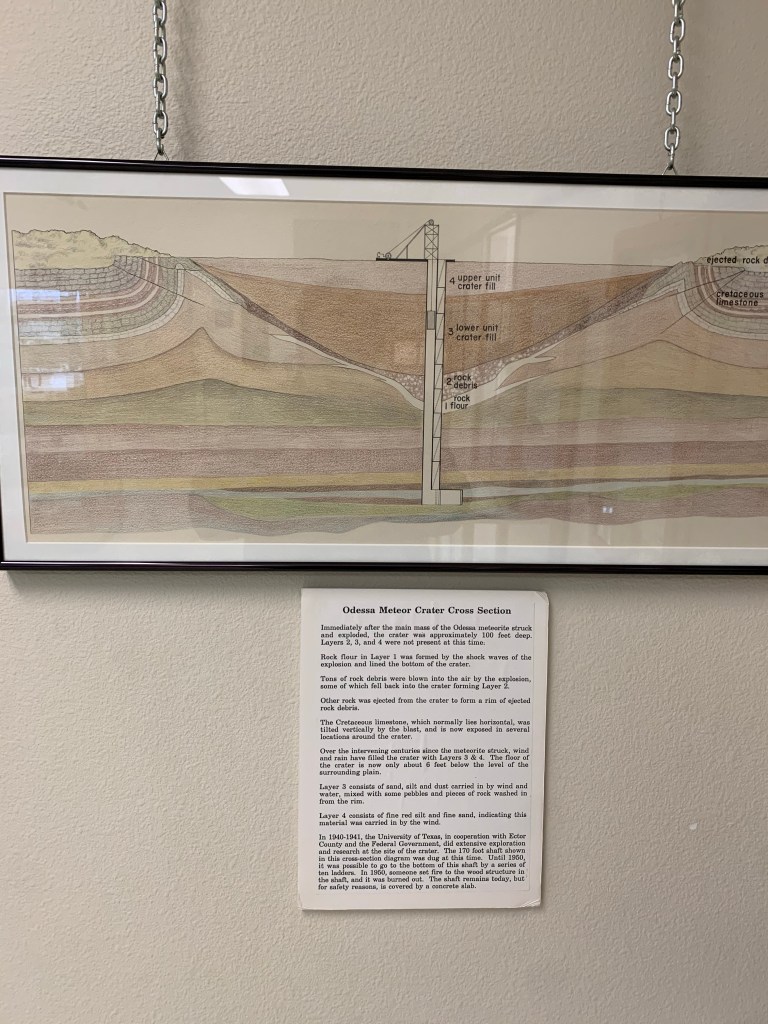
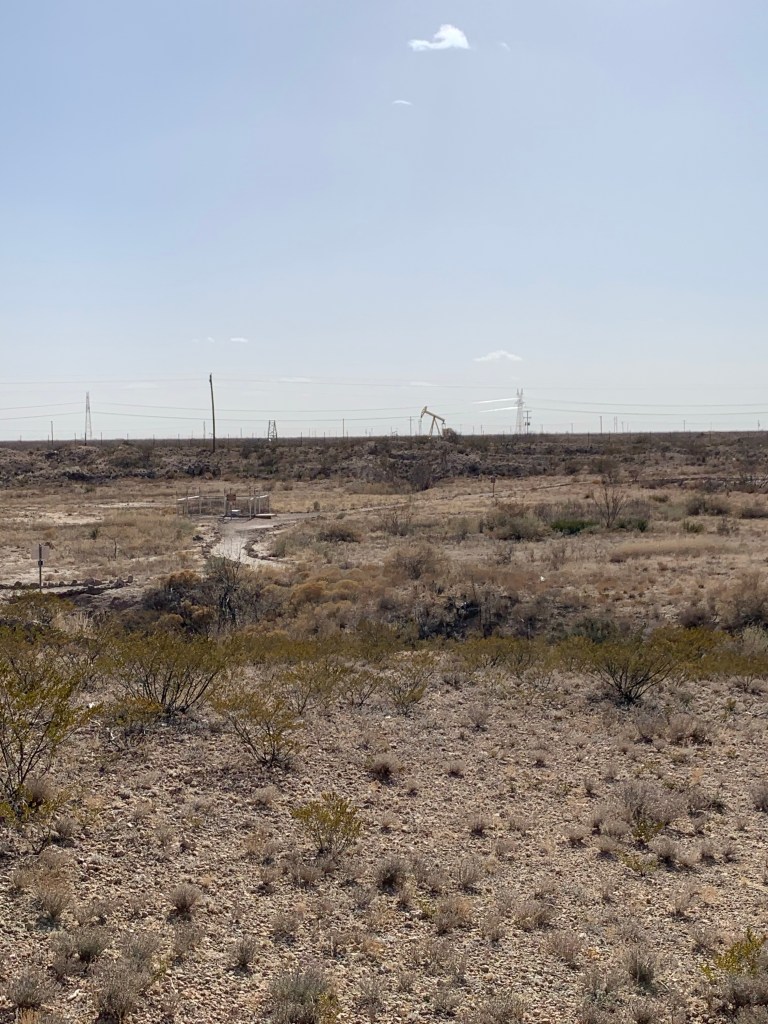
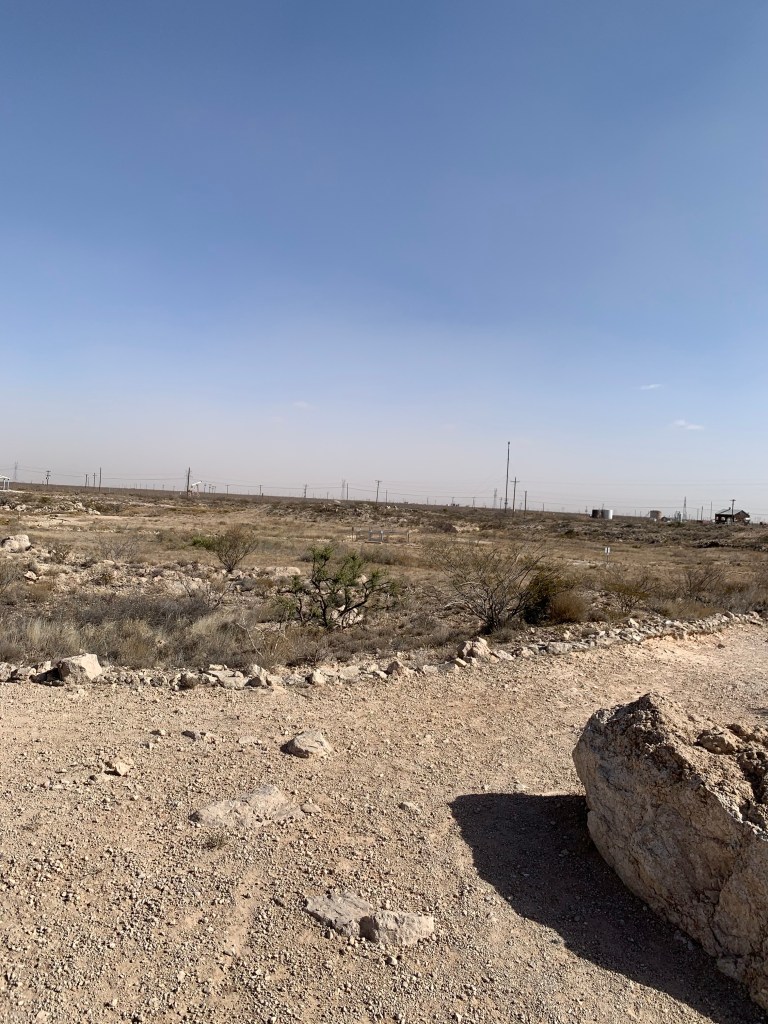
It turns out that about 20,000 years ago, a relatively small metallic metorite struck the unassuming grasslands and Wham! Instant, literal, dust bowl; when a meteorite strikes, it creates a fine powder of “rock flour” from the shattered sandstone. Over time, the crater has filled with sand and plants to create only the outline of the impression in the dust. For some time, researchers thought they would find a solid core of the metal but it appears that the metorite broke up and created a several craters close in from the main one. There is a shaft where people dug deeper to the center of the impact, but they never found the “heart”.

A Time Filled With Life

Somehow, I found a metaphor in this meteor story. I sometimes feel that on this journey, I am searching for the “heart of the matter”, that one big piece that will explain my life, my universe, my everything–those of you who know about Douglas Adams will likely get the reference, my search for the question to the answer, which, of course, is 42. I think that just like the pointlessness to Adams’ query, the question, or the answer, may not reside in the mythical heart that I’ve been seeking to find. Perhaps, just like the multiple fragments of Odessa’s meteor(ite(s)), there never was a single heart, especially at impact with the vagaries of life? Perhaps, instead there have been different little pieces and they reside within the several lives I’ve lived, Hippie football player, musician come antiwar activist, revolutionary socialist, dancer, singer (again), teacher of children with disabiliites,, research scholar, husband, father, teacher of teachers, singer/dancer/narrator, student of history and time. And, just like time has a way of filling impact craters, especially in places as ephemeral as sandstone on the prairie, or humans, perhaps the craters in our heart are filled with the accumulation of time’s . . . markers. Perhaps I should spend my time seeking out the kernels that are at the center of each of these remarkable moments in my historical timeline?

I think this journey took me to Odessa to understand that just like me, the Comanche have had many pieces of a full heart. They cannot possibly be just the fierce warriors the world has chosen to focus upon them. Anymore than cruel conquistadores simply meant to bring destruction to the world.

History, at least the kind we’re used to reading, and studying about, has a way of making the lives that have been lived in two-dimensional characters, sometimes full-blown portraits, sometimes caricatures, always just a painting if sometimes even in film. We think about history in the deeds that were done, the reasons, the pretexts, even the contexts, but always just about what is salient.

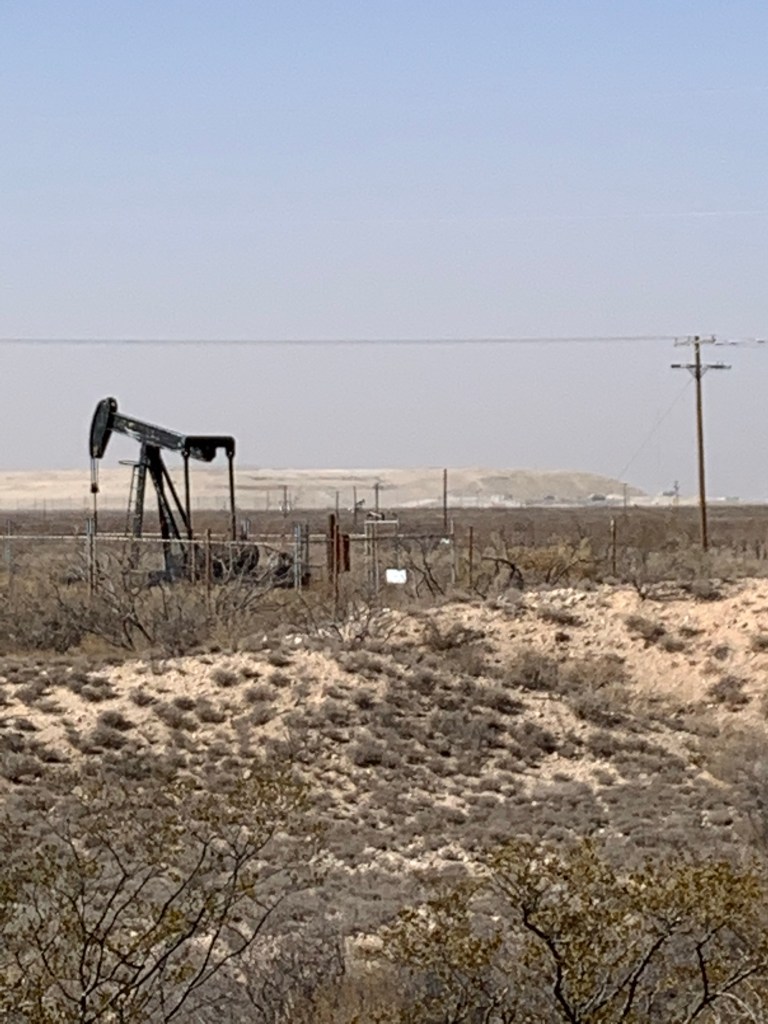
I wonder if we are really to learn from history, we might want to see the less salient, the more mundane, the comedy, the frailty in our character? I thought about that as I wondered what it was to be at a buffalo wallow? Is there something we can know about the lives of buffalo; other than, you know, dinner? Is there something about a Comanche warrior that is salient in what might have been the mundane, or in the times when they may have failed in what they did best? Is my journey just a set of places I have come to visit, or is it also when I tried to find something meaningful when all there was was a meaningless drive across a vast sea of nothingness, stabbed by oil pumps? And then to come upon a metor(ite(s)) crater filled by time and a wallow, now filled by city runoff, where long dead fleas once died a rather silly death from a beast rollin’ in the prairie dust?

Dusty?

So, imagine a couple of Comanche hunters looking to get a few easy kills sneaking up on some buffalo contentedly scratching themselves on the ground, all happy, snortin’ away. Maybe flickin’ a few fleas at one of their partners, “Flea fight!”, fur all flyin in the lazy afternoon sun. The two Comanche, let’s say they’re named the equivalent of “Joe” and “Hector”, see it’s their lucky day, “Yeah, we got lunch for about 3 months” Joe says. “Let’s get up close so we don’t miss, we’re kinda short on arrows”. Hector snorts, “Yeah, you really need to stop wastin’ ’em on the damn Spaniards, just let ’em go next time so they can bring back more horses”. “Yeah, ok, but we need to get these buffalo right now! “C’mon!” said Joe as he started to crawl up close to the wallowing buffalo. “Don’t get so damn close, you’ll spook ’em!” Hector warned. “Nah, just c’mon” said Joe. And, as Joe got closer, the dust started to get a little thick, “Ahh (he tried to hold it quietly)”, “Ahihhh…”, “CHOOO!” he sneezed. . . . . . Years later, Joe finally took a wife and had a few children. One of the boys, while taking a bath in one of the springs with dad noticed this somewhat large holey scar at the top of his dad’s butt crack. “Wow, what happened there, dad?” “It’s an old battle scar when some Spaniard tried to sneak up on me” Joe said. “Hey, dad. Some of the other kids saw some buffalo out in this hole rollin’ around in the dirt, can we go hunt ’em?!” “Leave the damn buffalo hunting for the experts, son. ‘Fore you know it, fleas and fur can get all up in your nose. Just let ’em play .. . . “
I’m just sayin’ that nobody seems to think Comanches did anything but steal horses, kill settlers, and kidnap people. Fearsome warriors, adept at hunting. All that had to happen with a few life lessons. Somehow!

“Los Despoblados” Riding on the Trail of Fears: A Pandemia Chronicle

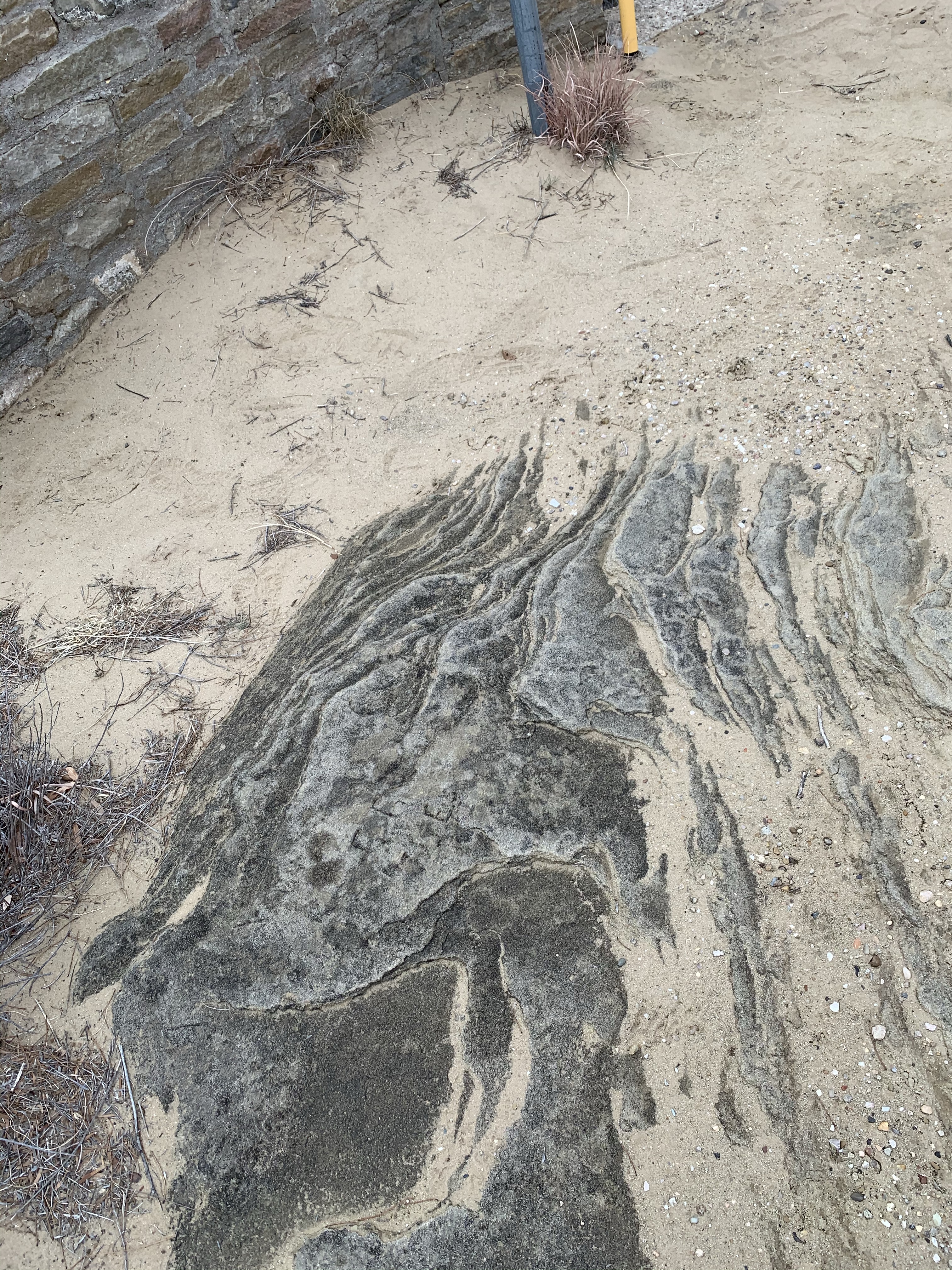
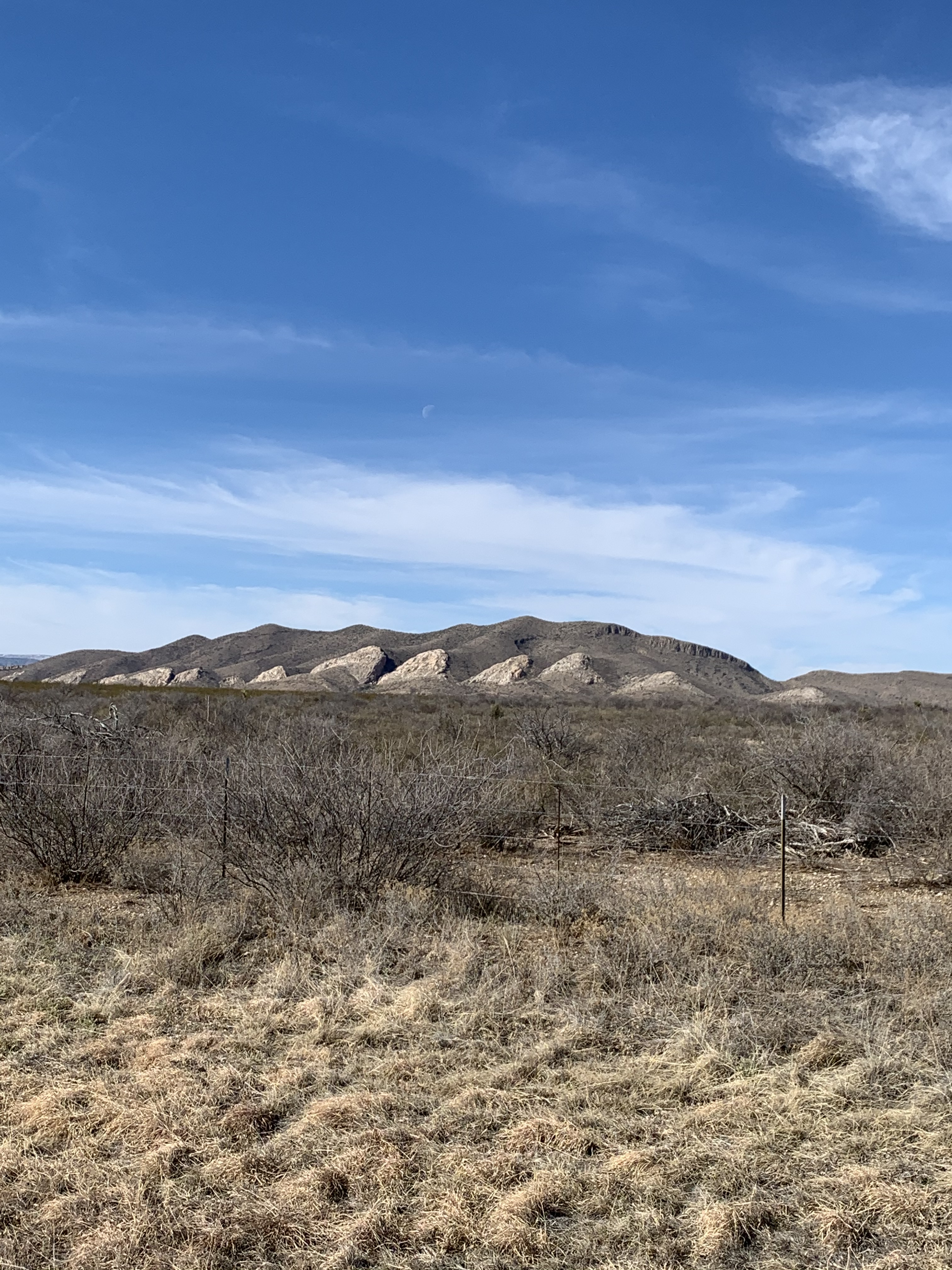
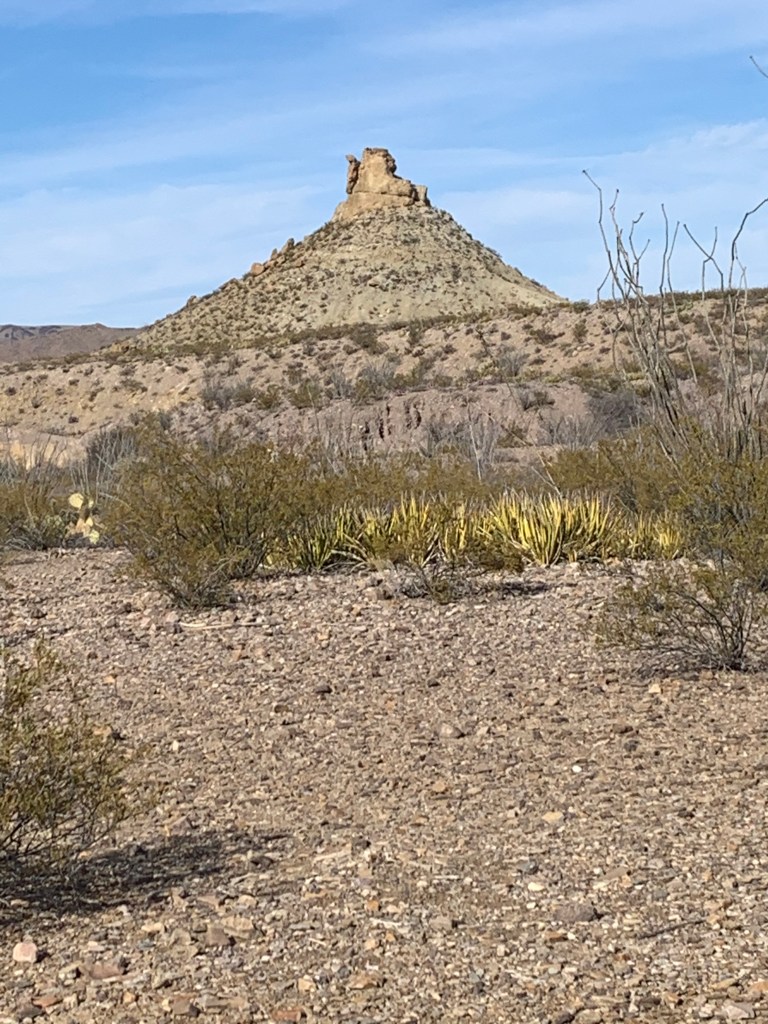
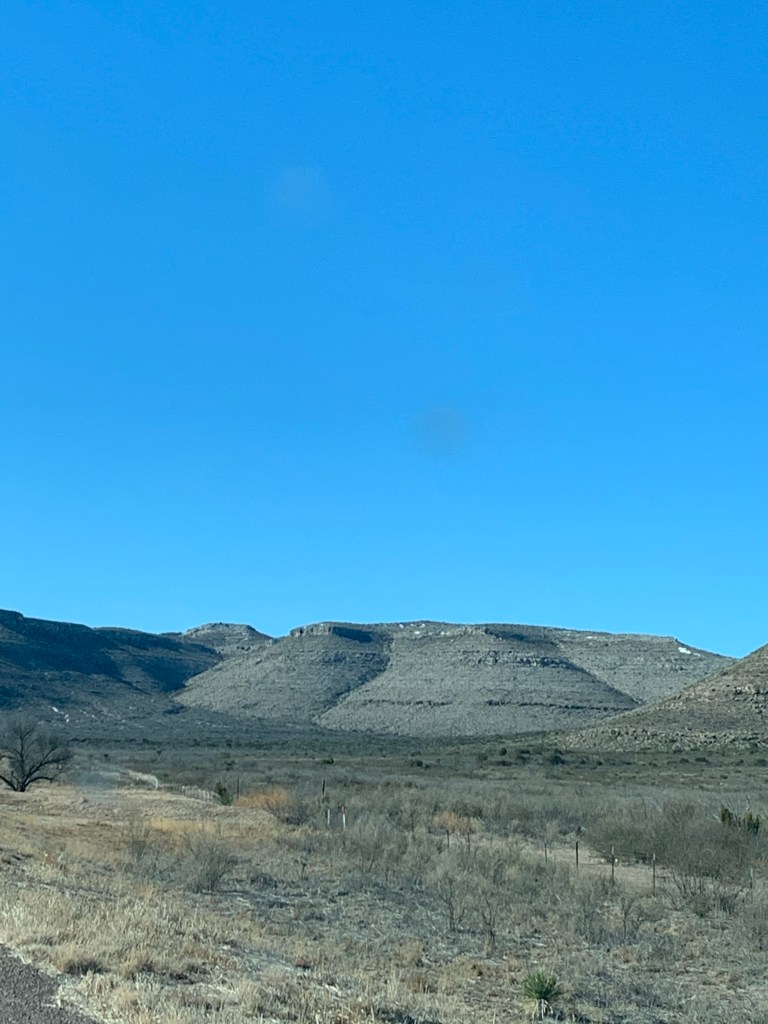
The Spanish Named These Lighter Outcrops “Caballos”–Horses. They seem to run across the rocks.

To the Spanish and Mexico, the area of the Chihuahuan desert on the Rio Grande was uninhabited, “despoblado”. To the Texans and U.S. Army, with the help of the “Buffalo Soldiers”, it was a land that needed to be cleared of its native inhabitants so that it could finally become populated by “real people”. It’s interesting to note that today, the Big Bend area of West Texas remains despoblado, except from tourists, researchers, and state park personnel, all of whom are focused on the wonder of a land and its former inhabitants, those despoblados who began inhabiting this area 8,000 years ago.

Basket Makers to Ghosts

Nancy Edwards (1968), a young high school student in Marfa, Texas described the first inhabitants of the Big Bend as “the Basketmakers . . .men [sic] of Asia and possibly came across the Bering Strait thousands of years ago”. Today, these basketmakers are now known as “Paleo-Indians” and were here between 8,000 to 6,500 BCE. Personally, I like Nancy’s description of “basketmakers”. Paleo-Indians sounds a bit like folk who might hunt and gather for uncooked food at Whole Foods more than a people living a subsistence lifestyle before the “dawn of time”. I like the idea that they made baskets. Seems like they might have been Salt of the Earth. This despite the likelihood that they contributed to the demise of the large megafauna of the post-glacial period according to Timothy Flannery in his excellent book, The Eternal Frontier.

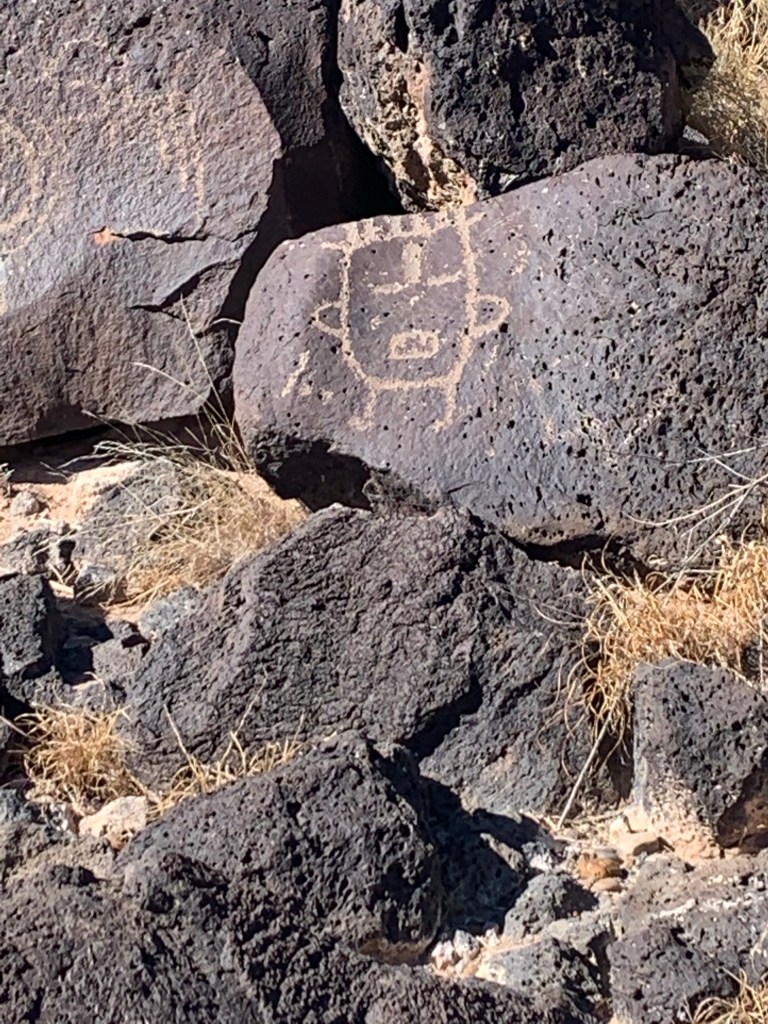
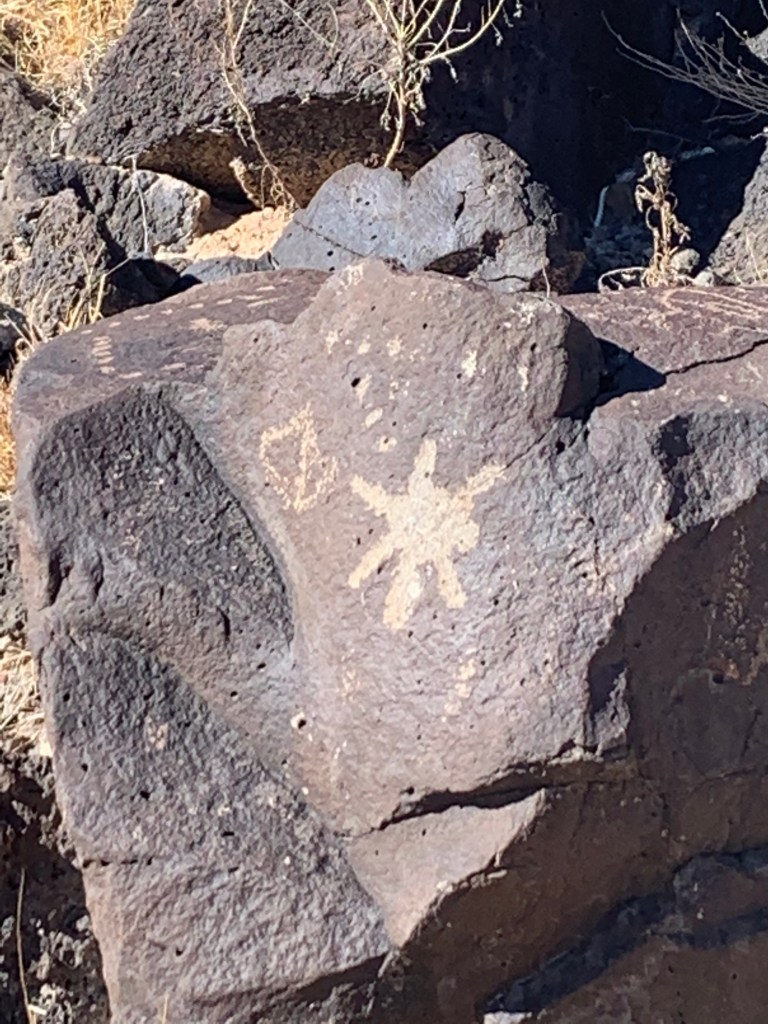
Eventually, these people evolved into more distinct groups whom the Spanish called “Jumano” who built adobe huts and grew a range of plants such as corn and squash or collected plants like mesquite beans and hunted small animals. They represented “America’s” first immigrants from which all the major nations and peoples that built civilizations, or just baskets, on this continent before Europeans came. The Big Bend was a wilderness upon which history was written in spearpoints, bone tools, pots, and, yes, baskets not to mention pictographs (see previous post on Del Rio) long before history was ever recorded by, well, our current predecessors (you might guess at what descriptors I used for Europeans before I decided it’s time to stop pressing the point).

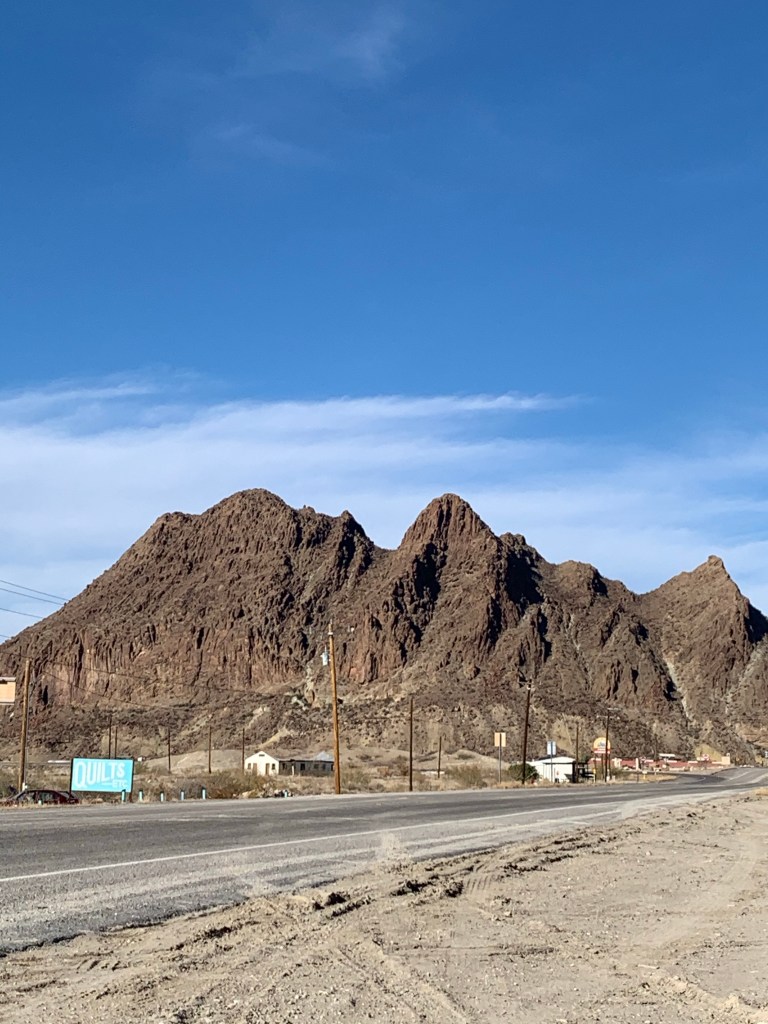
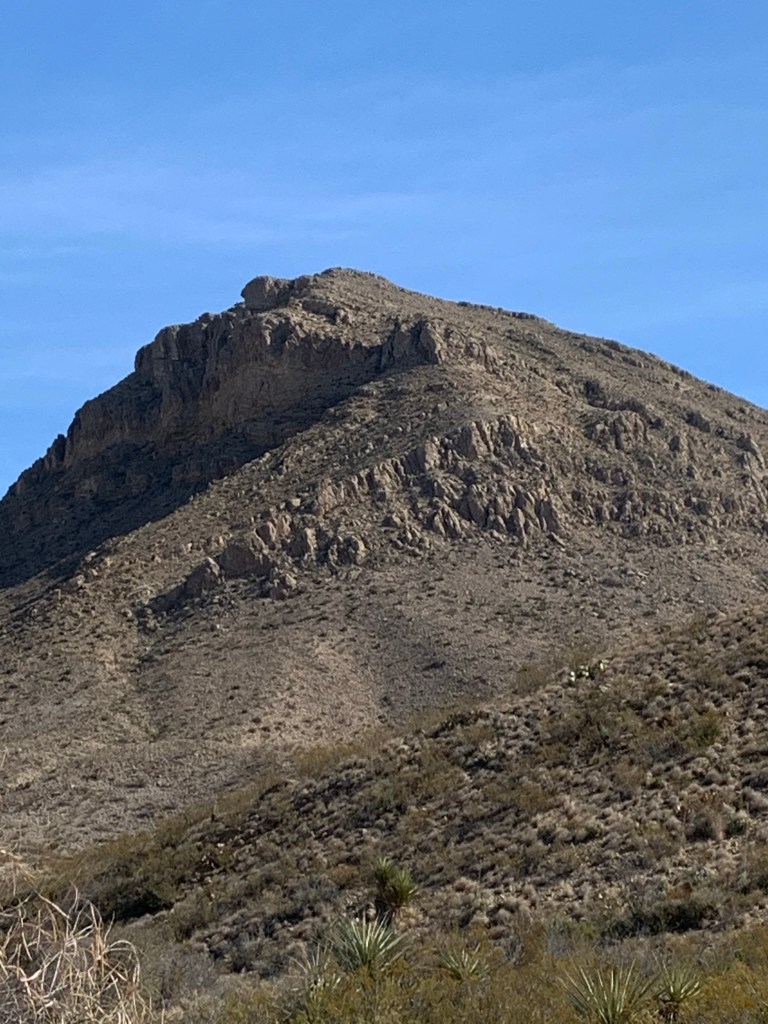
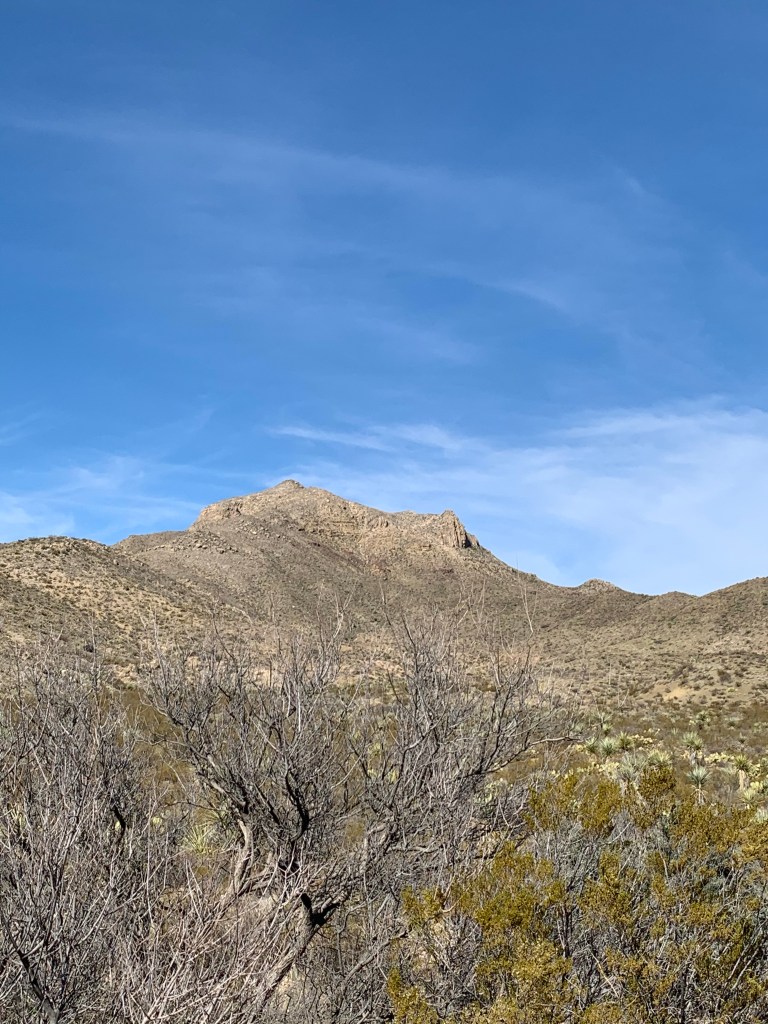
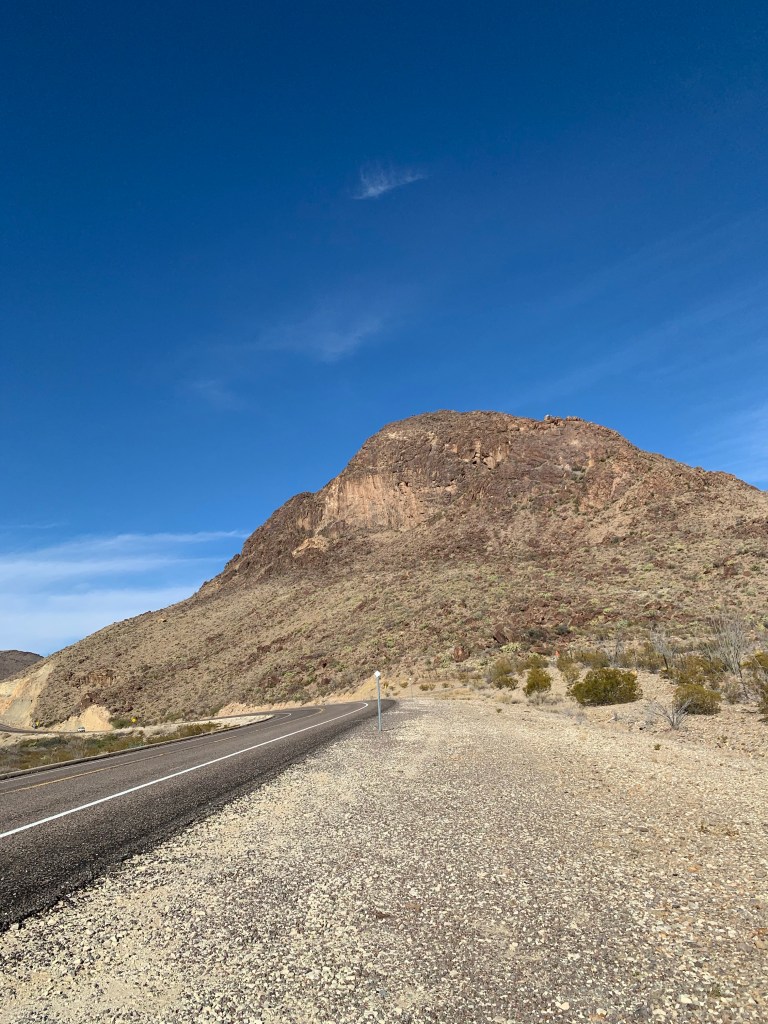
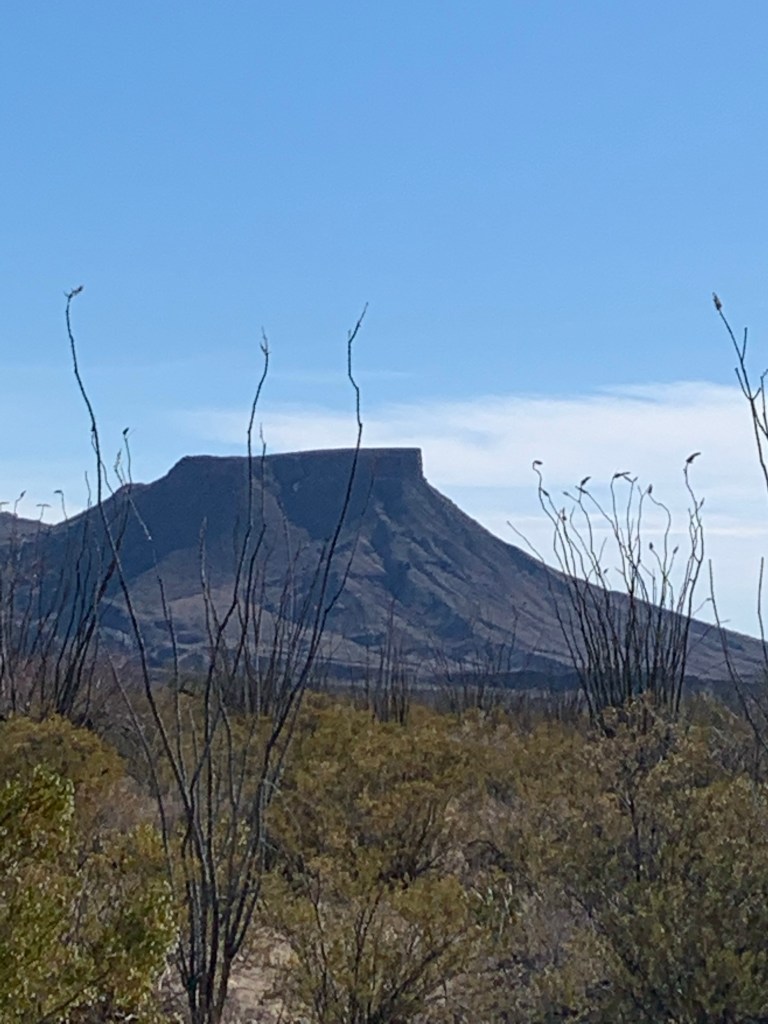
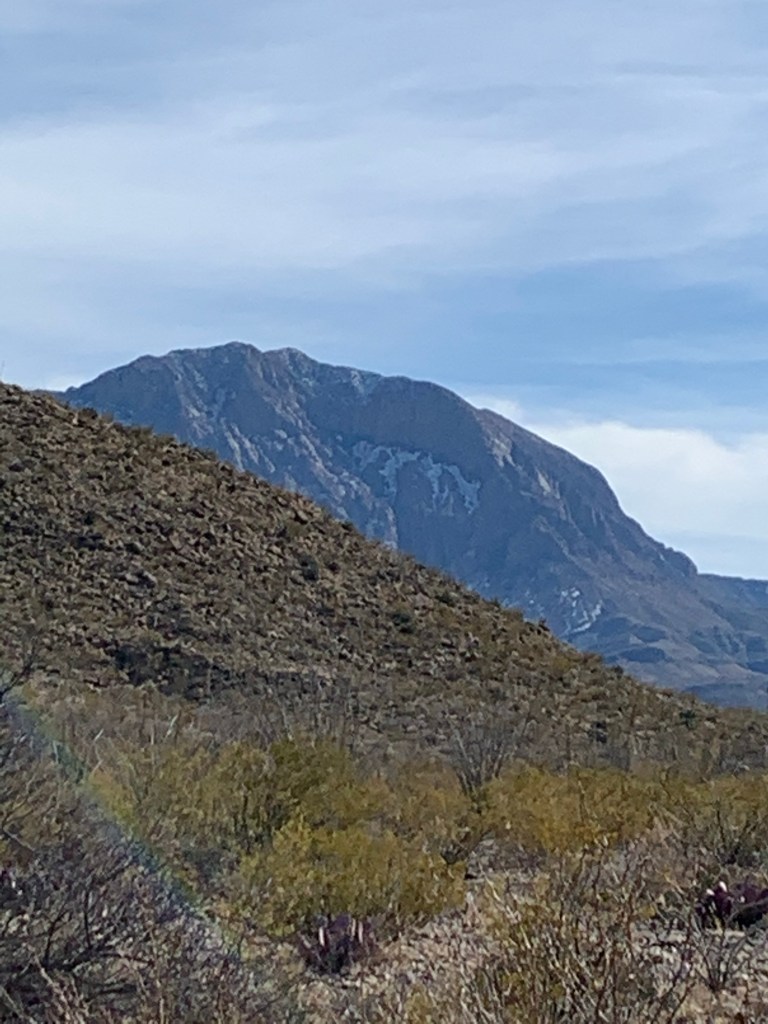
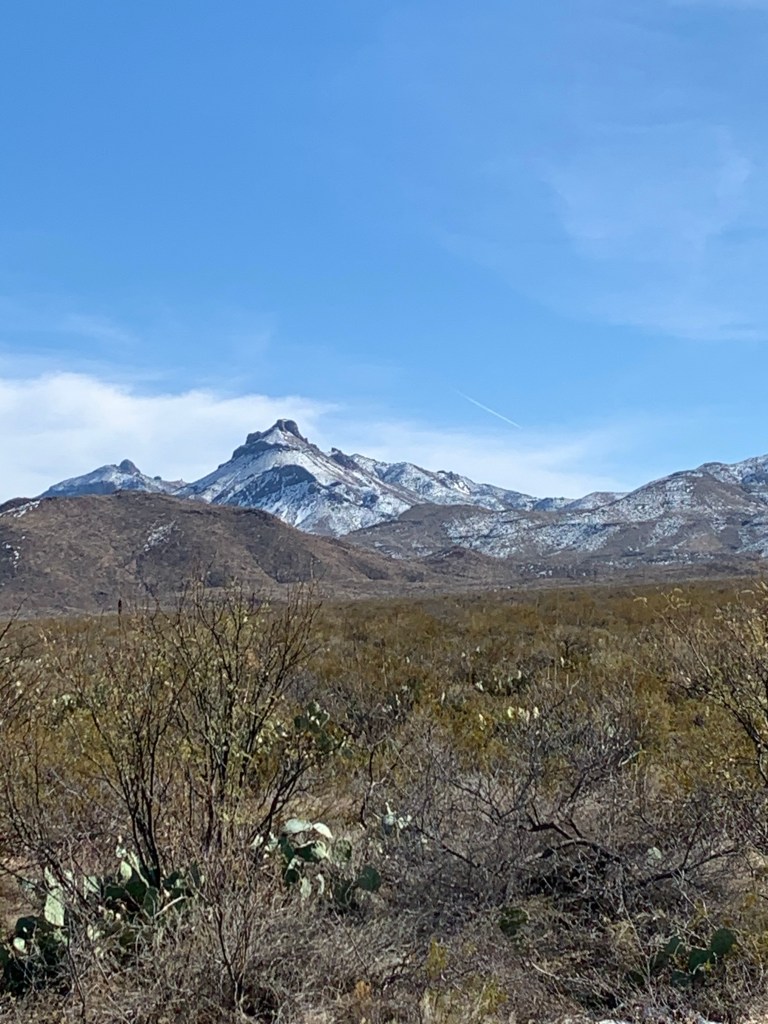
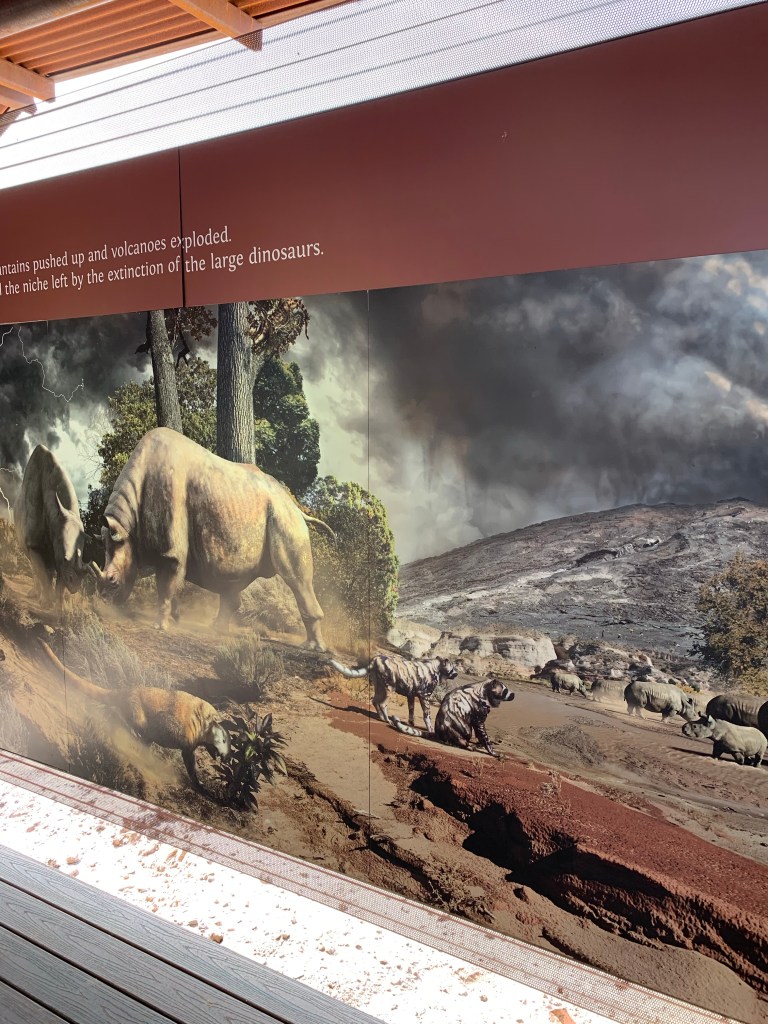
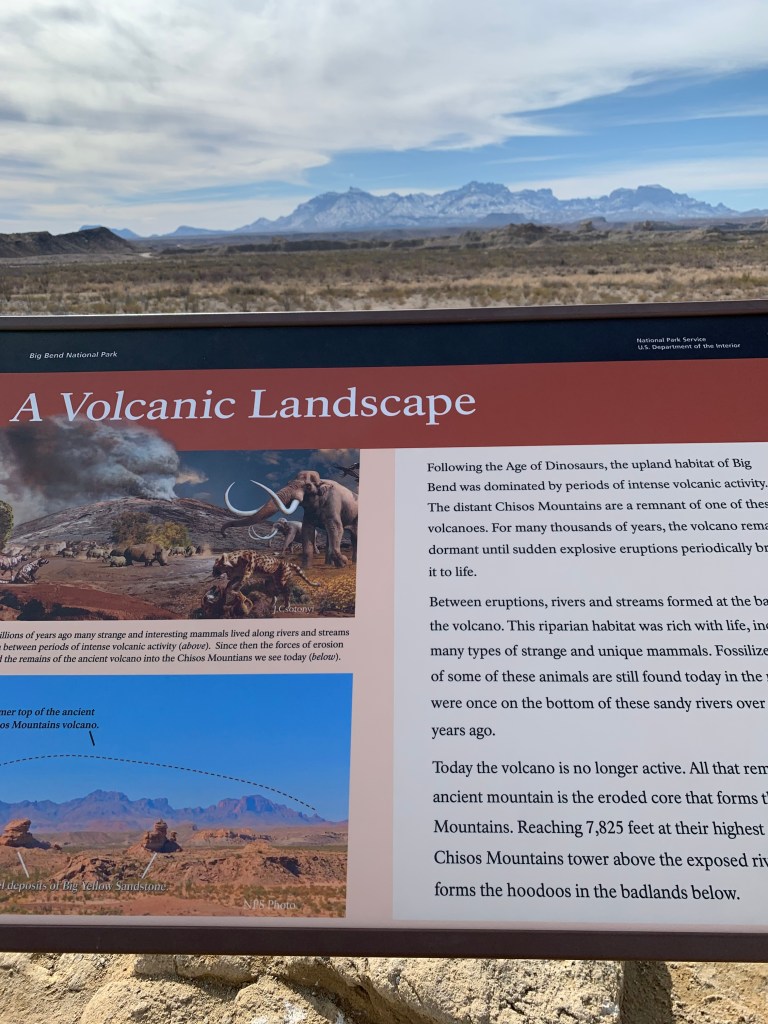
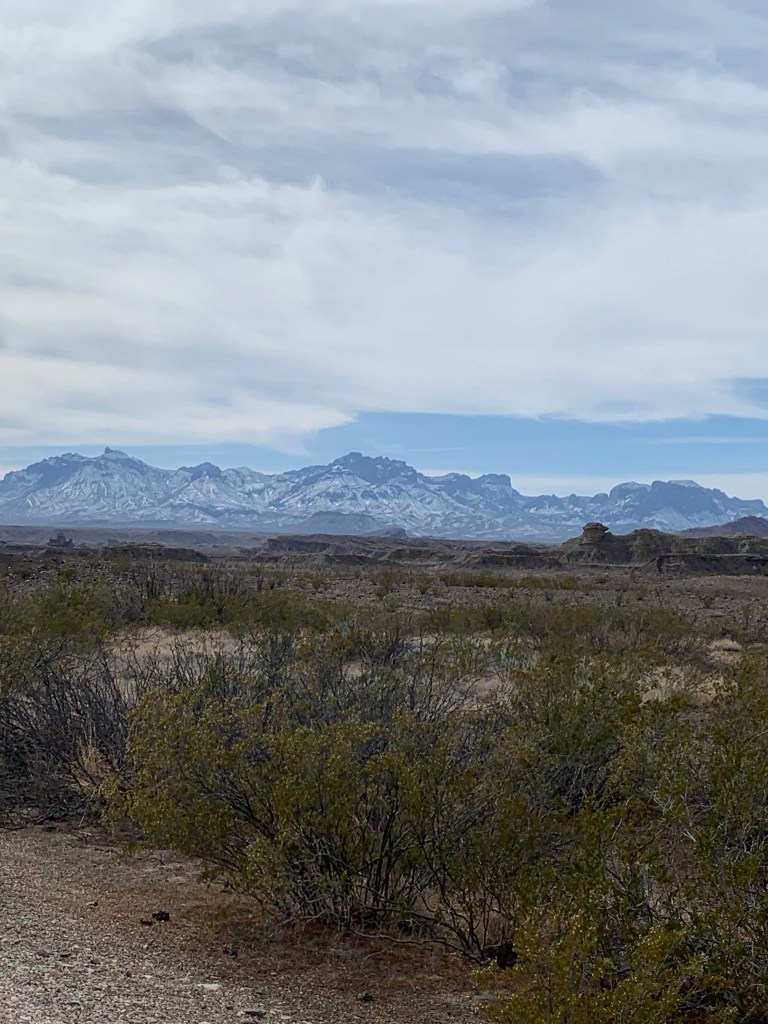
I took the roundabout route through Big Bend that took me first to Panther Junction at the northeastern edge of the Chisos Mountain range and then to Terlingua back to Alpine, Texas. The Chisos range is wholly enclosed within in the Big Bend park and is loosely a southern part of the Rocky Mountains. It represents the core of what was a much larger volcanic “mound” that has eroded into its present shape. It is a majestic range of mountains named after the Chisos people, one of the Jumanos who inhabited the “Despoblado” region. Chisos refers to this people but is also believed to be their name for “ghosts” or short for “hechizos”, the Spanish name for “enchanted”. In either case, the ghosts of the “uninhabited” land seem to remain.

A Trail of Fears

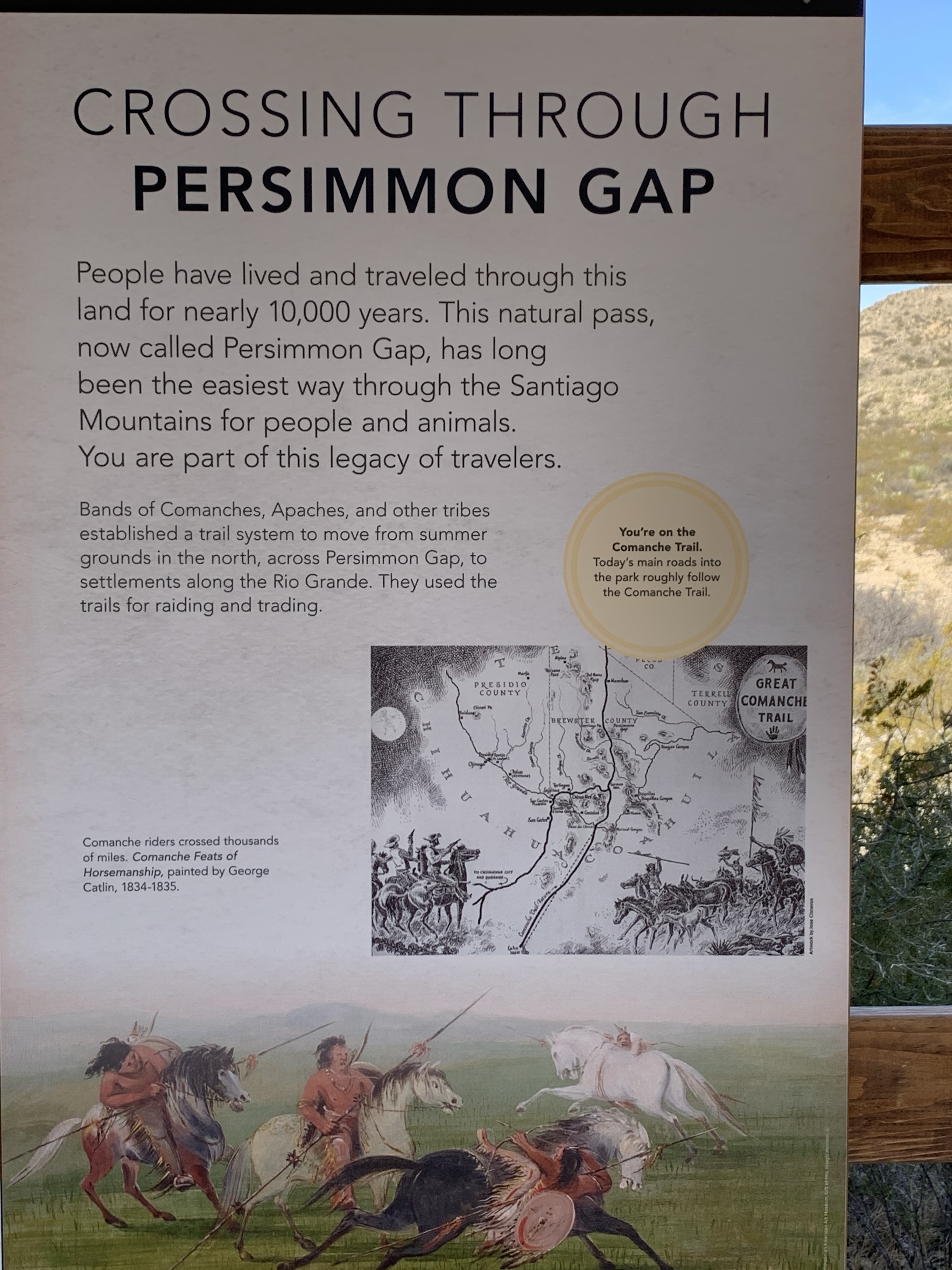
Later, the Jumano were, mostly forcefully, incorporated into other people who encroached upon them like the Apache and the Comanche. The Big Bend is best known historically as a major branch of the “Comanche Trail” who by the early 1800s had largely displaced the Apache. The Comanche rode into northern Mexico on raids for horses and people. Phyllis Duncan called it the “Trail of Fears”. The Comanche ruled the southern plains largely because of their unparalled skill in using horses to hunt and garner horses and people from other tribes, like the Jumano and from the Spanish or, later, Texans. The Persimmon Gap was their route to and from Mexico. Driving through the Persimmon Gap had a certain poignancy today.

Driving A Lonely Path Into the Wilderness

I undertook this journey to uncover a history of the past and to examine my own. Driving through this, for me, newer history took me someplace I didn’t expect to see. I am acutely aware of my precariousness as I’ve driven, first through the familiar path to Brownsville and my “fortress”of fortitude, South Padre and now into places I had never been. I know that driving through the midlands of Iowa, Missouri (well just a piece of it) , Kansas, Oklahoma, and Texas is a great danger in a time of unparalled plague, among people alternatively doing their best or at times greatly irresponsible in putting themselves and others at risk.

I drove today through history in the midst of history in the making. As I write, I note how Los Angeles County in the State of California has begun to ration the use of oxygen to only people with a chance likely to survive as coronavirus cases swell and overwhelm hospitals and their staffs. I am aware with few exceptions, every state of the Union remains at alarming levels. I travel knowing that at any moment, someone with asymptomatic infection may cross my path. In addition to seeing wondrous mountain ranges, “seeing ghosts” of peoples oft forgotten by “history”, I spend my days deciding do I dare go inside a gas station to use their bathroom, deciding whether to go inside a restaurant and eat something more healthy than a breakfast burrito from McDonald’s (I so far decide the latter, just too much risk)? And, what of the people serving me through that drive-thru window? Are they working sick? Not to mention entering a hotel (eventually I’ll try to find an AirBnB for a longer stay with its own set of risks) or a public restroom (so far, I’ve found these safer, or at least I think so in my mind 🙂 ).

I am quite aware of these and then remember that my life at “home” in Minnesota was just as frightful, despite for different reasons.

The world remains in grave danger and I really don’t believe it matters where we are. It’s best, at least for me, to recognize the “Four Agreements” (Drawn and adapted from Ruiz) reconciled for my travels through Pandemia:

Be impeccable with my word; tell myself the truth, be honest, and know what it is you are doing

Take nothing personally; people act as they will, doing the best they can to be intelligent. They are not trying to hurt you and you must expect from them only what they appear able to do. This one has been especially challenging for me, hence, why I am on these travels.

Make no assumptions; A friend you trust can make mistakes, it’s best to own your own safety and not cede it to others. Among others, do not assume they think or act like you despite their seeming agreement with you.

Do the best you can; be as safe as you know how to be within the choices you have made. It may not be enough, but it will be what you must do.

And, just like every human effort, the above is fraught with unforeseen dishonesty, personal perceptions you cannot avoid, unassuming assumptions, and only as good as you are able.

Today, in a time of history making–the State of Georgia hangs so many things in this country in the balance despite the flawed belief that a new government will be all that good. Today as history records some of our gravest mistakes in judgement compounded over years that threaten our entire planet, the ghosts of people largely ignored by history, who made baskets, sought their solitude beneath groves of palm trees, those who fought and tried their best to stave off annihilation, all of them speak to me. In the winds and sunlight gleaming on snow inside a forest made of rocks. They tell me that, despite the risk, and your possible demise (sorry about that, brother), it is good you came to say hello, honor our presence. It’s all we ever asked. We were lonely and, well, it was good you visited.

I think that I’ve been lonely all this time. Just like them. It was good I came to visit that part of me. Despite the danger, it was best I came face to face. I’m not sure what I do with that. Not yet. But I am here. And I will do my best. To come home.

(San Felipe) Del Rio To Alpine: A Pandemia Chronicle

I have been to most parts of Texas in my life, but never to the Big Bend area of the Rio Grande River. I thus left Brownsville to begin what is the least known part of my journey. It begins with a trip to Del Rio, Texas. My route took me close to some earlier memories, like Kingsville and through Cotulla. Going through Kingsville took me back to to a time in the 70’s as a young anti-war and Chicano activist. I was hitchhiking home to Brownsville for what, I don’t remember. But as I was thumbing my way through Kingsville, I was stopped and detained by Kingsville police ostensibly for hitchhiking. It was illegal to do so on a public highway, but the incident seemed a bit unusual since there were many people doing just that on most days in and out of the Valley. Somehow I reached my mom and she along with her companion, a man named Leonel, “Noni”, Garza came to get me (I was only about 20-21 at the time and with few resources or contacts; what can I say). What was unusual was that there is no record of this “detainment” (aka, arrest). It was not the last time I was “detained” on different occasions during my youthful career as a revolutionary radical activist. Among these included having police visit my apartment and speak to my roommates (I wasn’t there at the time, on the road, you guessed it, hitchhiking to activist conferences), detatined for traffic violations in Houston and a little later in Chicago and a curious set of incidents during a journalistic tour of Texas with a couple of fellow reporters for the Militant newspaper reporting on the “Raza Unida Party”, an organization that was centered in Crystal City, Texas, which of course took me through Cotulla. I am today unsure if all this activity (along with others in different parts of the country) was a result of the FBI’s Counterintelligence Program (COINTELPRO), a program with far-reaching coordination with local law enforcement agencies that targeted antiwar, Black, Brown, and other poltical activists. My experiences were rather mild compared to what was happening to Martin Luther King, Malcolm X and activists around the Black Panther and Young Lords Parties, but COINTELPRO was a pervasive counterintelligence operation in the radical movements of the time. . . Maybe. Or, maybe I just engaged in a lot of legally questionable traffic and hitchhiking activity deserving to be called on it. It just seems there should be some record of all this scofflawing.

Like I said, leaving from Brownsville through the upper reaches of South Texas took me through some memories.

To be sure, I skipped over that part of my memories and proceeded to Del Rio. What we know today as Del Rio, Texas began, well, for Europeans it began as San Felipe Del Rio a small enclave of Spanish colonists (they liked to call themselves explorers at that point in time) who settled on the (north) eastern side of the Rio Grande from their main colony, Ciudad Acuña directly opposite on the (south) western side. in truth, the region had been inhabited by native people for over 10 000 years before the “Joneses” (“Cortezes”?) came to (build a) town. You know, on top of everybody who had been living there all along. We know this to be true because today we’ve learned how the history of indigenous people was drawn on the many pictographs within the caves and rock walls all around the Rio Grande and Devil’s River. Once the Spanish and subsequently, Anglos of the Texas Republic, not to mention, Mexicans and “Americans” (yeah, still have the problem with the broad stroke designation for the U.S.) came to town, one has to wonder why the vistors/explorers/colonists were continuaully in a state of surprise and incredulity when Jumano (those were the ones before the Spanish), Apache, and Comanche would try to get them off what they believed was their land the one way native people could get their message across; kill them. As many as they could, wherever they could, however they could. I mean, what part of “get out or I’m gonna burn your face while you’re still living” did they not understand?

Especially, since all those unwanted guests kept standing up in front of them with some proclamation about how they–the native people, that is—would have to convert to Christianity, or, grow corn or something or they would either be annihilated or enslaved to mine silver. Or grow cotton, whatever. And (!) proclaiming so in Spanish, or English (whatever), ’cause what the hell, don’t you foreigners in your own land not understand the King’s English, er Spanish?

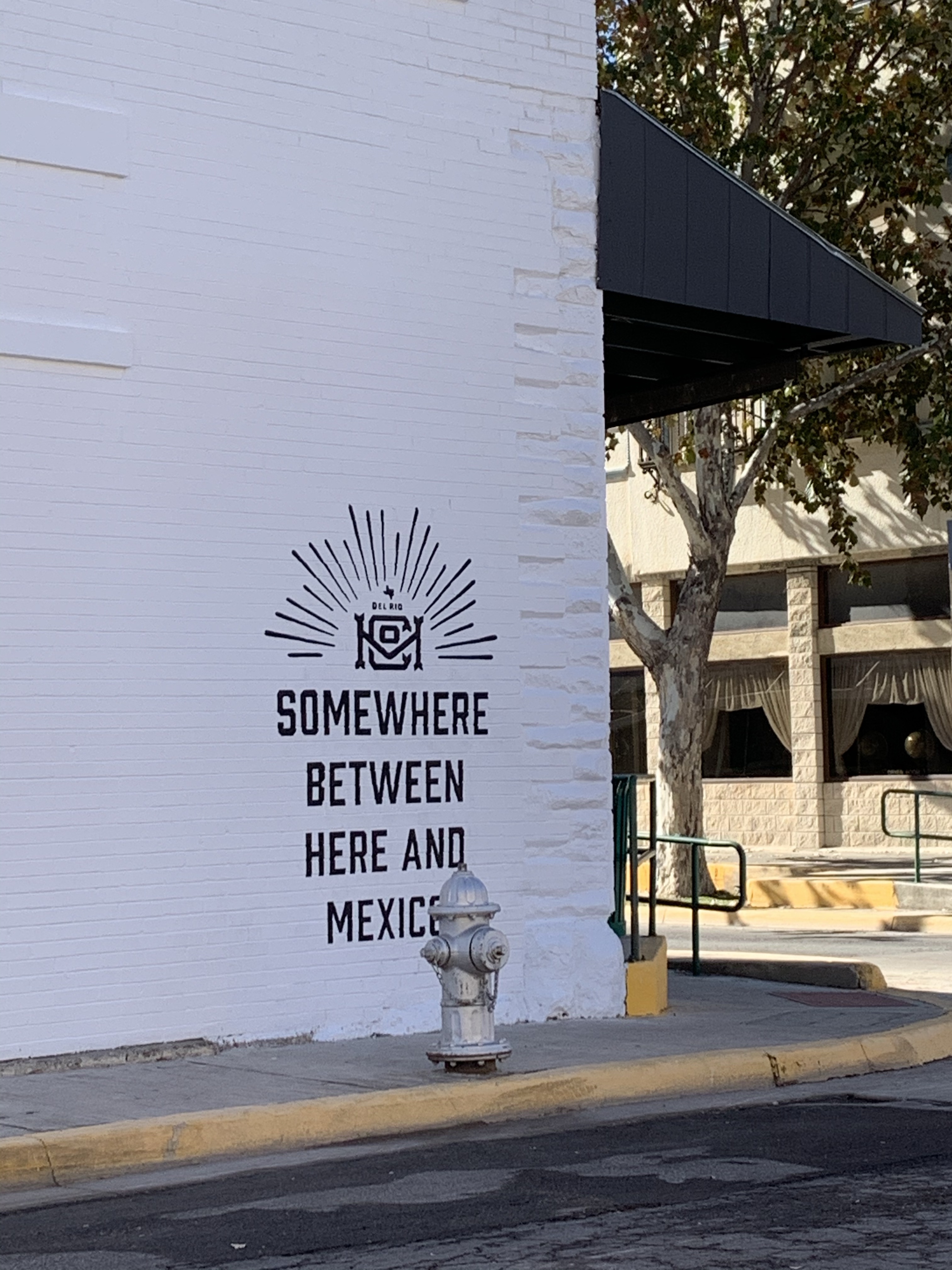
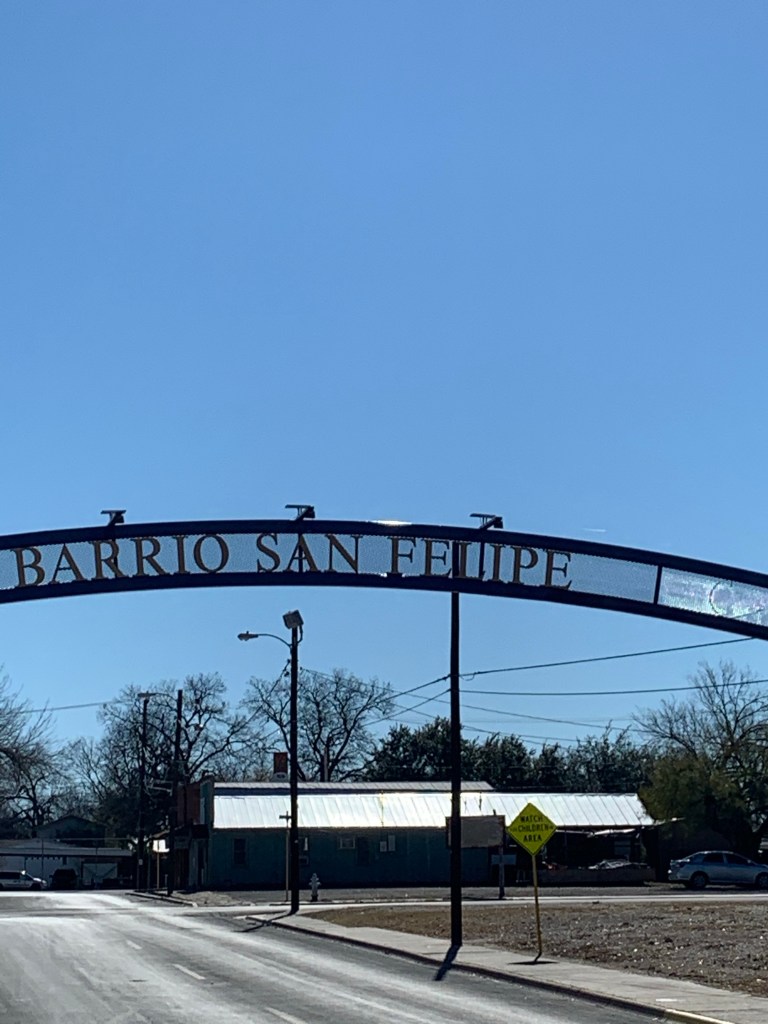
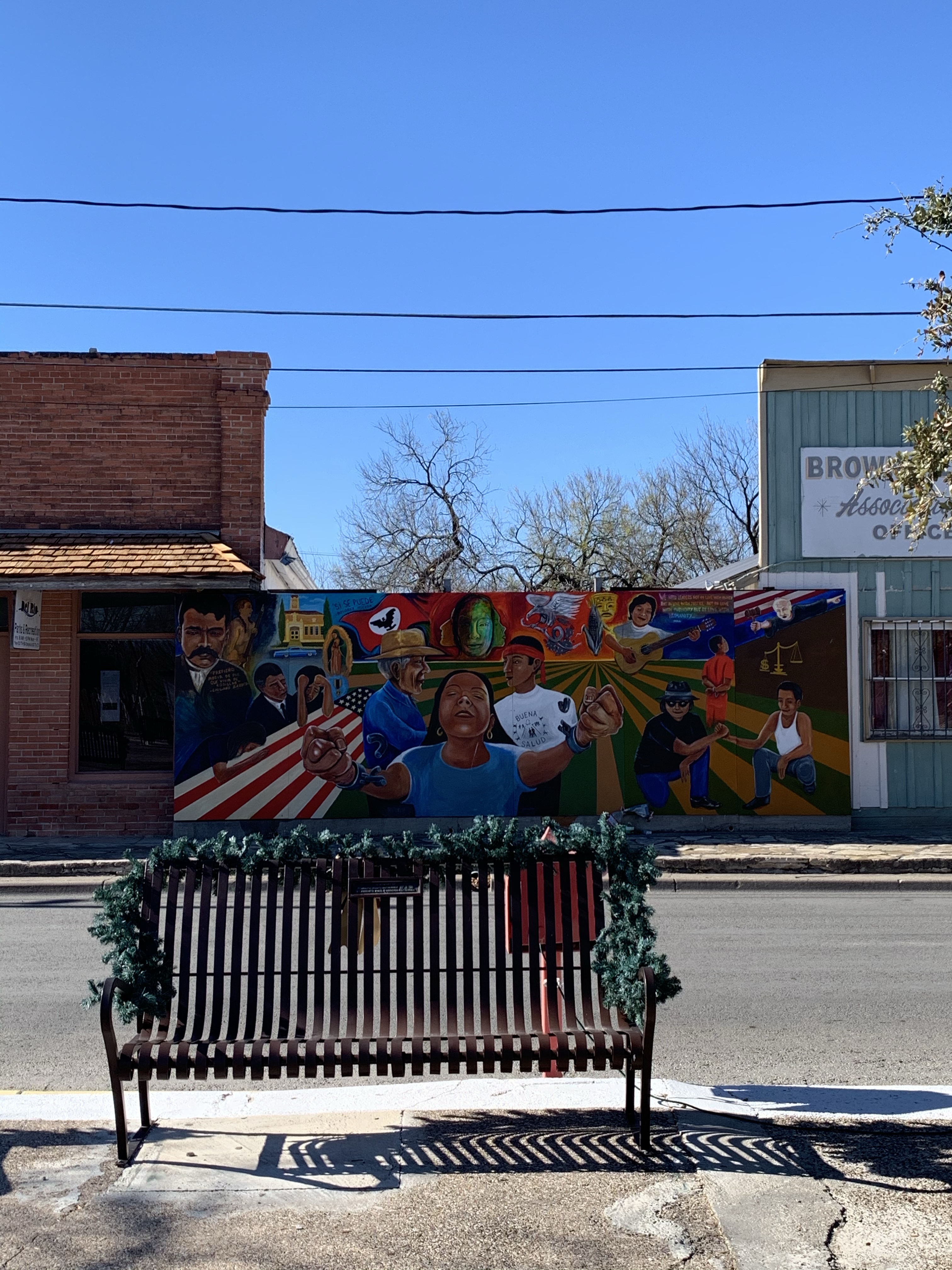
So, San Felipe Del Rio, named for that King the Spanish who wanted the Jumano/Apache/Comanche (whatever) to submit, became, finally (!), a place. Hence, “someplace between here and Mexico”. Now, hundreds of years later, the “Barrio San Felipe” is a cultural center portraying the “Latino” heritage of the “Hispanic”, Mexican-American–c’mon now, Chicano–people. I was struck by the cultural trappings of the Barrio proper situated behind an Arc and surrounded by neighborhoods telling of significant poverty “across the tracks” from the rest of the city.

This cultural framework, of course, is situated, as we “Raza” are, within a history of oppression beginning with our existence as the product of rape and assimilation into “Hispanic” culture and then successive additional racism from the advent of “Texas” and then “America”. Our focus on the European part of our “culture”, a denigration of who we are in my view, began in the disintegration and subsequent extermination of our native roots, all but obscured by our adoption of the Spanish “heritage” in our blood.

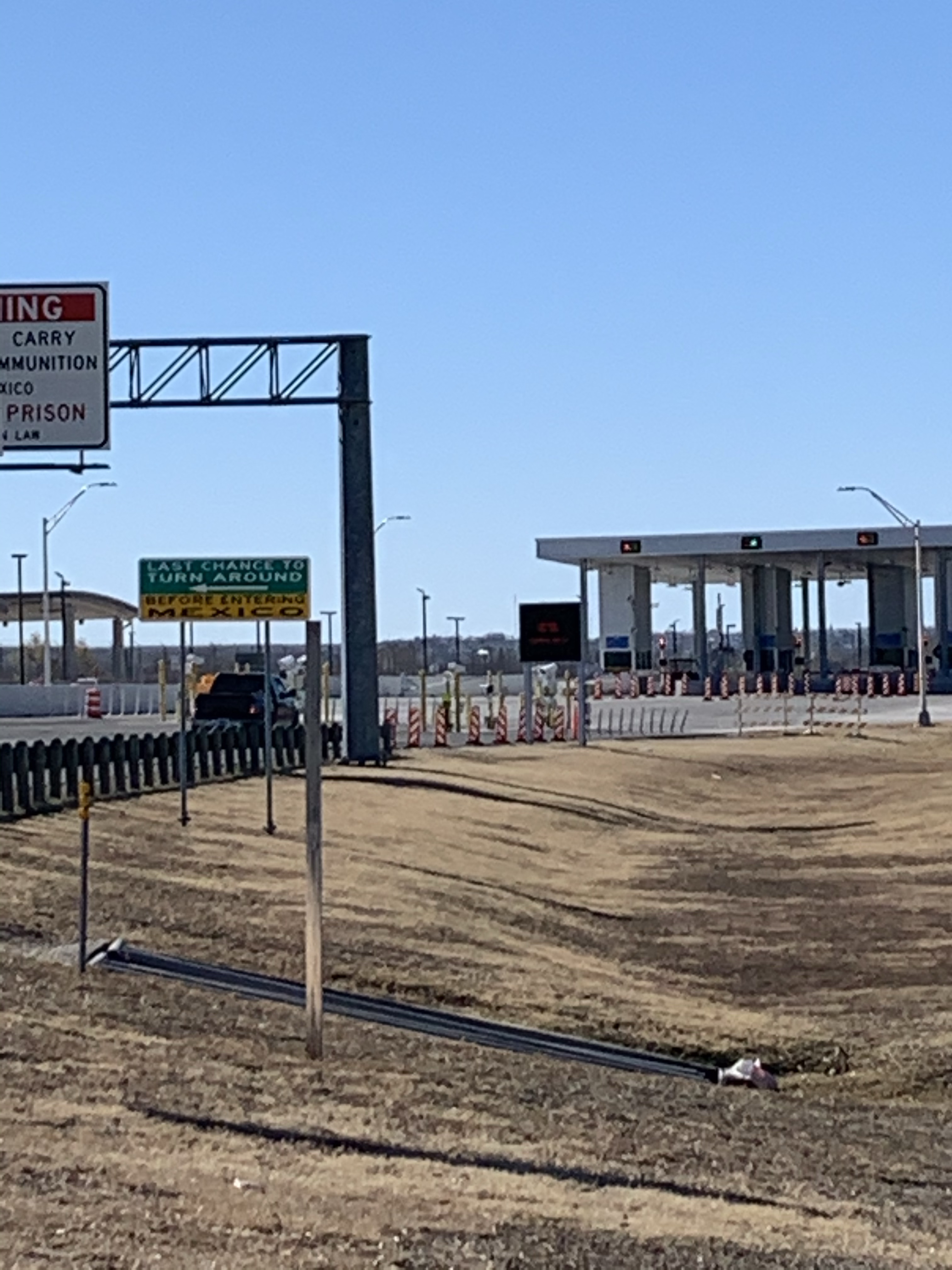
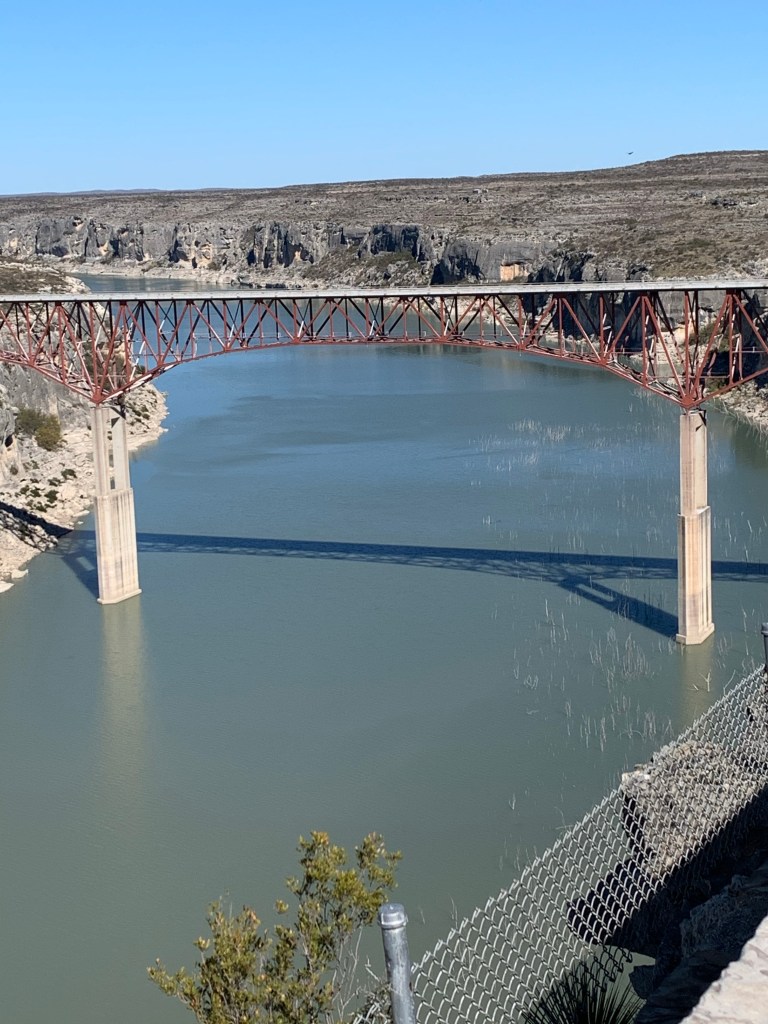
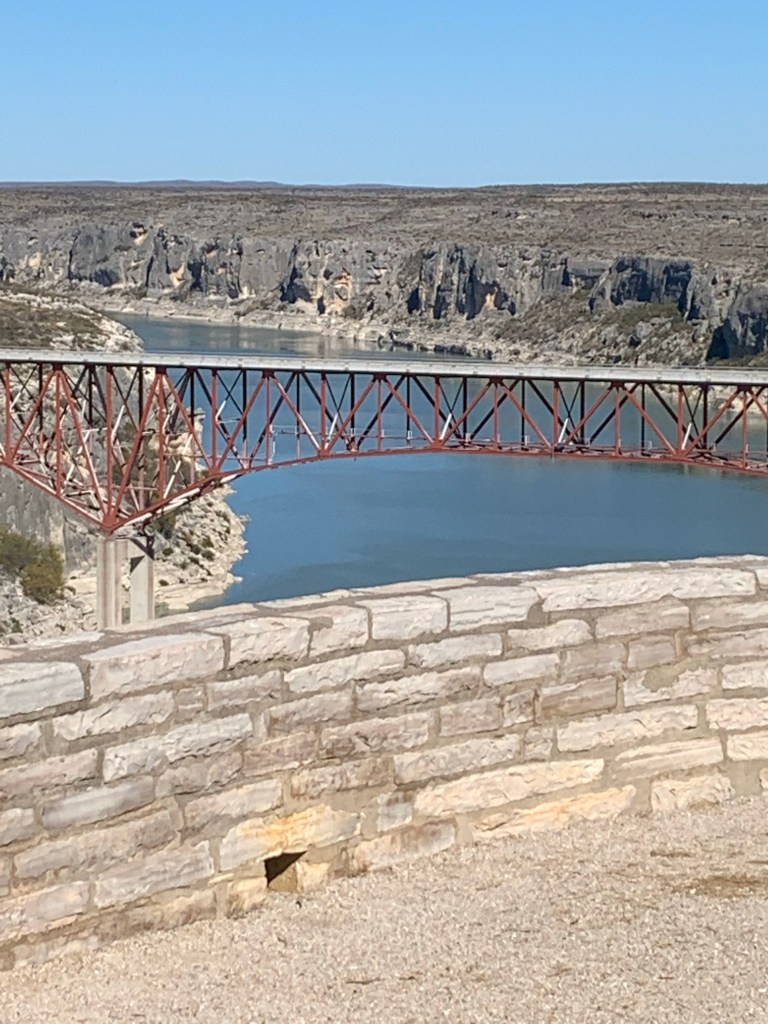
The chief symbol of this layered history is, of course, a bridge.

If we cannot end the time of bridges as the closed gates they’ve become, I will do my best to open them. If it be just a sound that’s drowned in the cacophony of the wind. Perhaps the effort will give the sun and winds a bit more strength.

Alpine At the Gate

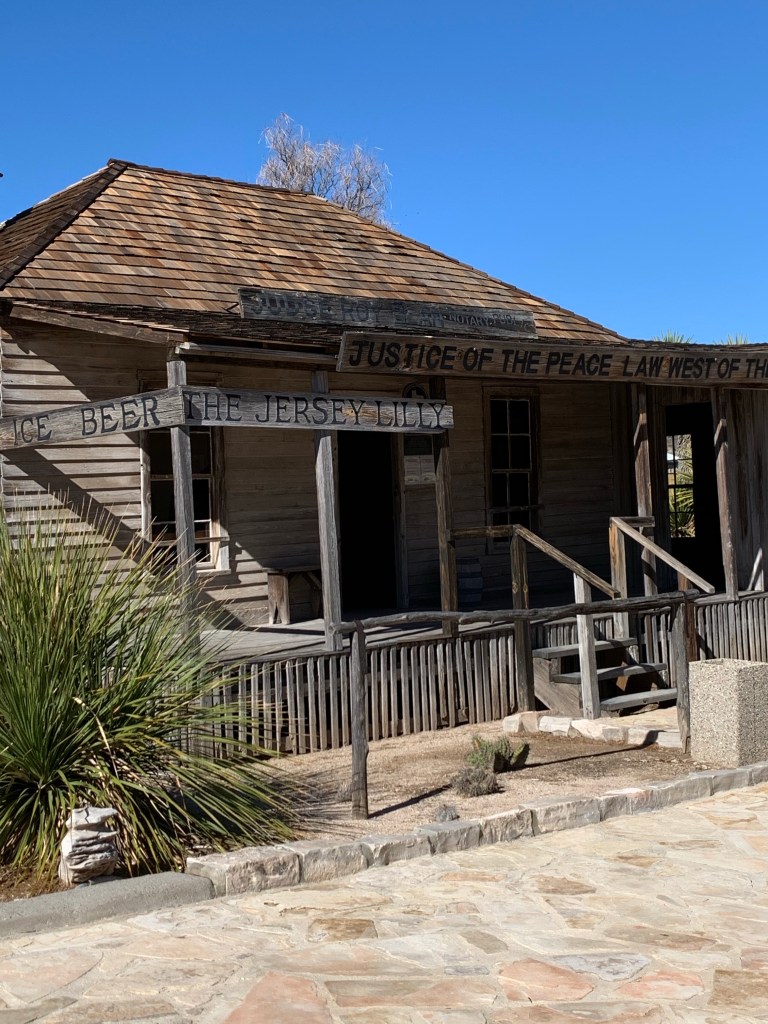
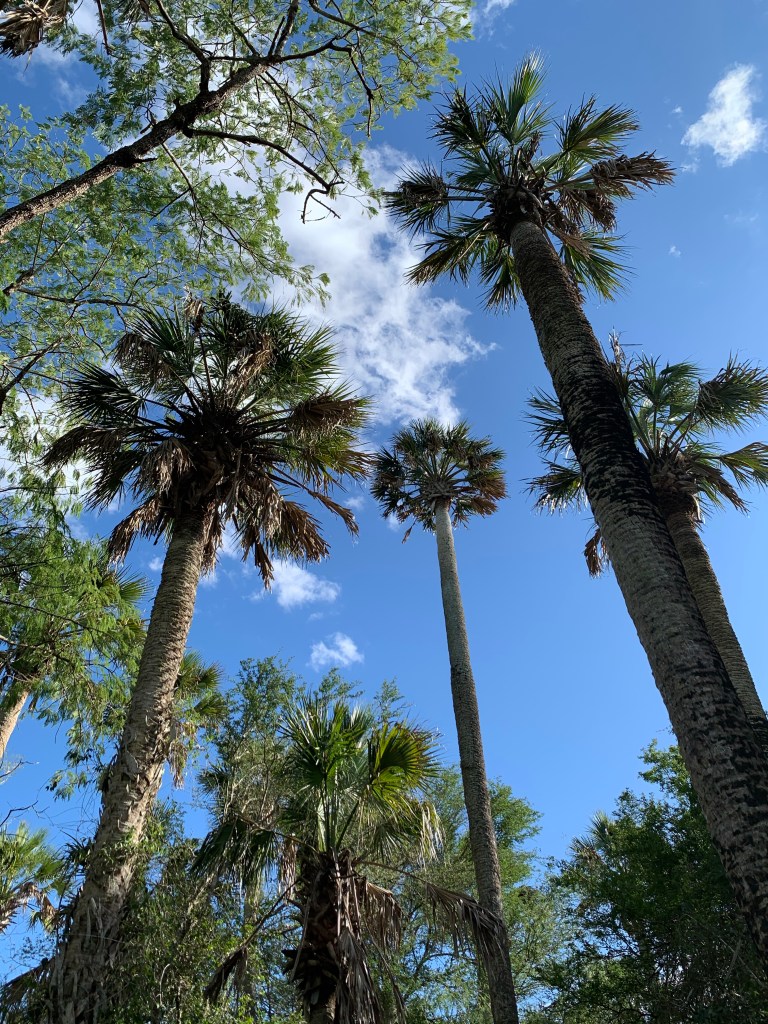
I’m now here in Alpine, at the gate of the Big Bend. I’m weary, but excited to see what else I haven’t seen. My day was full of great sites, among the unevenness of history and this land, once named for native people, but has come to be so different. I can only hope that the winds and flowing streams will see a better law “West of the Pecos” and a better, farther “past” where palm trees witness better times.

Sabal Palm Sanctuary: Greeters and Witnesses at the Border–A Pandemia Chronicle

[I somehow lost the previous entry of this post and have tried to reconstruct it here. Of course, there has been some time that’s passed in between, so, I have given it some additional thoughts. I believe the essence of the original intent remains. I hope you agree.]

Much about borders has been ado about drama of invasion. Never mind that most–well, all–humans who inhabit the lands we call “America” and the lands we call “the Americas” have witnessedassault and invasion, conquest and su the millenia we like to call history. It seems we like to violate each other’s boundaries as a matter of course. It shouldn’ surprise that settng up boundaries–a perceived right to privacy where we can conduct whatever busness we believe we should conduct; egregious, laudable, mostly self-absorbed–is tantamount to saying “we are the real people”, everyone else is our guest or, more likely, enemy. And, it shouldn’t further surprise that we have been very good setting up proper boundaries for ourselves where we are always clear about who and how others violate them, but less clear when we violate others, especially when it is we’ve felt slighted in their recognition of our own.

What a piece of work we are; a tangled web we weave designed in practice to deceive. . .ourselves.

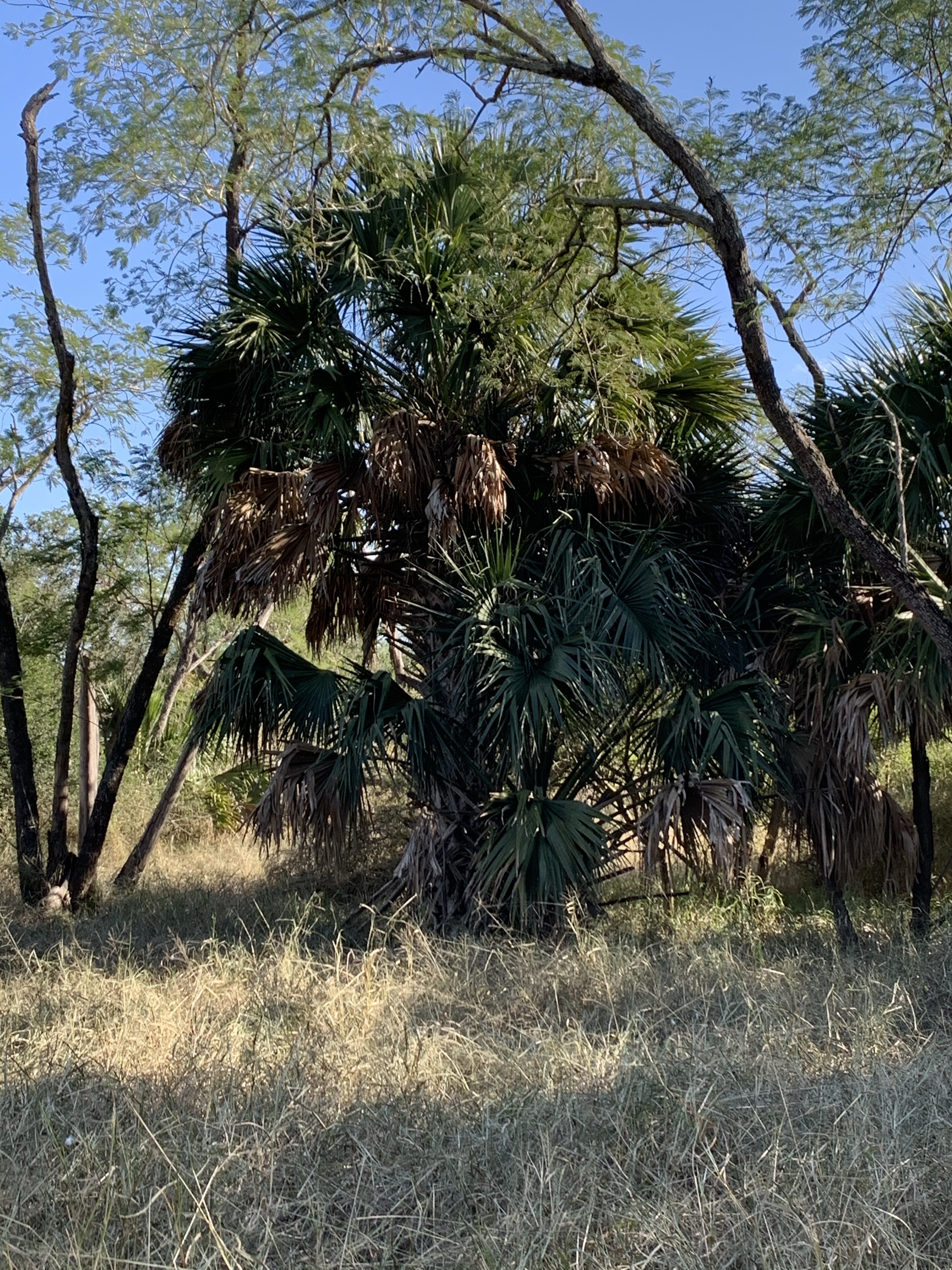
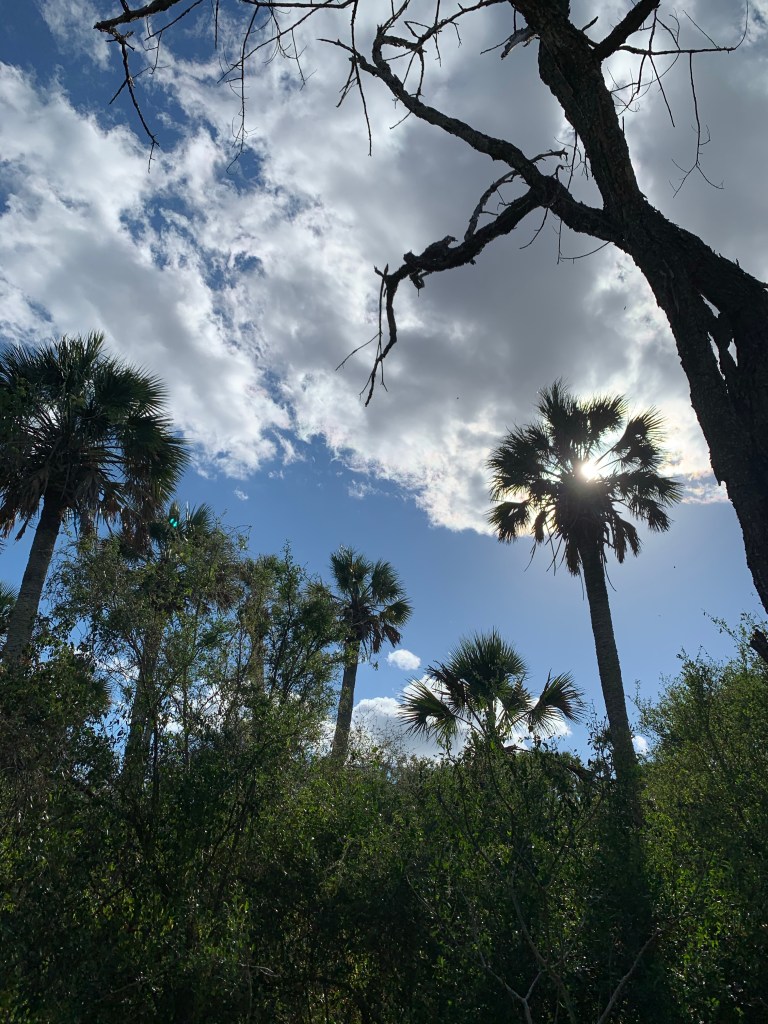
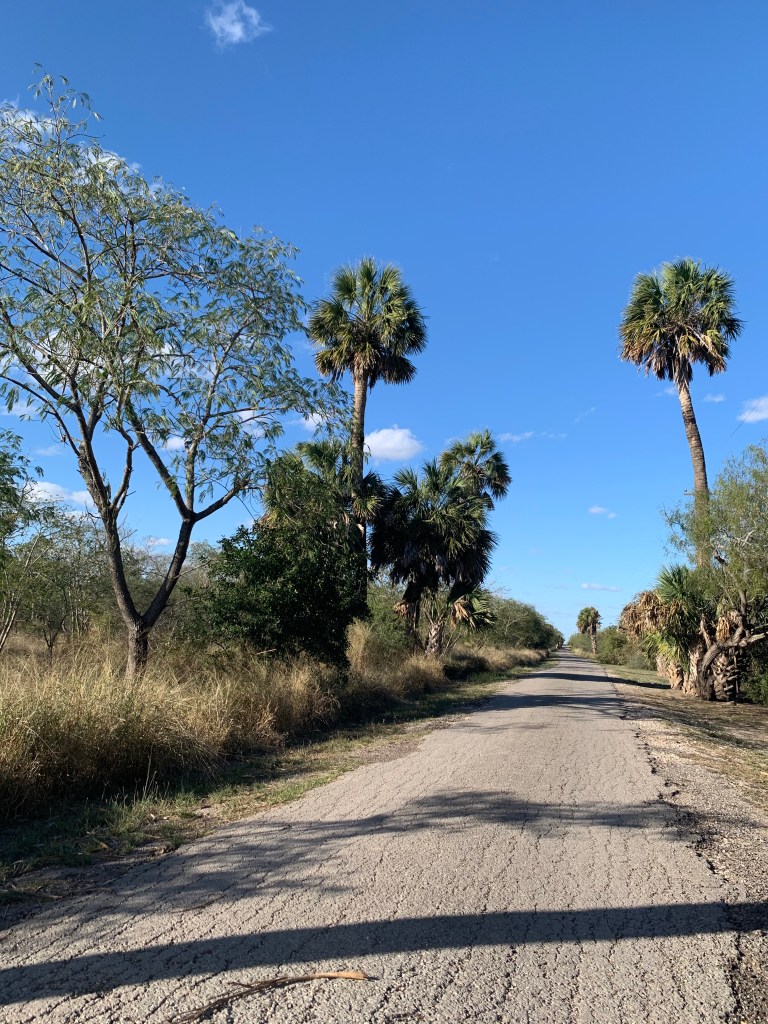
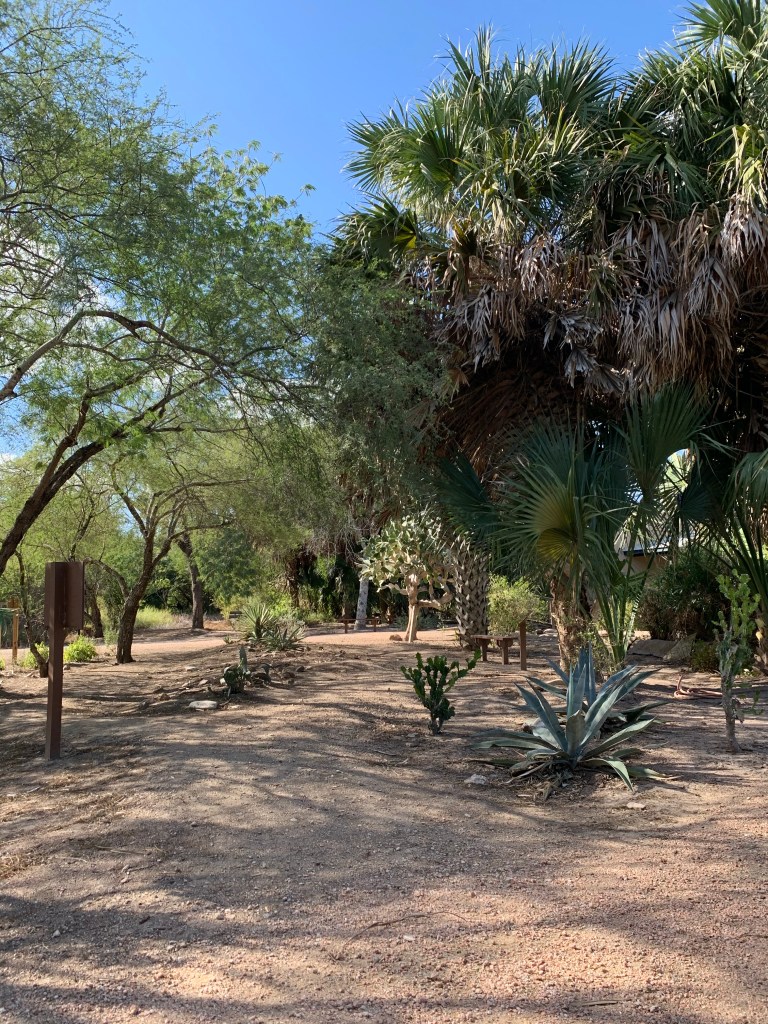
I visited the Sabal Palm Sanctuary, a place that has witnessed human capacity to create boundaries, borders where only a river teeming with life all around it existed. Sabal palms of the kind here are unique old growth palmetto mexicana, the only ones of their kind on this side of border of the Rio Grande River. For millenia, these trees witnessed a flowing river, were nourished by its waters and sheltered multitudes of fauna, migrating birds, quadripeds large and small. The first humans to come here were likey the Atanaquaypacam, one of many groups of Northern Mexico and Southern Texas eventually named Coahuiltec by the Spanish and who lived in this region. Coahuiltec is a word from that language meaning “people who live in between the trees and among them”.

The Spanish called this region “El Seno Mexicano”, Seno is a word for “breast”; fitting, especially for the lower Rio Grande as the river seems to nourish the land much like “mother’s milk”. I can imagine the Atanaguaypacam living in between and among the palm groves benefitting from the river and the land it nourished. Indeed, the Sabal Palm was a source of food for humans on the river. It’s core root, the “heart of palm”, like other palm trees, is edible and is now a delicacy enjoyed throughout the world.

The Sabal Palm groves are an idyllic place, calm as they seem to watch over the river and its history. People like the Atanaguaypacam lived mostly to survive and like their counterparts across the region, were often encroached upon by various “empires”, the Huastecans, Mayans, Aztecs from the south and, in later times, the Apache and Tonkawa (pressured by the Comanche) from the north. Of course, the greatest source of destruction in this region was the coming, first of the Spanish and then all the other iterations of Europeans. All empires seeking to “do better” with the land that these early “Paleo-Indians” (as they are now called) inhabited for many centuries if not thousands of years.

And, the Sabal Palms have born witness to this slow turning of a river of life into a line in river sand demarcating which group of later immigrants have laid claim to which side of its banks.

I grew up here at a time when the border was much more . . . .flexible in its conception. Like the stream of water flowing into the sea nourishing the land through which it passed, a stream of humans would pass across into each other’s “lands” conducting the business of commerce, loving. . .living.

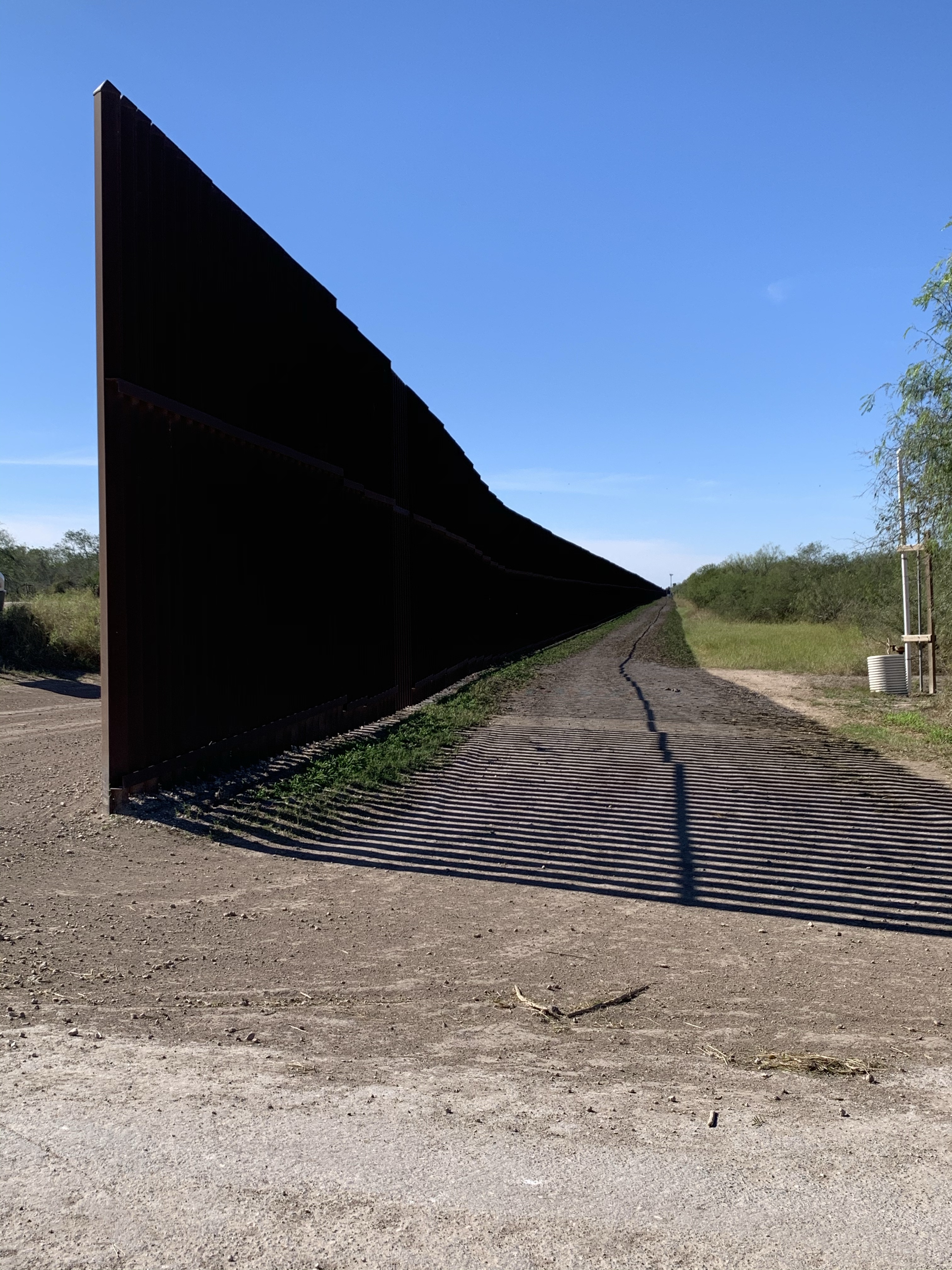
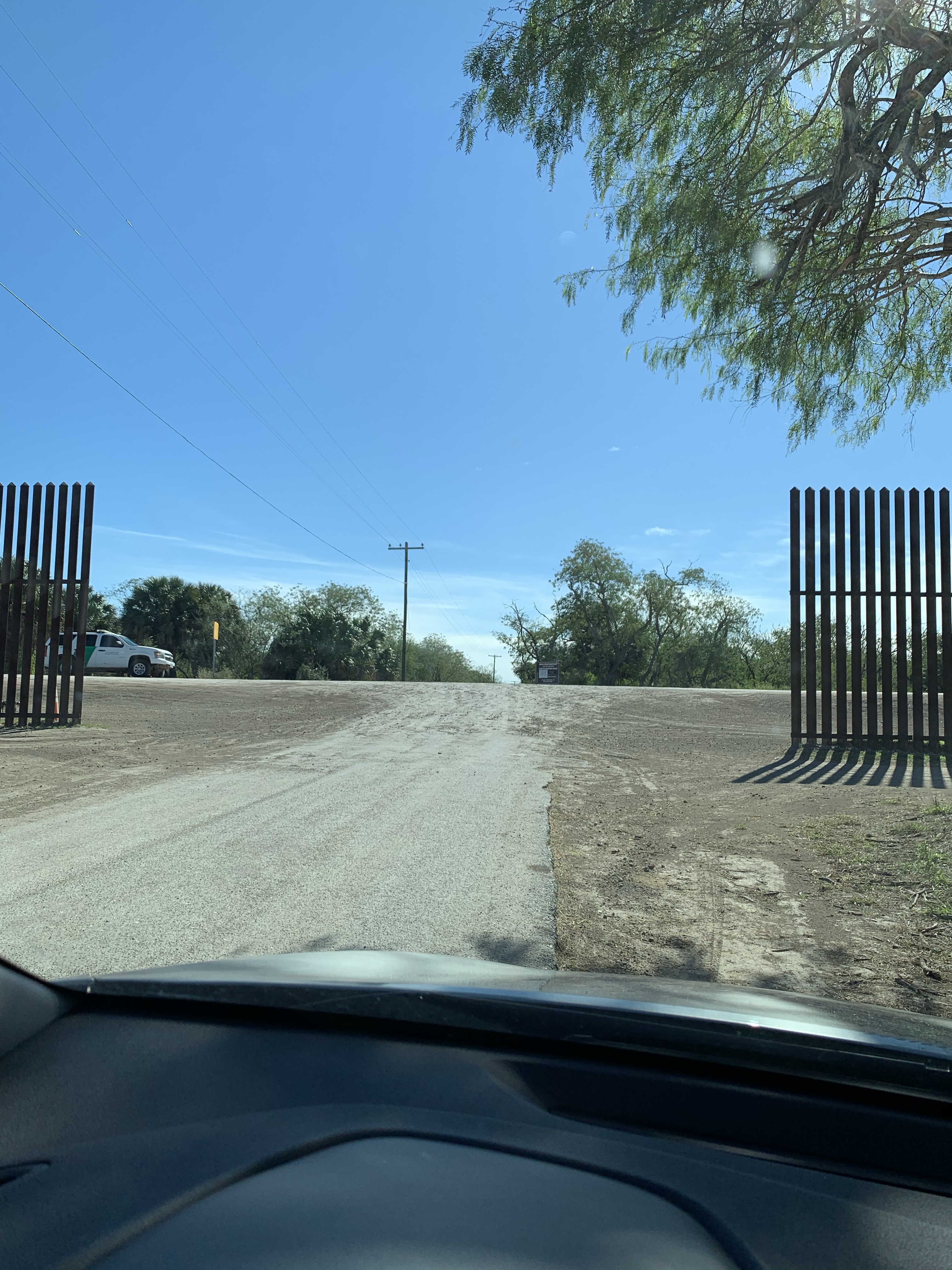
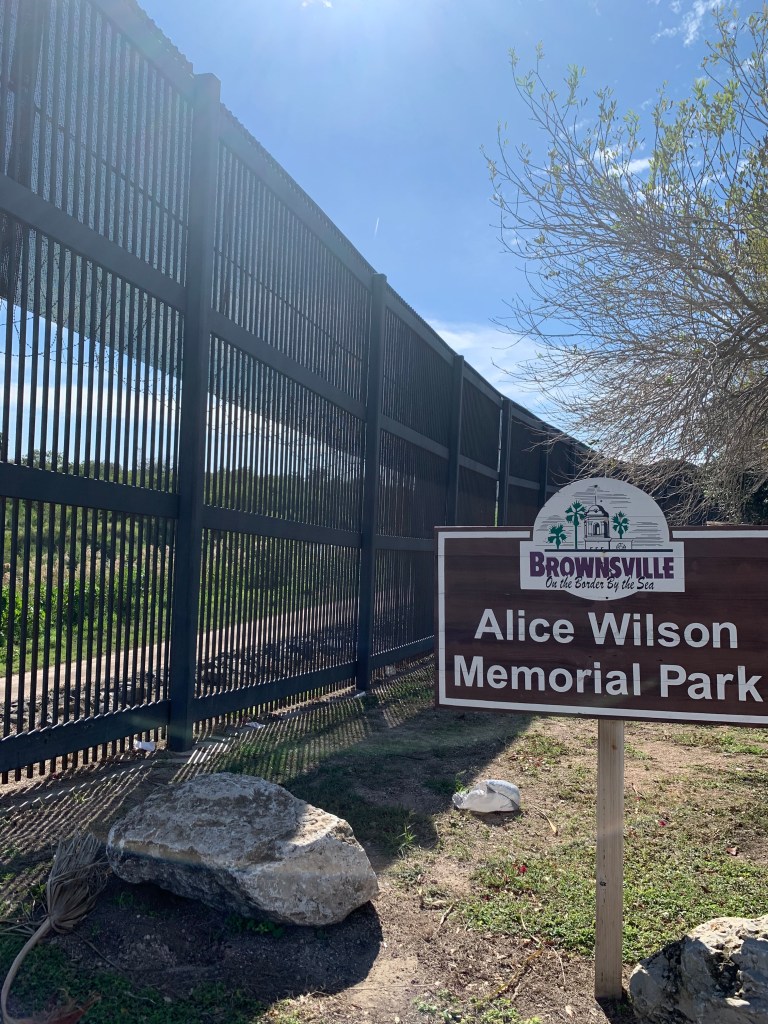
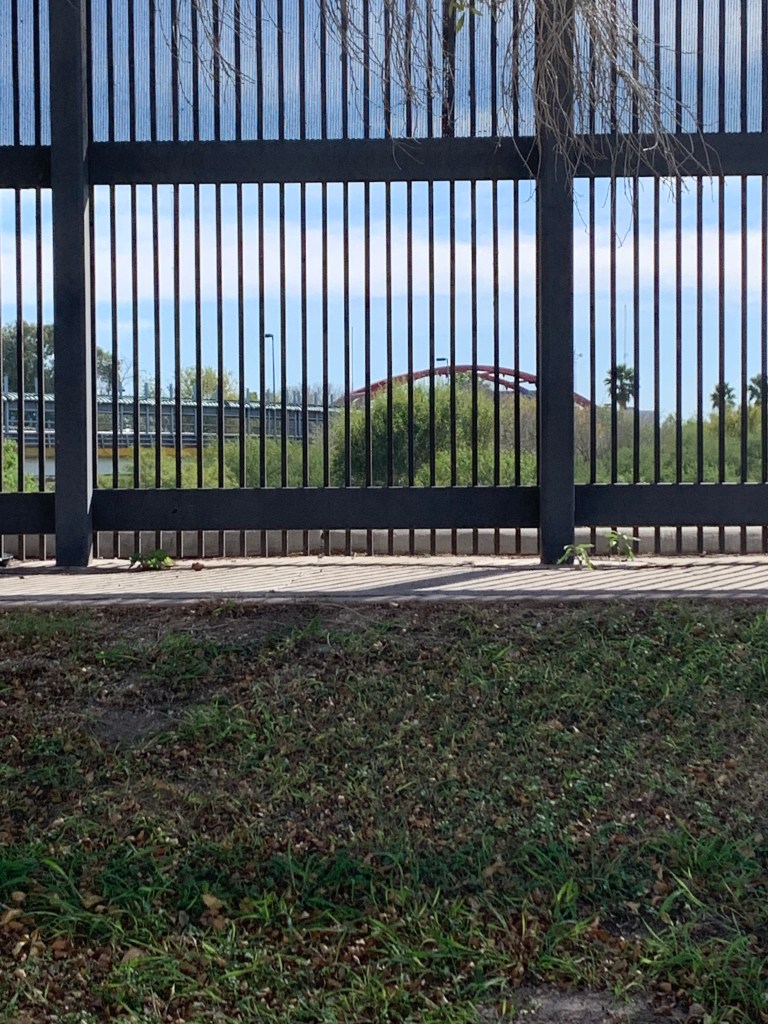
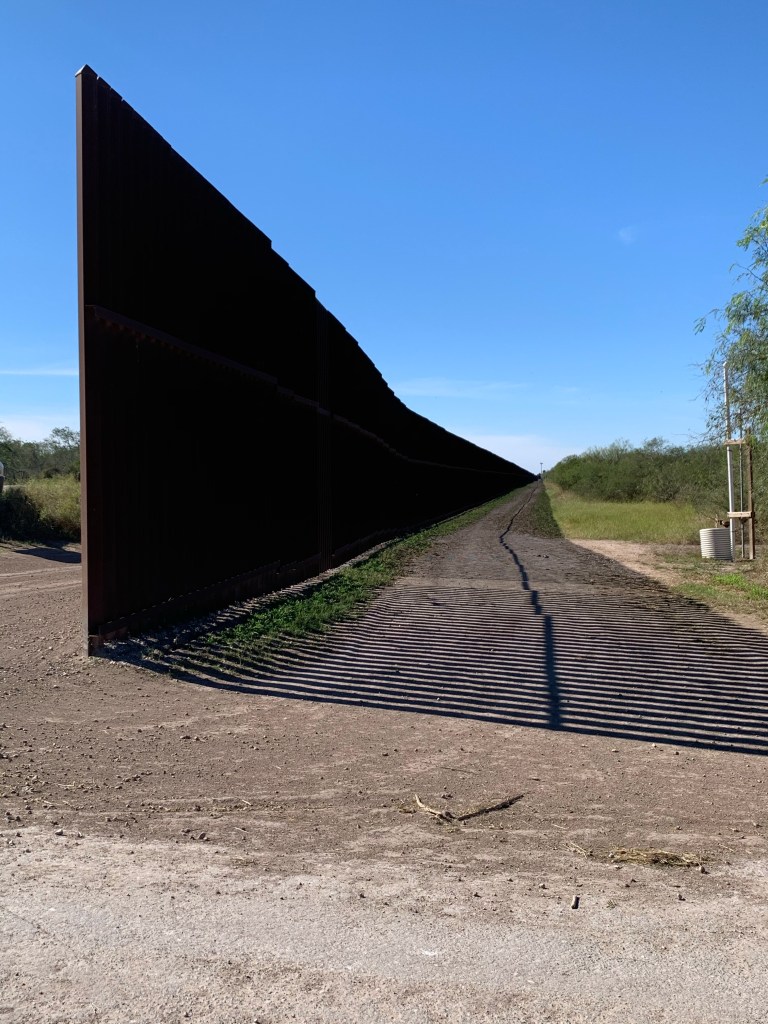
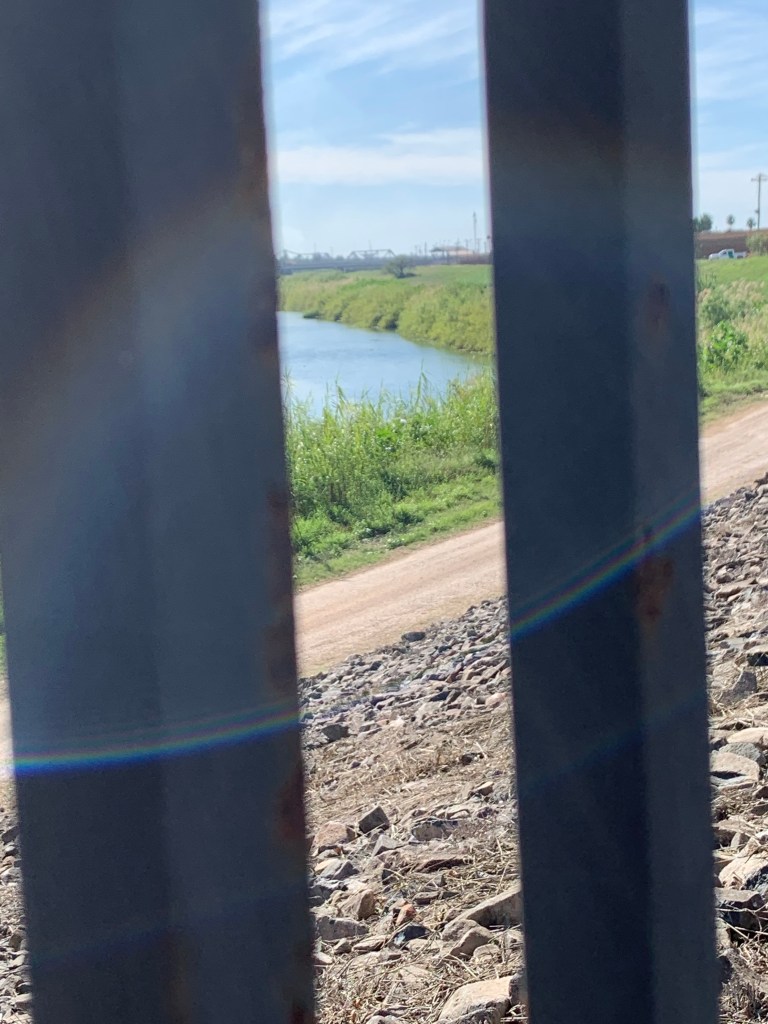
The harshness that the palms have come to witness is palpable with rising of metal “vegetation” sprouting out in front of them like spikes impaling land and sky. And, now the river can only be enjoyed through those prison bars. The palms incarcerated in their role as greeters, witnesses to the mark of hatred holding the world out and keeping people who seem to find solace in their boundaries in.

There remains a light of hope: There are bridges. Those bridges can become gateways. I think the gateways are best seen as windows to bring in light to an ever darkening world beset by the fallacy that we are not one people when in fact we are. The palmetto mexicana may yet witness a better day. Where the light may return to the dark and the sound of welcome joins with it.

Coda DS al Principium

Returning to Boca Chica was much like returning to a portal. In important ways, it represents a return to a beginning, like a coda in music repeating an important part of a song. Except in this case being a return to a journey taken only in my dreams and now in waking. I needed to return. I needed to honor loosing the fear, embracing entry into a space that isn’t solid ground. Riding the surf to a more distant part of the shore needing me to swim into the currents. In doing so, I might have the chance to find a place to build a vessel that I can use to sail and then navigate to the places and times I will meet upon this new and open sea. . . . Yes, words and analogies by necessity are mixed here. There is no true template for this kind of journey. Not if it is to be more than just another trip into the familiar without the benefit of different sight and different thinking; that can turn sight into insight. . .

It’s a tall order and as I’ve mentioned before, perhaps I’m not up to the task. But it doesn’t matter if I ultimately am not. I will only fail if I just return to the present without having taken the journey.

Namaste To the World

I have to honor the chance I have that others simply do not have the chance to take. It’s best for a wild heart to take on the wilderness with reckless abandon, but to do so honoring the souls in others, a namaste to the world and to those in it that, in each their own way, have wished me Godspeed with their gift in letting me to know them.

I returned to my birth canal portal today to start a new tradition, to use the tools I’ve gained in the past years, yoga and the playing of my didgeridoo, to honor and appreciate the change in me that this portal now represents; the willing dive into uncertainty for the sake of greater access to the Truth.

I was wondering why I brought my didgeridoo with me when I left. I guess I found out.

At the portal where I cross into a new beginning, I salute the sun and play the sound that speaks from my soul. . . .

Yes, it’s a bit of a strange and new practice. And those who’ve said notwithstanding, I don’t think myself a shaman or any great spiritual being. It just seems fitting that I should have come back today to Boca Chica beach leaving it not behind but drawing energy, honoring the beginning to a new journey.

Continue reading “Coda DS al Principium”

Birth Canal: Boca Chica–Chronicles From Pandemia

I’m scared of little; what I’d say if I ever met Mitch McConnell and he asked me about his record on fiscal responsibility, what I’ll do if the silly Texan at the table next to me “educating” his Chicano guests keeps on about Joe Biden hiring only Black people for his cabinet and staff along with veiled antisemitic inuendo about the “Israeli lobby” dictating policy (yeah, I need to leave this restaurant pretty soon, ’cause now an argument about who to support, I Ran or I Rack), and murder hornets–I mean 2020, did you really have to throw in murder hornets onto this giant pile of . . . apocalyptic . . .dookie?

[Note: The time at the restaurant described above was in an open patio by a resaca and a pleasant light breeze blowing with very few people and me at a corner sufficiently away from the “silly Texan” and his guests. As you can tell, I ate and left.]

I was scared today.

Boca Chica, An Idyllic Memory

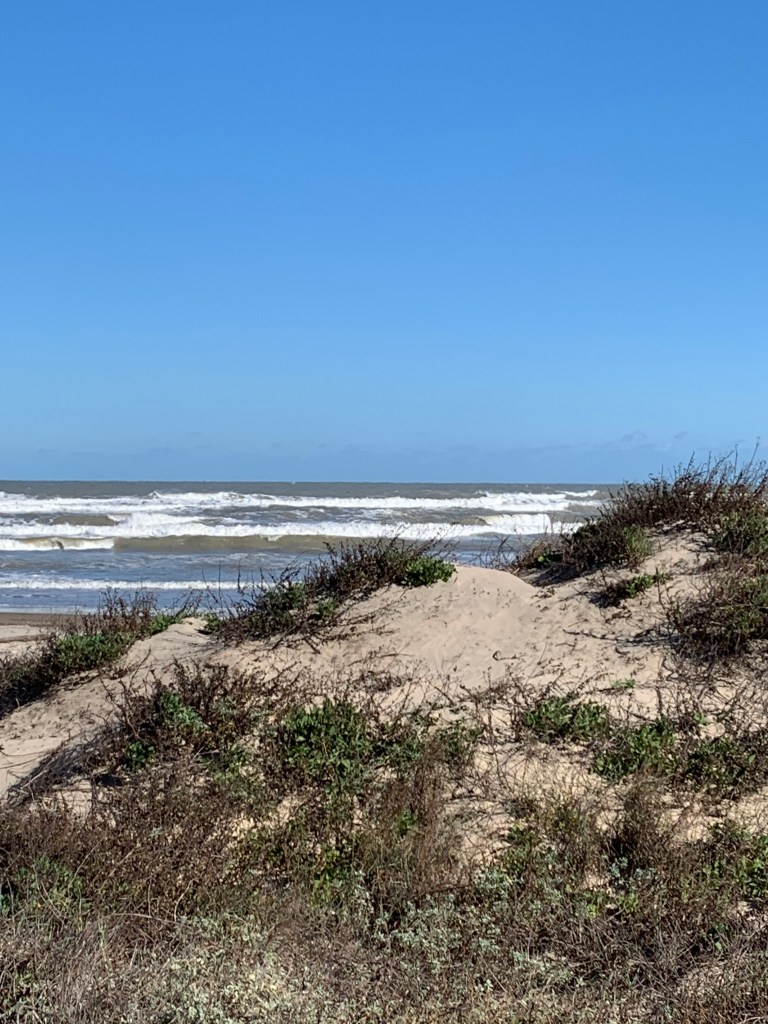
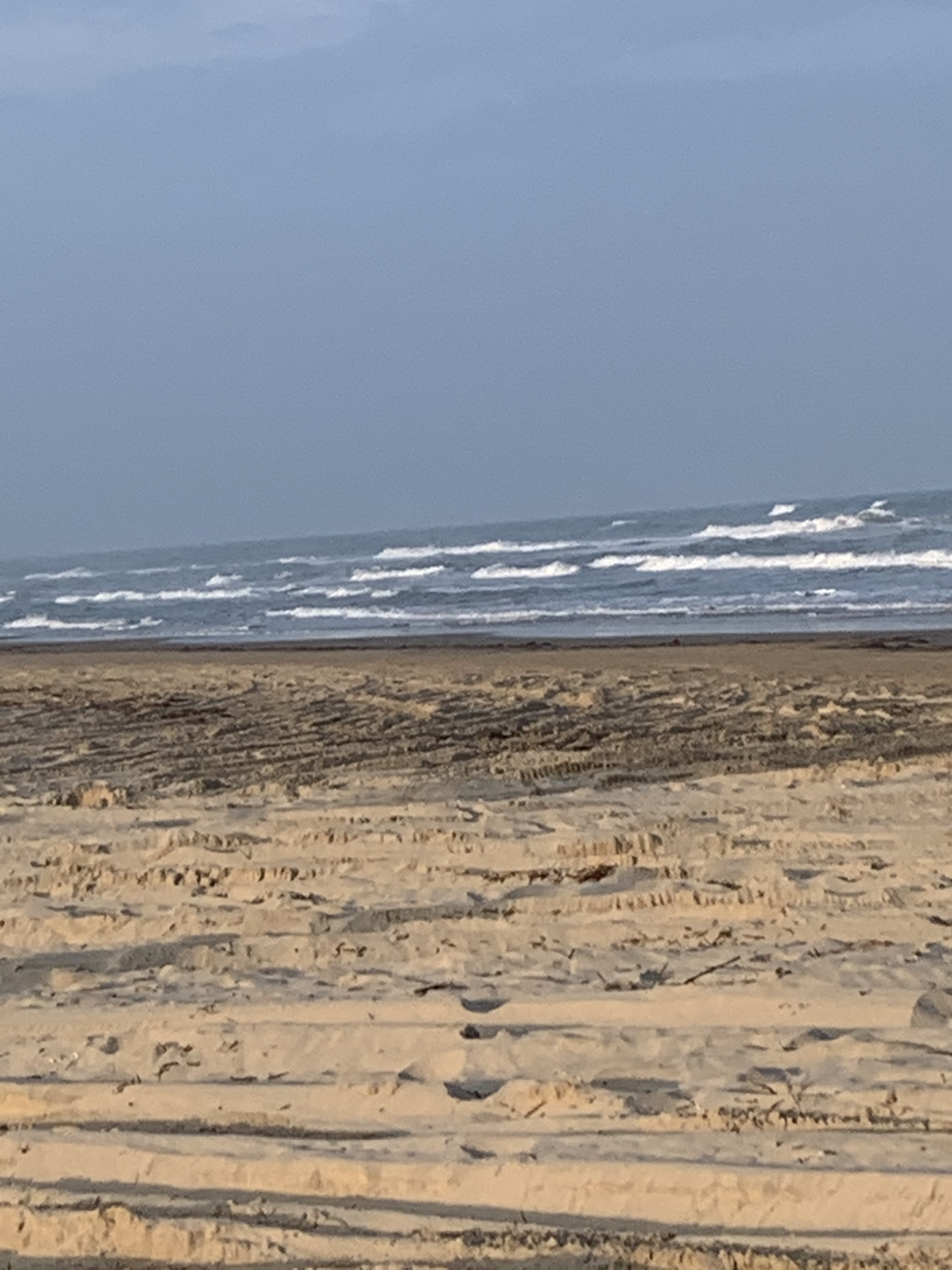
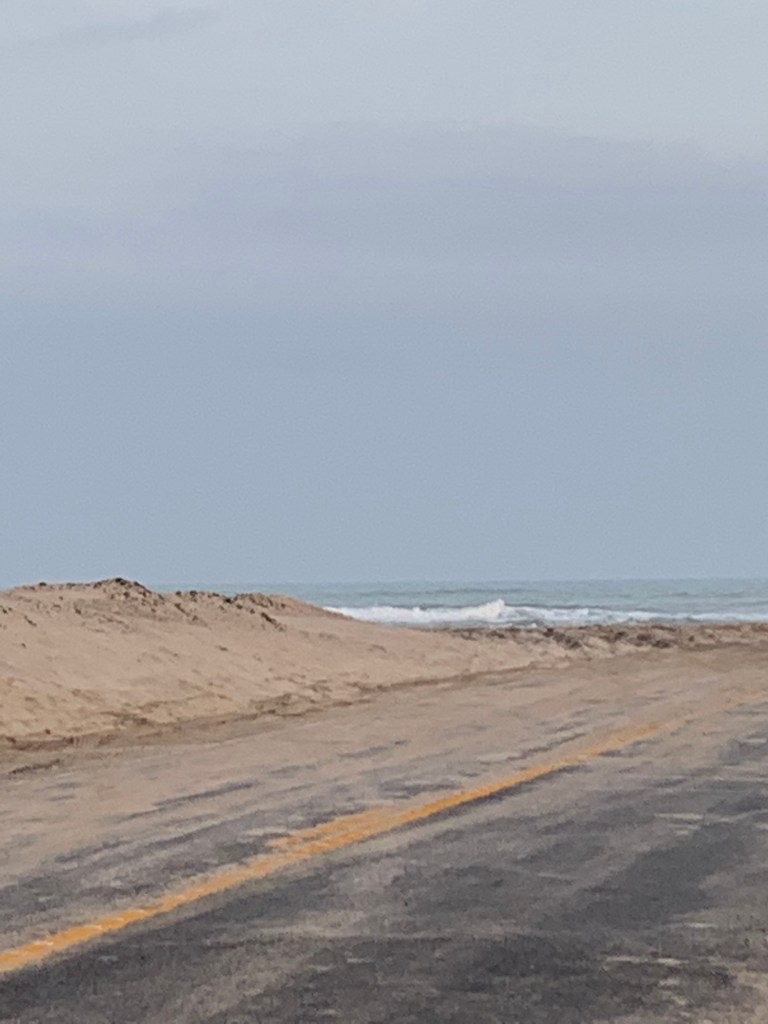
Boca Chica is Spanish for “Small Mouth”, it is the U.S. portion of the beach alongside the mouth of the Rio Grande River spilling into the Gulf of Mexico and marks the border between Texas and Mexico. The beach entrance is about two and a half miles from the river where one side is the U.S and the other side, Mexico.

Boca Chica beach was for much of my childhood a favored day trip for my family because it was easily accessible by road, we could take picnic food and assorted blankets and poles to spread as a tent with our car as the anchor. Great times close to the Gulf and the river, sunburns, sand in all the wrong places, but hours in the water and a chance for an idyllic happy memory that likely obscures many things; like Dad trying to make nice with Mom, cousins with unhappy homelives getting a brief respite from the wars at home, the thousand little problems that the suspension of regular life at the beach can be a welcome distraction, if only for a lovely Sunday afternoon into evening.

You know, good ol’ times of the good ol’ days. . . .

And I am serious, they were the good times among the underlying struggle to be a family. It is only with the hindsight of reflection (likely a bit blurred by time) that much of what I feel I now know has become more clear. What I do remember well, are multiple Wonderbread bags of “baloney” and chicken salad sandwiches, a few large tupperware tubs of potato salad, splashing in the surf and contests for who could swim out to the farthest sand bars and stand upright (yeah, such things as undertow and sandsharks or “vejigas”–“balloon” jellyfish or Portuguese Man-o-Wars–weren’t really a thing to worry about).

Boca Chica was much different than going to South Padre Island. One, SPI required going onto a raised bridge in between letting shrimp boats and such pass by (no longer necessary because of a great Causeway crossing the Laguna Madre in between). There were also the many cabañas and rental cabins where we could stay on the Island. Everybody liked going to the Island, but it was more expensive and, so, a treat. Boca Chica was our cheaper date. SPI involved barbecueing burgers and hot dogs, overnght stays. Boca Chica was a way for us kids to work ourselves out for a day and sleep on the way home. Some people camped out. I don’t remember us doing it.

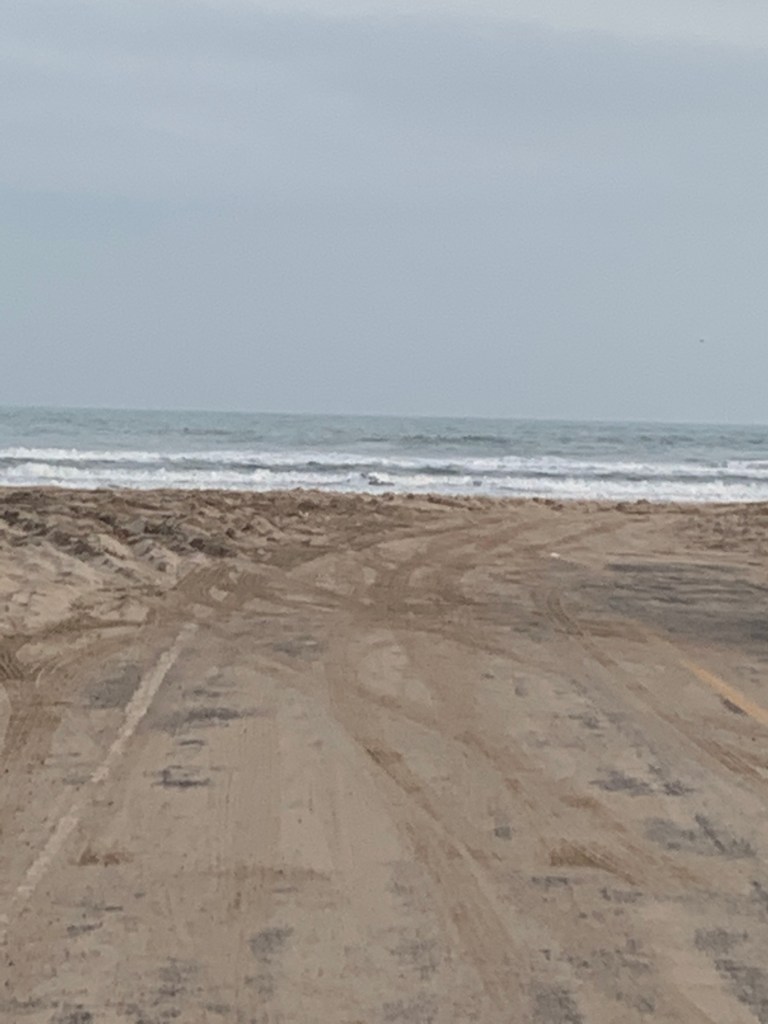
The thing is, two events seem to have mixed themselves into my mind; a fall from a bunk bed on SPI and the surprise you get when you arrive right on the beach, off the road, with the swelling, roiling water almost splashing you inside the car upon waking from a nap on the trip there.

That, and maybe a memory of my emerging from my mother’s womb.

The result is a recurring dream that has been a source of dread.

A Recurring Dream

First, about the dream, or at least the dream as a template for lots of dreams. In it, I find myself being pulled with unrelenting force into the surf, farther and farther from the shore and deeper and deeper water where I vainly try to feel for the welcome sandbar that I can then stand and get some rest. Sometimes, I get onto the sandbar, sometimes not quite ever. When I reach a sandbar, then my problem is, of course, returning to the beach. When I don’t, there is the desperate race against the current, time, and waning strength to reach the solid land. In time, I often “learn” the important solution to let the tide take me to the shore even if it doesn’t land me where I started. But not always. In the times when I fail to learn, I often wake as I’m drowning.

What is often different in this dream is the issue I am processing that may be represented. Determining this dream’s effect and the issue represented has been elusive. The sense of reaching safety, or failing, is what is usually left after the specifics. It seems straightforward that images are about being drawn from a place of relative safety, the hum of the road in the back seat of a car lulling me to sleep. And comfort. A time and space where both are suspended, no past to traumatize, no future yet to meet. . . . And then the abrupt chrashing of waves waking you into reality, the surf like claws dragging you into the challenge of an open sea where everything before you must be explored, the safety in a place, wthin the water, where you can stand and catch your bearings.

Or the realization that the sea is much too big to swim. That to find the shore at a different time and place is both possible and a chance to discover. Do you return from where you came? Walk further down the beach? Build a boat to take you out to sea?

It’s may be the vastness of the ocean that calls you, but its the reaching arms of the tides and surf like fingers that are pulling you; sometimes in fear. Well, mostly in fear.

And you then set to making choices. To let the fear leave you groundless, use your wits to bring you to place of bearing or your patience to allow the surf to take you where it is you go knowing that it’s your newfound place to start.

And just like every challenge you will ever have, you may not meet it. You may drown. I think that’s been my fear whenever I have had this dream. The likely chance that I may fail.

A Fear Unfaced; And ReSurFaced

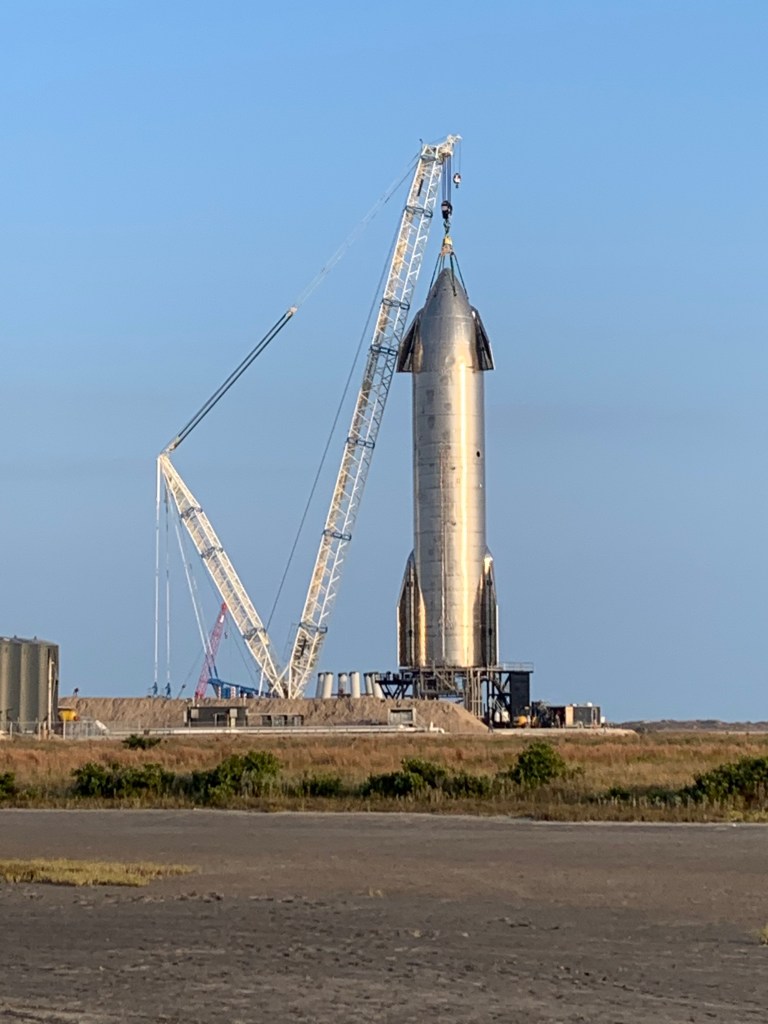
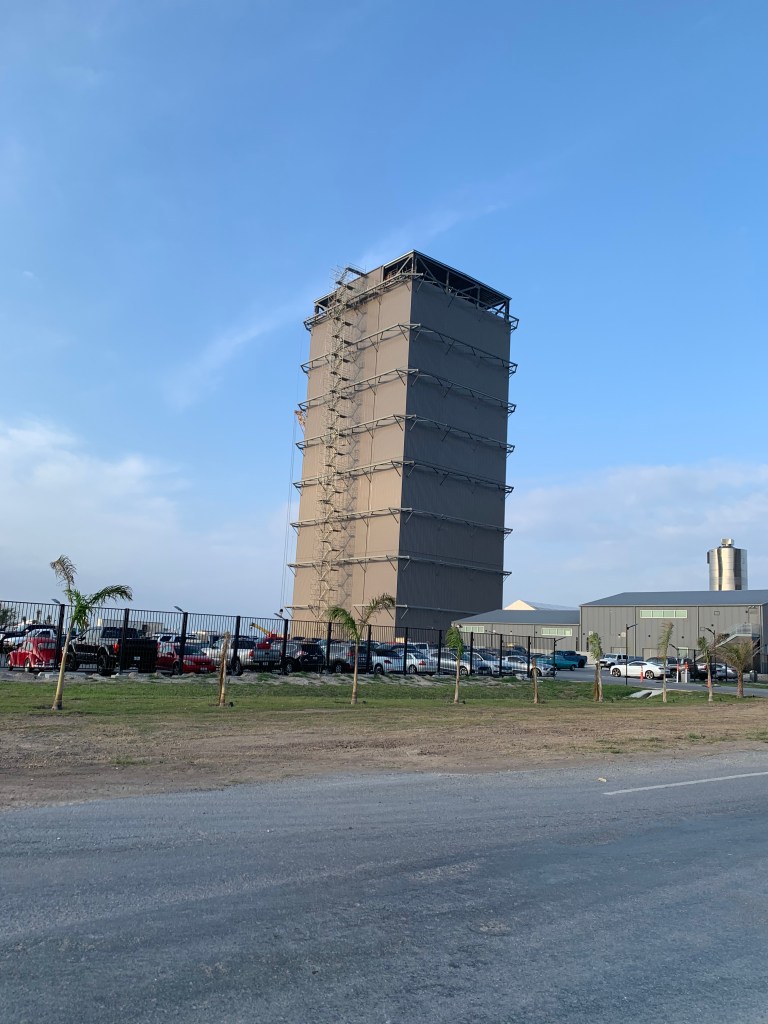
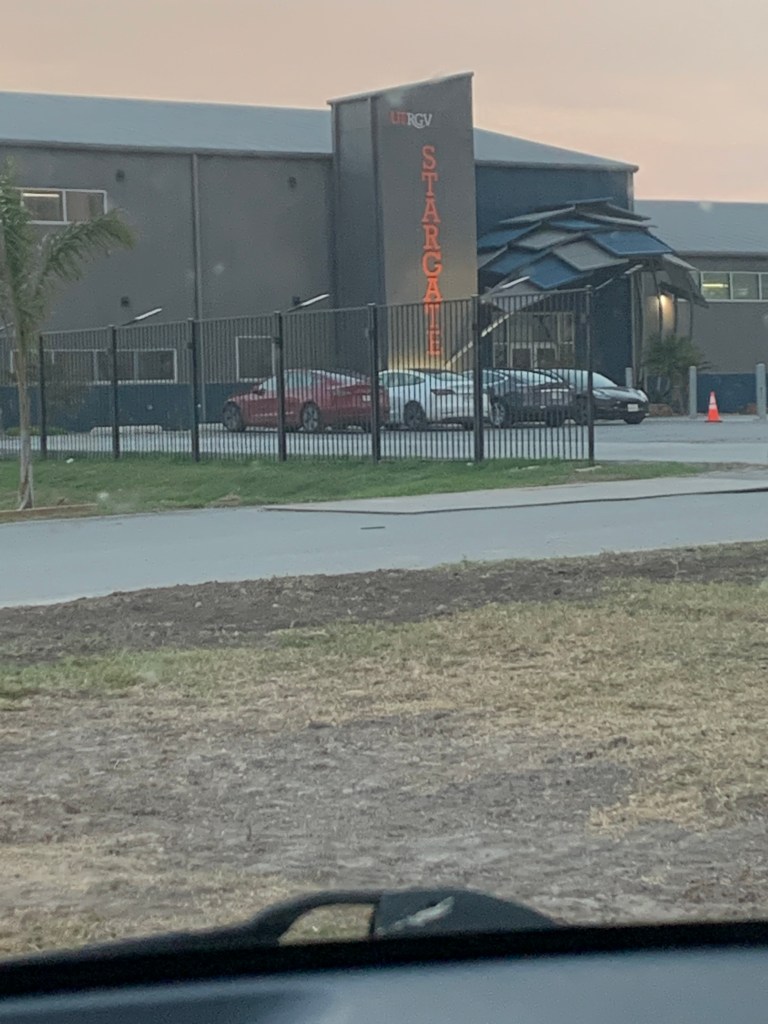
A few years ago, I was here in this place of origin. A friend of mine had come with me and we decided to visit Boca Chica so that she could see the contrast between South Padre’s beach and Boca Chica’s. There was something new on the road, the new Tesla Spaceport–SpaceX Launch Facility–and the related University of Texas–Rio Grande Valley Technology Center, the “UTRGV Stargate”. . . .cool title, huh?

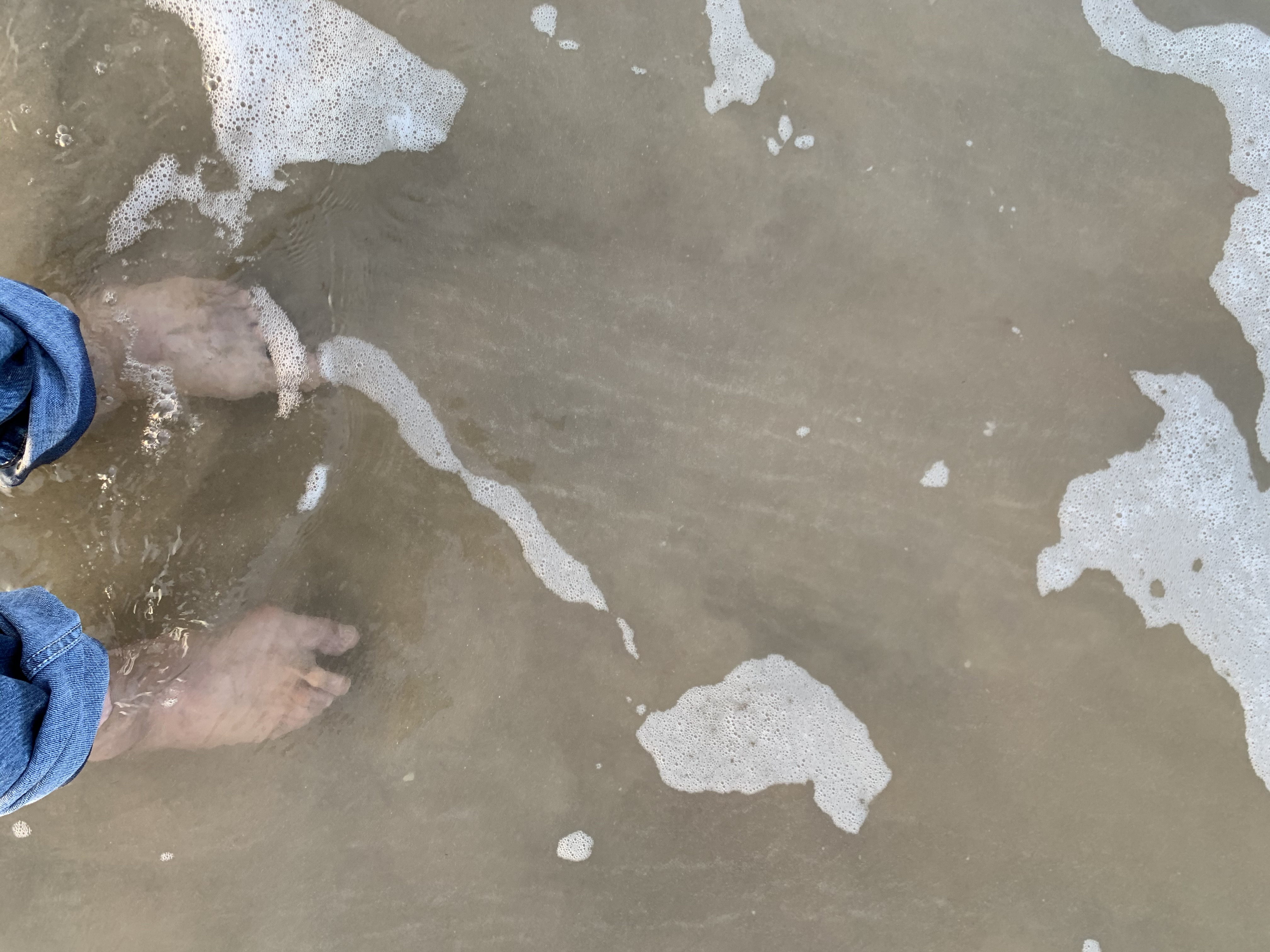
After beng suffiiciently awed by the spaceport and the “Stargate”, we drove up to Boca Chica beach. I don’t believe I let on to my friend, but the effect of reaching the end of the road with the waves and surf splashing and surging, struck me with a force that I thought I’d jumped. I do remember saying something like, “Whoa!” Believe me when I say what went on inside my mind and heart was like a crashing wave on a rough beach that hits you and briefly drowns you. My recurring dream was alive and I was awake, but its force nearly took my breath. In the span of a few seconds, I was transported into a dreamstate where I felt every fear of “losing”, “failing”, doubt, and desperation. And I felt myself being pulled right into the sea. I remember telling my friend that the beach reminded me of a recurring dream. But there were other things that we were dealing with at the time (another story for another time).

But that moment has stuck with me until now. It scared me and I simply filed the fear away clearly not being ready to address it. I think this dream “template” is like an archetype for me. One that leads me into a fear state when I find myself being pulled into a new test. . . .

Of course, I had to come back here.

A Beach Entrance as a Birth Canal

Most writings about the birth canal dream seem to talk about it as the springing of new life or the desire to “birth” something new. The feeling I get from my dream is one where I am spilling out, almost like out of a womb. Perhaps this kind of dream has served multiple purposes for me, about the inner fear of challenge, the recognition that in meeting changes don’t always take you where you intended to go. At this moment, it is as if the sea is pulling me out not so much against my will as it is done abruptly. Like it is time, but you are still surprised by the force of the “call” of the sea. And in a way that I am not sure I will really find my way with the very real chance that I may have to swim with an uncertain strength.

In these times, what has served me best has been my utter giving in to the waves and natural rhythms of the surf, knowing that a surf, while roiling and tugging underneath, inexorably is destined to reach the shore. To find a different place along the land you seek is a good result. To find the pull of waves upon different shores requires building new vessels that take you to another beach. One that may show you other promises.

The fear seems to lie in the determining what it is you really seek? And whether you can take the path to get there, especially when you cannot walk, but must swim. Not just lead. But follow.

Origins—Texas: Pandemia Chronicles

Hi 😊

Portrait of the Traveler On the Nueces River

I entered Texas yesterday realizing how every time I come here I am different and how Texas, if it were a person probably is too. I would say we’ve grown apart. Or to be more accurate, I’ve learned how very different Texas always was and I am just in some ways catching up.

You see, in my mind I don’t believe I had all the information and went about my youth largely in a fog about why all the animosity? Amid all the genteel southern hospitality and the almost regal Spanish politesse there lay a seething antagonism, antipathy, between Anglo and “Hispanic”. Along with the complete dismissiveness of anything plebeian, otherwise known as “Mexican”. Of course, never ever mentioned was the “Indio “, except in the romanticized version depicted by Tonto and the Lone Ranger or the strong silent type dominating TV shows in the early 60’s who could communicate large messages in a few hand flicks of sign language. It’s not hard to understand why much of Texan society in the Rio Grande Valley tends to operate in two-dimensional caricatures passing for a life. For Anglos, status is not important because, well, they have it and if you’re not White, you don’t. It doesn’t alter all the other class antagonisms that are a feature of society, White or not, if you’re White, you are afforded a little more leeway in most things. For “Hispanics”, everything seems to revolve around status; from how close to White you are to what kind of title you have, from what neighborhood you come. There is a pecking order many seem to be much more clearly aware about than I ever seemed to notice.

The Texas I’ve come to know seems far divorced from its formal history, which of course I received as part of my public schooling. The more accurate truth is that our history began with a lie.

No, everything you probably heard did actually happen, Cortéz did come to Mexico and the “Aztec” empire (another term distortion) was defeated by a few hundred Spaniards and 500 years later, here we are with South Texas “Hispanics” and “Anglos” (what? You thought the problem with terms only applies to one and not the other?) all playing nice and hatin’ at the same time. It’s the problem with the truth. It can hide the lies so well. First, the Aztecs. . . .

You know, before you know it, you start into full professor mode and, well, maybe I’d like to do that sometme but I don’t really want t do book reports about history here. Odyssey goin’ on. It’s more about trials and tribulations.

I’m writing here as I am a bit more replenished (not really refreshed) recognizing that my trials have mostly been about tribulation. And how my origins seem to have deeply affected every way I’ve connected to the world. I don’t mean to impy I’m any different than others, but I do believe that the social context of our existence does affect our personal history. Being a Chicano (yes, a deliberate choice of identity) growing up in the 1950’s and 60’s, I believe, had a profound effect on every way I’ve intersected in the world. Anger and hurt are mostly situated in our core personal experiences. Although such experiences might explan much, the social context of “status” and class and identity, the one foisted onto us by circumstances, has a powerful influence on everything we think and how we walk in the world (I think S. deBeauvior and F. Fanon had much to say about these things). The question is how do we grow beyond it.

That, I think is my quest; for this part of the Odyssey at any rate.

Of Triggers and The Impulse to Expect Rejection

I struggle with the concept of “triggers”. It’s not that I don’t understand how previous hurts can unwittingly guide our responses to new situations where we find ourselves vulnerable. If we have often felt shamed when we were seeking acceptance, it shouldn’t be surprising that we’ll react expecting some kind of rejection. Sometimes actively seeking it out because it is what we’ve come to understand and to expect. It somehow serves us. It can be uncomfortable, but it is more familar than actual or healthy acceptance. Even more so difficult to understand that one can honestly interact with you with no real malice; dislike what you are doing but not necessarily dislike you. As a student of children, I do understand how that is what so many of us have experienced in our early lives. It’s one thing to understand, quite another to learn more healthy responses; especially when you don’t always know what those responses ought to be.

But to call such activating events of learned poor reactions, “triggers”, sounds too much like we are all loaded guns waiting to shoot with deadly force. When you’re a gun, your life is destined in some way to shoot. And kill. I refuse to think that being a gun is all we’re meant to be, even in a world as violent as this one. In any case, if we create methaphors about ourselves as destructive weapons, it seems difficult to make the case for how we should care about each other. Or, more to the point, how we can learn to act differently than to be a gun. . . . .Yeah, I know, still professor mode. Sorry.

Why Origins?

Chicanos in Texas have a distinct biological and related cultural characteristic; we are the product of rape, hated in history for neither being “pure” European nor pure Indian, I hope you note the utter contradiction in calling Europeans or native indigenous people pure. It is both a contradiction and a conceit; a way to create and maintain a hierarchy of social status. After all, if you’re a product of rape, it’s not easy for your parents to see you clearly, even in the best intentions. And it is even more complex than one might see at first “blush” (sic). Among us rape children there are those of us actually closer to one or the other progenitor. In some contexts there are even color schemes of dark to light. All of that is written in our psyches if not our DNA. The history of South Texas in particular is marked by usurpation of indigenous cultures, the colonization first of Spanish colonists and then subsequently European Anglos expropriating the land, not from native peoples but from descendants of Spanish colonialism who had colonized the land and its people. Layers upon layers of theft and outright murder, all for the sake of making use of land that others before them hadn’t “productively” enabled its capacity.

There are of course historical landmarks, the wars of Mexican independence from Spain, the war for Texas “independence”, the Mexican War, and, finally the unheralded, barely recorded ethnic cleansing of South Texas from 1915 to 1920 (there are many good works about this history, one is B. Johnson Revolution In Texas). What some people consider the orgins of Mexicans beginning to consider themselves Americans, hence, “Mexican-Americans” or, in my case like many of my youth, Chicano. It is this history that has had its psycho-historical impact on how people of the “Valley” have grown up.

Upon entering Texas this time, I realize that this journey is in truth a journey to a new world albeit ancient in its origins. Marked by its past and only dimly understood by all of us who came from this world.

I am mindful how my travel here is new, but ultimately the most important, not because of a new insight into history but because of a growing insight into myself. It’s tough when your tribulations requre not redemption but compassion for the anger in your soul and empathy for the pain in your heart. That your trials have never been the ones you have experienced but what you have to learn to overcome what they have taught you.

A Brief History of Gravestones and a Dream Awakening: A Chronicle of Pandemia

I left Lawrence (Kansas, don’t know any Lawrences currently) a little bedraggled–emphasis on the “draggled” with very little time to “be” in bed, at least asleep. It seems an Odyssey leaves little time for wanting to if not actually sleeping. It just seems more fun to see a world you’ve seen before with an eye for, well, different detail in contrast to meticulous detail. I didn’t really spend much time through Kansas and Oklahoma, except for the approximately 9 arduous hours of flat and open space. It isn’t surprising to see how . . . .uneven people have become here and how much many, though not all, cling to the ownership of land and privilege so thoroughly wrested from other more original inhabitants, but who nonetheless were migrants and immigrants themselves. I had breakfast at truck stop (takeout to my car) and was struck by the generally Latino/Latina workforce, most serving food, but others taking care of the “grounds” cleaning up the parking lot so that truckers and drivers don’t trip over all the trash they offhandedly throw everywhere but in the trash bins. It was as if I was transported (sic) to a different time; some slaves taken from conquered tribes by Mayans or Aztecs, cleaning the steps to pyramids and markets so that artisans and farmers of the “nation” could do their business without the filth they were prone to create. Here, today, were the descendants of the progeny between Europeans and indigenous people, having mgrated back to what were likely the ancestral lands of their native forbears. Returning to clean the pyramids to the gods paying tolls on a highway and feed the mouths and privilege of the “citizenry”.

Both Kansas and Oklahoma are lands that have special relationship to the Midwestern “Breadbasket” despite just being two among the many with the same kinds of story. As the Kansas Historical Society puts it:

“The land we now call Kansas had been home to many American Indian peoples. The Arapaho, Cheyenne, Comanche, Kansa, Kiowa, Osage, Pawnee, and Wichita are tribes that are considered native to present day Kansas. The area has also been inhabited by many emigrant tribes. Emigrant Indians are those people who have been moved to a new geographic region after being displaced from their original homelands. As non-native peoples became more numerous in the eastern part of the United States, plans were developed to move Indian tribes farther west.”

In short, Kansas was home to many native peoples, the originals were eiher eradicated or colonized and were joined by “emigrant” native people removed from their ancestral lands and made to live with the originals of what is now Kansas, a melting pot, emphasis on melting. Some of the people that came, and went, live on in names of creeks, rivers, and state counties. Driving through from Lawrence through to Fort Worth (Texas), you could see some of those that came and went, Osage, Pawnee, Wichita, a town in Oklahoma called Comanche.

Oklahoma is even more special, for much of early U.S. history, Oklahoma was the buddng nation’s open prison house of indigenous nations where people who were defeated and displaced to serve European settling ended up becoming “emigrants”, that is, a Leavenworth Penitentiary for the inconvenient in the way of “American Progress”.

The stories and history are just too numerous to tell here (there are many books on the topic, one very comprehensive one is 1491: New Revelations of the Americas Before Columbus by C. Mann. All I really want to say is that driving through these often barren lands was a bit like driving through a cemetary with only names of the gravestones written on county road signs and highway markers. Perhaps, the land seems more stark in coming winter and knowing how so many nattive people have suffered disproportionatelty in the pandemic. It was not lost on me to remember the effect of previous pandemics of Europe that were brought here by settlers, sometimes the virulents laced into blankets given to native people as part of “initiating” into . . .civilization.

The Kansas and Oklahoma territories were the last stop for many people who tried too vainly to forestall Pax Americana.

I say all this because this now second day in what I know will be a long journey is really a gateway to a history I need to feel and touch, see and hear on the wind, in the heat of day, and light of a moon. It’s also, likely most important to me, a gateway to the anger and despair we all live, but that is meaningful to understanding at the deepest level my own anger, despair, misbelief.

Wakefulness Into Dreaming: A Twist Before Dying

I said at the beginning of this post that today started off a bit bedraggled. I got to sleep very early. In the morning; about 5 am and slept fitfully until about 10 am. Maybe it was because of a strange bed, or because I didin’t follow my well established regimen for sleeping, ‘honed” in my retirement. It’s amazing the things you need that you packed in your car so you wouldn’t have to buy them on the road; my new iPhone charger (yes, I’ve entered the dark side. Blame my daughter for that. ), charger for my headset, mouthwash but in a different bag, some clementines and crackers (don’t ask) to settle your stomach when you take some medications. . . and, oh yes, your favorite pillows from home to supplement the six available in your twin queen bed hotel room (you really don’t want to know). Hence, what you could have brought in one trip upstairs, ends up being three (the distance between room and parking lot in a large, mostly empty hotel will surprise you) . All around 2 to 3 am. And then sleep, perchance to pretend with your eyes closed hiding the fact that you are wide awake.

I finally did get to sleep, woke up to my alarm at 8 and then promptly decided to just close my eyes awakening about 9:43 after an amazingly deep but brief REM (like) sleep.

And here’s the point (and you thought there wasn’t one, didn’t ya?). As, well, some may know, your dreams come to you after a REM sleep in the period just before waking. They sometimes feel like they are longer but they aren’t. And, of course, there are many good and not so good theories about dreams. You can believe of them as you will. My view, is that everything you dream, everybody in it, is really all about you and the parts of you that people in your mind seem to represent (yeah, you may think otherwise, analyze away for yourelf). For a very long time, I have had several recurring dreams. I know they are because many of them I wake remembering only the most general details; some murderer finding ways to kill me that are only effective if he finds a way to saw through my spine–from the front, a house that holds all my family including my deceased mother (but not my deceased father), a young alternatively blond, sometimes brown-haired girl who has become my new love (yeah, there’s lots there, not the point here, pay attention), and a young dark-haired angry, desperate, self-loathing boy. Even now, the images are receding, which tell me that this dream is by no means over for me. But in my dream last night, I struggle with this boy, fighting with him for being such an angry louse, such a petulant, emotionally manipulative child and how he has ruined just about everything including any chance at love. . . I only remember the struggle. And the conclusion. I kill the boy in the most visceral way, taking hold of him and jumping off the building (it’s a building this time) to our common death, a death that somehow I know we will survive, so, just before we leap, I snap his neck so that I know that he is dead.

And this dream has been recurring for a very long time. It comes as no surprise to me that it occurs during a time of what has been emerging resolution, especially in exposure of a “core hurt” (a word borrowed from a friend) that has resurrected itself for yet one more time in my all too not so young, but very youthful (that is to say, immature) life. I’ve been struggling for a while with fear of acceptance that often manifests as coming on too strong in connection to relationships that are promising but really only just beginning; the fear that you will lose out if immediate full gratification doesn’t show itself right away. Or, when gratification comes but then you wonder if it isn’t real, or you’re not “ready” or a myriad of other ways that some people call an issue with “object permanence”. When you’re a smart guy, you can fool a lot of people that you have it all together. When you’re a caring guy, you spend a lot of time wishing you could be better. And it can be . . . .enlightening when you meet some caring and very smart, loving people and they call you on all of it, sometimes in soft ways where their unconditonal positive regard humbles you and sometimes with a clear rejection of your hurting and emotional self-manipulation, which to them is just manipulation.

I am here on this journey knowing the very real danger that is out here in a pandemic that is running rampant. I only recently became clear that I face another danger, one that is not a problem of acute mental health (at least I don’t think so), but because while I have tried, often with apparent success, “killing off” that angry, distraught, emotonally stunted little boy (sure, you can insert dad issues, mom issues, whatever. But I’m a grown-ass man, so, you know, no) , I think that killing him off has been exactly the problem. Last night, or rather, somewhere between 8 am and 9:43 am today, I sensed something a little new. At the very moments just before waking, I heard myself say something, not to problem child, but to me directly. Only one word, and it has blossomed into ever growing thoughts around, Compassion.

I’ve made lots of emotional errors, and, if today is any indication, I will continue to do so. But I think that what I might try to do more is show myself compassion as I try to do better. I think it is best to be self-compassionate instead of seeking to eradicate a part of me that likely serves other purposes, my anger at the historical injustices of the world we inhabit and species we represent, my disbelief that just because you’re “smart” means you can be complacent in not learning more, and the recognition that just because we’re old, doesn’t mean we are completely mature. Smart is as smart does and mature does as mature is.

Well, like I said, it’s a long journey into this dark night fueled apparently by sharing, really baring, deeper recesses of your soul. I’m not sure it’s what I’d counsel anyone to do. Hell, I’m really very tempted just to set this off permanently into “draft” mode. But I think I have learned one thing about myself. I’d rather choose honesty and truth. We may not know the entire truth and we may not always succeed at being completely honest (some people may argue that hiding some is a good idea, ’cause, you know, creepy otherwise). I do know that I’d rather all of you within the “sound” of my voice hear me being honest and as truthful as I currently know to you. You deserve that and I no longer wish to have you like me without this rather unendearing transparency.

If I walk alone. It’s ok. I’ve been so fortunate to know, some a lot, some too precious little, such wonderful humans. I believe that our problems, certainly regarding me, are not that we are men or women, but that we are humans. We often say something similar in the positive, that “we’re only human”, so, we can’t expect perfection. That is true, but it is also true that because we’re human, we make such terrible mistakes. . . I almost said “unimaginable” mistakes, but you know that isn’t true. We imagine horrific mistakes, make them, and then chalk it up to being human, so, “do over”.

And still, I think our greatest tool out of all of that is for us to be gentler with ourselves, with each other, compassionate. Because in our compassion for ourselves and for others, there is the chance that we can imagine, and then do, better.

I’m gonna try.

Maybe tonight, a dream, perchance to sleep.